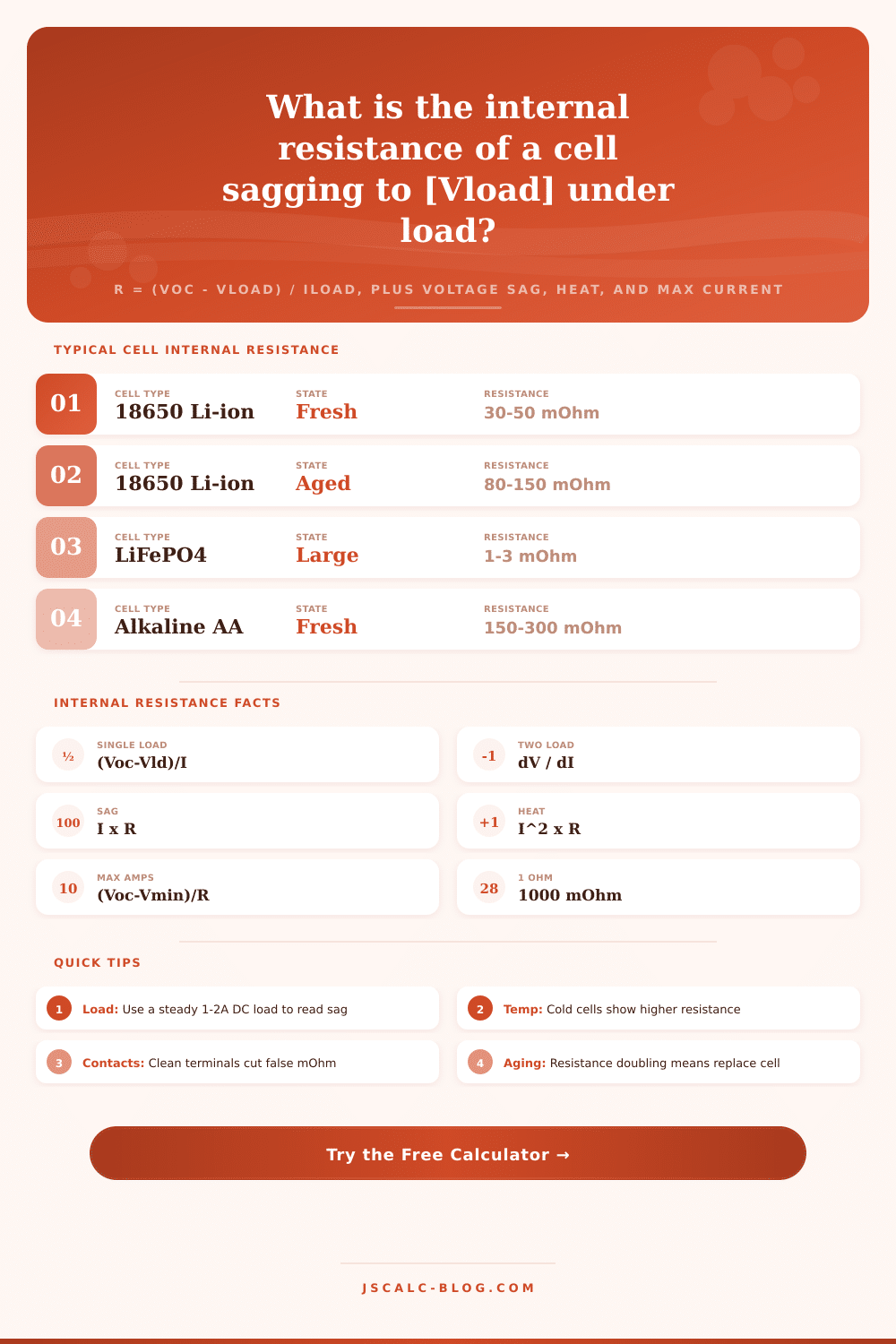
Battery Internal Resistance Calculator
Measure a cell internal resistance from a single loaded reading with R = (Voc - Vload) / Iload, or use the two-load method R = dV / dI. Then see how much voltage sags under load, how much power turns to heat inside the cell, and the highest current the battery can push before it drops to your voltage floor.
⚡Choose a Method
🔋Real Cell Test Presets
📝Measurement Inputs
Resting terminal voltage with no load connected.
Terminal voltage while the test load current flows.
Steady DC current drawn during the drop test.
Voltage at the smaller current I1 in the two-load test.
The lighter of the two applied currents.
Voltage at the larger current I2, always lower than V1.
The heavier of the two applied currents.
Current at which sag, loaded voltage, and heat are reported.
Lowest usable voltage; sets the max deliverable current.
Milliohms suit Li-ion; ohms suit coin and alkaline cells.
🔢Formula Snapshot
📋Typical Internal Resistance by Cell Type
| Cell Type | Condition | Internal Resistance | Notes |
|---|---|---|---|
| 18650 Li-ion | Fresh | 30-50 mOhm | Healthy laptop or pack cell |
| 18650 Li-ion | Aged | 80-150 mOhm | Capacity fade, high sag |
| 21700 Li-ion | Fresh | 15-25 mOhm | High-drain EV and tool cell |
| LiFePO4 large | Fresh | 1-3 mOhm | Prismatic solar storage cell |
| LiPo pouch | Fresh | 2-8 mOhm | RC and drone flight pack |
| NiMH AA | Fresh | 20-40 mOhm | Rechargeable household cell |
| Alkaline AA | Fresh | 150-300 mOhm | Rises fast as it drains |
| Lead-acid car | Charged | 5-15 mOhm | Whole 12 V battery figure |
📊Voltage Sag at 5 A Load
| Internal Resistance | Sag at 5 A | Voc 4.0 V drops to | Verdict |
|---|---|---|---|
| 10 mOhm | 0.05 V | 3.95 V | Excellent |
| 25 mOhm | 0.125 V | 3.875 V | Very good |
| 50 mOhm | 0.25 V | 3.75 V | Good |
| 80 mOhm | 0.40 V | 3.60 V | Aging |
| 120 mOhm | 0.60 V | 3.40 V | Weak |
| 200 mOhm | 1.00 V | 3.00 V | Poor |
| 300 mOhm | 1.50 V | 2.50 V | Retire cell |
🔥Heat Dissipated Inside the Cell
| Current | At 25 mOhm | At 50 mOhm | At 100 mOhm | Formula |
|---|---|---|---|---|
| 1 A | 0.025 W | 0.05 W | 0.10 W | I² × R |
| 2 A | 0.10 W | 0.20 W | 0.40 W | I² × R |
| 5 A | 0.625 W | 1.25 W | 2.50 W | I² × R |
| 10 A | 2.50 W | 5.00 W | 10.0 W | I² × R |
| 20 A | 10.0 W | 20.0 W | 40.0 W | I² × R |
| 30 A | 22.5 W | 45.0 W | 90.0 W | I² × R |
🗃Cell Comparison Grid: Sag, Heat and Max Current
| Cell Type | R_int | Voc | Sag at 3 A | Heat at 3 A | Imax to 2.5 V |
|---|---|---|---|---|---|
| LiFePO4 large | 2 mOhm | 3.30 V | 0.006 V | 0.018 W | 400 A |
| LiPo 4S pack | 6 mOhm | 4.10 V | 0.018 V | 0.054 W | 267 A |
| Lead-acid car | 10 mOhm | 12.7 V | 0.030 V | 0.090 W | 1020 A |
| 21700 fresh | 20 mOhm | 4.15 V | 0.060 V | 0.180 W | 82.5 A |
| 18650 fresh | 35 mOhm | 4.18 V | 0.105 V | 0.315 W | 48.0 A |
| 18650 aged | 120 mOhm | 4.05 V | 0.360 V | 1.08 W | 12.9 A |
| NiMH AA | 30 mOhm | 1.35 V | 0.090 V | 0.270 W | Below floor |
| Alkaline AA | 220 mOhm | 1.55 V | 0.660 V | 1.98 W | Below floor |
⚙Formula Breakdown
💡Practical Testing Tips
A battery are really just a bunch of cells, each one containing an ideal voltage source and a secret resistor. As soon as you use the battery’s output to do work, the resistor kicks in and causes the terminal voltage to droop. The amount of drooping you measure divided by how much current you drew equals the internal resistance. This tells you how hot the cell gets, how much current it’ll let you take out before collapsing, and how much the voltage will sag.
There’s no need for a lab bench or any other tricks, because you can tell from just one number whether a cell works for your use or not. The math is done on the page, all you need to know is the numbers. Internal resistance are the opposition to flow inside the battery itself. That’s all the parts of the battery: electrodes, electrolyte, separator, etc., plus everything connected to them inside the casing.
What Is Internal Resistance?
This is why two seemingly identical AA batteries (a fresh one and a nearly dead one) may both be reading 1.5 volts at rest but will react entirely differently when under load. You only see the open-circuit voltage with no current flowing. Add a load and you see the voltage drop because part of that potential is being stolen by the internal resistor as current moves through it, and the size of that drop compared to the current are the resistance in ohms or milliohms. It’s not just a number; it’s a measure of how much energy you’re losing before it even reaches your device.
One load drop in one shot: This is the fastest way to measure resistance. You read the unloaded voltage, you put it on a constant current, you read the voltage again and then take away that number from the first value. If we have a rested 18650 with a resting voltage of 4.18 volts which under load (at 2 amps) sags to 4.11 volts, then the lost voltage is 0.07 volts. That means the resistance was 35 milliohms, right in line with what you’d expect from a good high-drain battery.
Note that if your probes aren’t clean or you don’t get a really solid contact, your result will include whatever resistance you’ve added to the equation by having a flaky connector. You’ll read an additional 20-ish milliohms, causing a perfectly fine cell to appear aged. That may not sound like much, but accuracy-wise it’s HUGE.
The two-load technique eliminates offsetting measurements. You don’t take one single open circuit reading that you hope was accurate. You send two different currents through it and measure the corresponding two voltages. Then you plot voltage vs. Use the current to find the slope (resistance). For example: if one cell measures 4.15 volts at 0.5 amps but 4.03 volts at 2.5 amps, then 60 milliohms is the answer. Both those readings were taken while the meter was loaded down by current. So any fixed meter error cancels out. That’s why professional testers likes this method.
The tool up top will do all this math for you after you enter your pair of sets of readings. This eliminates potential for human arithmetic mistakes.
When you’re using it, that’s voltage sag… What your gadget feels. 0.175 volts sag. Same current, 0.6 volts less. At rest that battery might hold charge, but the extra voltage drop falls below the cut-off point for a power tool. Why do some batteries with equal capacity feel dramatically different on demanding devices?
It’s because of this: the heat produced increases in proportion to the square of the current. 3.5 watts inside. Double the current to 20 amps? The heat quadruples to 14 watts. Engineers go nuts chasing low resistance cells for high-demand tasks because they waste fewer watts as heat instead of doing useful work and run cooler while they’re at it.
To put those into perspective, the reference tables on the page provide some real numbers for comparison. Large LiFePO4 prismatic cells are only about 1 to 3 milliohms. Fresh 18650 cells is 30 to 50 milliohms. Alkaline AA cells begin at 150 to 300 milliohms and increase sharply as they empty, and a fully-charged 12-volt car battery measures 5 to 15 milliohms. So use those points of comparison as a standard and apply them to what you’ve measured.
If the resistance is about double what it was new, that’s telling you that it has aged, which should of been a reason to retire that cell from heavy-duty service even if its capacity doesn’t seem degraded. And here’s where this method comes back to voltage drop… But unlike just knowing what the number is, now you know the cost in terms of exposed sag and heat instead of an ambiguous percentage. The next time it happens, you’ll know exactly what it’s costing you, before it costs you in the middle of the field.