Supercapacitor Runtime Calculator
Estimate the hold-up backup time a supercapacitor gives your circuit as it discharges from full voltage down to the dropout voltage of your regulator. Enter capacitance, the charged and minimum usable voltages, ESR, and the load as a constant current or constant power, and get runtime, usable energy in joules and watt-hours, and the ESR voltage drop.
⚡Load Model
🔌Real Backup Presets
📝Supercapacitor and Load Inputs
Rated capacitance of the supercap or bank, in farads.
Voltage on the cap at the start of a power outage.
Dropout: lowest input your regulator still runs at.
Constant current the load draws during backup.
Constant power draw, typical for a DC-DC converter.
DC-DC efficiency, used only in constant power mode.
Internal resistance; causes an instant drop under load.
ESR drop shrinks the usable window at the top.
Controls rounding on every result card.
🔢Formula Snapshot
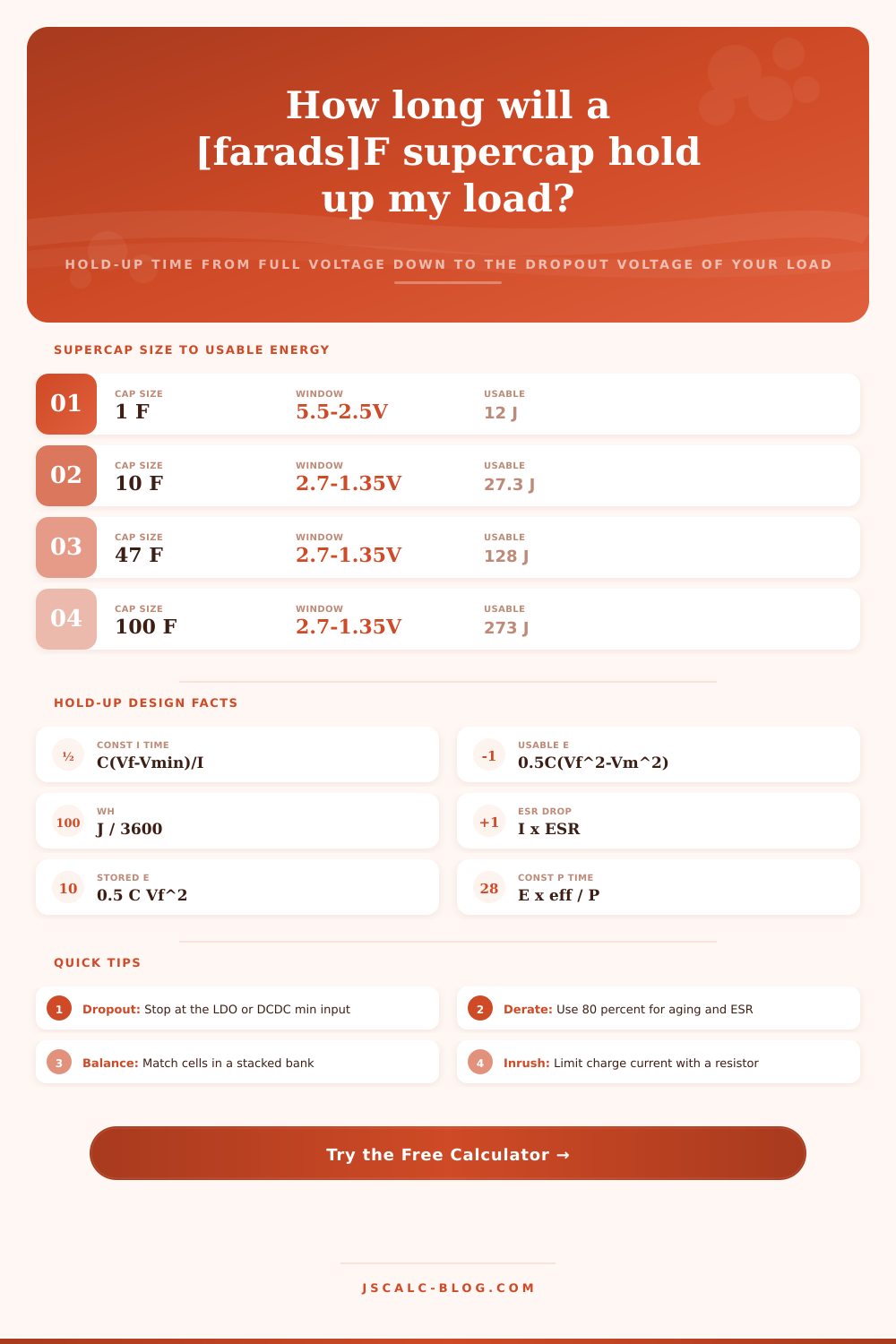
📋Supercap Size to Usable Energy
| Capacitance | Voltage Window | Usable Energy J | In Watt-Hours |
|---|---|---|---|
| 0.1 F | 5.5 to 3.0 V | 1.06 J | 0.000295 Wh |
| 1 F | 5.5 to 2.5 V | 12.0 J | 0.00333 Wh |
| 10 F | 2.7 to 1.35 V | 27.3 J | 0.00759 Wh |
| 25 F | 2.7 to 1.35 V | 68.3 J | 0.0190 Wh |
| 47 F | 2.7 to 1.35 V | 128 J | 0.0357 Wh |
| 100 F | 2.7 to 1.35 V | 273 J | 0.0759 Wh |
| 350 F | 2.7 to 1.35 V | 957 J | 0.266 Wh |
| 470 F | 2.7 to 1.35 V | 1285 J | 0.357 Wh |
| 1500 F | 2.7 to 1.35 V | 4101 J | 1.139 Wh |
| 3000 F | 2.7 to 1.35 V | 8201 J | 2.278 Wh |
📊Constant Current Runtime Chart
| Capacitance | dV Window | Load 5 mA | Load 20 mA | Load 100 mA |
|---|---|---|---|---|
| 1 F | 3.0 V | 600 s | 150 s | 30 s |
| 10 F | 1.35 V | 2700 s | 675 s | 135 s |
| 47 F | 1.35 V | 12690 s | 3173 s | 635 s |
| 100 F | 1.35 V | 27000 s | 6750 s | 1350 s |
| 350 F | 1.35 V | 94500 s | 23625 s | 4725 s |
| 470 F | 1.35 V | 126900 s | 31725 s | 6345 s |
| 1500 F | 1.35 V | 405000 s | 101250 s | 20250 s |
| 3000 F | 1.35 V | 810000 s | 202500 s | 40500 s |
📏Dropout Voltage Reference
| Regulator Type | Rail | Typical Dropout | Note |
|---|---|---|---|
| Standard LDO | 3.3 V | 3.5 V input | Needs headroom above rail |
| Low dropout LDO | 3.3 V | 3.4 V input | 200 mV dropout part |
| Buck converter | 3.3 V | 3.4 V input | Steps voltage down only |
| Boost converter | 3.3 V | 1.0 V input | Can pull cap far down |
| Buck-boost | 3.3 V | 1.2 V input | Up or down, wide window |
| MCU direct | 1.8 V | 1.8 V input | No regulator, runs raw |
🗃Supercap Comparison Grid
| Capacitance | Rated V | Typical ESR | Stored E at Vf | Usable to Vf/2 | t at 20 mA |
|---|---|---|---|---|---|
| 0.1 F | 5.5 V | 75 ohm | 1.51 J | 1.13 J | 13.8 s |
| 1 F | 5.5 V | 30 ohm | 15.1 J | 11.3 J | 138 s |
| 10 F | 2.7 V | 0.20 ohm | 36.5 J | 27.3 J | 675 s |
| 47 F | 2.7 V | 0.10 ohm | 171 J | 128 J | 3173 s |
| 100 F | 2.7 V | 0.05 ohm | 365 J | 273 J | 6750 s |
| 350 F | 2.7 V | 0.01 ohm | 1276 J | 957 J | 23625 s |
| 470 F | 2.7 V | 0.01 ohm | 1714 J | 1285 J | 31725 s |
| 1500 F | 2.7 V | 0.004 ohm | 5468 J | 4101 J | 101250 s |
| 3000 F | 2.7 V | 0.0003 ohm | 10935 J | 8201 J | 202500 s |
⚙Formula Breakdown
💡Supercap Hold-Up Tips
So then what does the supercapacitor runtime calculator do? It help you answer the simple question: how long will this device last in my circuit when power goes out?
A supercap acts more like a leaky bucket than a battery, which hold its voltage steady until it is nearly empty. As charge drains away the pressure inside continues to decrease. That means you don’t just take the capacity divided by current = hours of use. Instead, you look at what’s left in the bucket when it finaly shuts off the lights and figure out how much was used up along the way.
How to Calculate Supercapacitor Runtime
That bottom number are called dropout voltage. Designers focus on difference between that dropout voltage and the top number when it is fully charged. People tend to confuse supercaps for batteries. Batteries output a constant voltage, which make it easy to do the math. Supercaps hold their charge on a surface; as they lose energy, the voltage directly changes based off how much charge they’re holding. When you draw energy out, the voltage decrease instantly.
Once you input voltage limits and capacitance into the calculator above, it does that calculation for you. You don’t have to guess at conversions or coefficients. Instead of assuming constant voltage during discharge process, it models it correctly.
There are two kinds of real loads, and the tool allow you to toggle back and forth since physics is different. One is a simple current sink, it take constant current, and therefore the voltage drops in a straight line. Run time = capacitance * (voltage drop) / (load current).
The other type is a switching converter which holds its output at a steady level by pulling constant power from the input. As the input voltage drop, it pulls more current to keep up with this rate. And run time then become an energy equation based on how much the squared voltages differ. Pick the wrong one and your guess could of been off by a factor of two or more.
Your power path also determine runtime, specifically the dropout voltage. The rule of thumb here is that if you’re using a standard regulator feeding a 3.3 volt rail, then your regulator will stop working once the input drops below 3.4 volts. That means you have the majority of capacitor left untouched. Replace it with a boost converter running down to 1.0 volt, however, and you’ll be able to drain the capacitor far more further down. By reducing the dropout from 2.0 volts to 1.0 volts, for example, you increase usable energy by approximately 68 percent on a typical bank.
That’s huge: the difference between saving data or losing data. All supercaps has some amount of Equivalent Series Resistance (ESR), which means there is an immediate voltage drop across that resistance when current flows. If your ESR is high under high load, then you may drop off much of the available voltage range without ever discharging the capacitor. With a high value for ESR, the calculator will calculate that drop and subtract it from initial voltage. This means you’re accounting for real-world electrical behavior in your runtime estimate. For light-load backup it won’t matter much, but for a powerful pulse out of a small cell it might dominate.
This margin is key in your design. Capacitance degrades over time, dropping as much as 20-30 percent over years of service; ESR increases in cold temps, sometimes doubling. These both eats into your hold-up time. Another general guideline is that you should design against end-of-life specs; multiplying the value you calculate by perhaps 0.8 will give you a buffer so that the circuit can still perform as needed after it ages.
For example, if you have five seconds of hold-up, spec for six and a quarter seconds out of the gate, assuming a fresh part. You can see from the table above how capacitance relates to usable energy, which can help you select a larger value if you’re currenty close to running out. When designing hold-up, making small errors cuts your safety window in half.
This tool lets you work with runtime formulas plus ESR drop equations and usable energy all at once. It simplifies a mess of algebra down to a couple seconds of number entry. Start with a default value, adjust it to the actual dropout voltage, pick the load model closest to your converter, and read it out.
Size your energy buffer, protect a data write, keep a clock running, get solid figures to work with. Tank leaks. Now you know just how quickly.