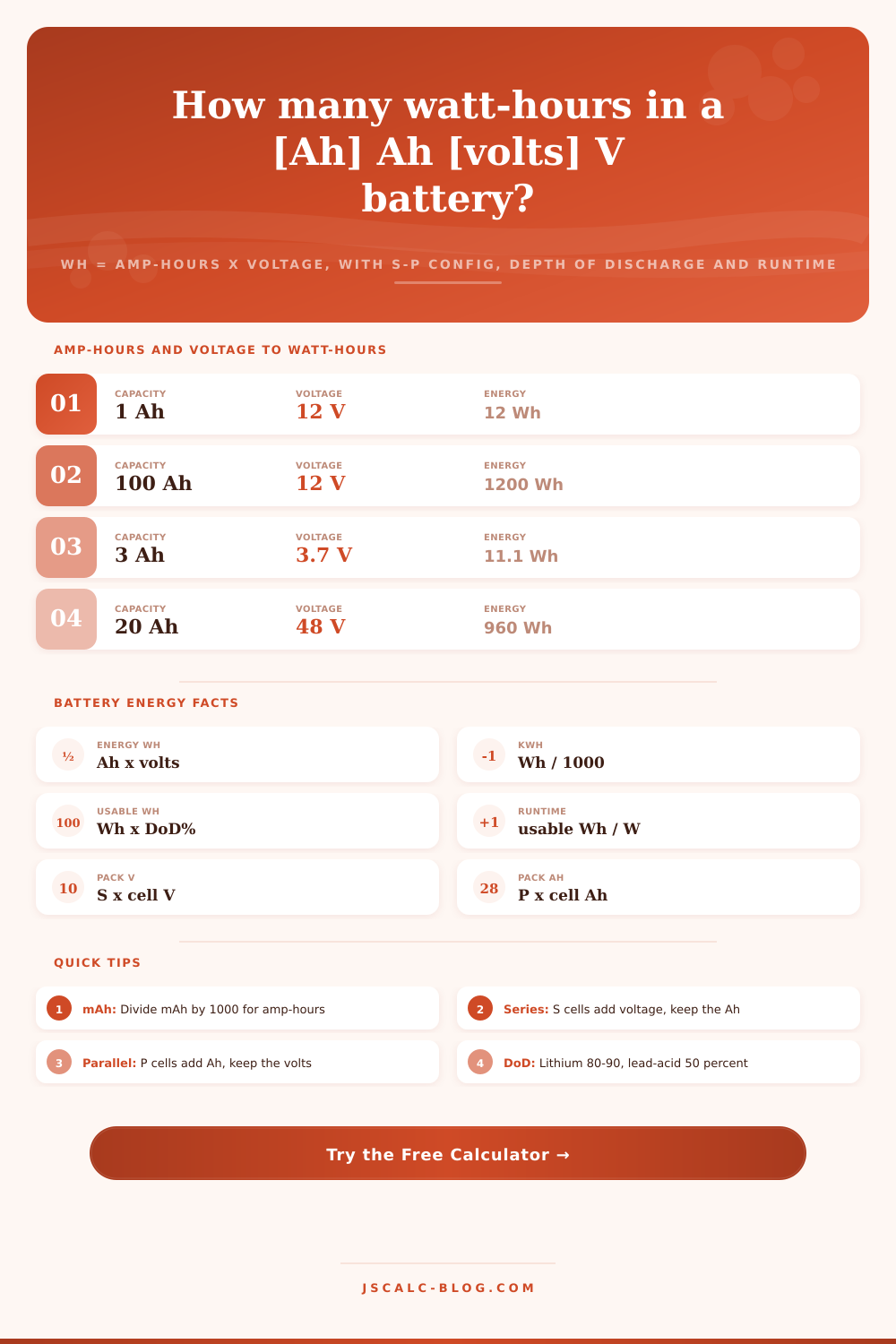
Battery Capacity in Watt-Hours Calculator
Convert a battery rated in amp-hours or milliamp-hours into watt-hours and kilowatt-hours using Wh = amp-hours multiplied by voltage. Add a series and parallel cell configuration to build a full pack, apply a depth-of-discharge limit to find the usable energy, and estimate how many hours the pack will run a given load in watts.
🔌Real Battery Pack Presets
🔊Battery and Load Inputs
Rated capacity of one cell or the base battery.
Pick mAh for small cells like 18650 or phones.
Nominal volts of the single cell entered above.
Cells stacked in series add voltage. S x cell V.
Strings in parallel add capacity. P x cell Ah.
Share of energy safely used. Lithium 80-90, lead 50.
Average watts the device draws while running.
Controls rounding shown on every result card.
🔢Formula Snapshot
⚡Formula Breakdown
📋Amp-Hours and Voltage to Watt-Hours
| Capacity | Voltage | Energy Wh = Ah × V | In kWh |
|---|---|---|---|
| 1 Ah | 12 V | 12 Wh | 0.012 kWh |
| 100 Ah | 12 V | 1200 Wh | 1.2 kWh |
| 3 Ah | 3.7 V | 11.1 Wh | 0.0111 kWh |
| 20 Ah | 48 V | 960 Wh | 0.96 kWh |
| 50 Ah | 24 V | 1200 Wh | 1.2 kWh |
| 10 Ah | 36 V | 360 Wh | 0.36 kWh |
| 60 Ah | 12 V | 720 Wh | 0.72 kWh |
| 280 Ah | 3.2 V | 896 Wh | 0.896 kWh |
📊mAh to Watt-Hours for Small Cells
| Capacity mAh | Equals Ah | Voltage | Energy Wh | Typical Cell |
|---|---|---|---|---|
| 2000 mAh | 2 Ah | 3.7 V | 7.4 Wh | Small 18650 |
| 3000 mAh | 3 Ah | 3.7 V | 11.1 Wh | 18650 cell |
| 3000 mAh | 3 Ah | 3.85 V | 11.55 Wh | Phone pack |
| 5000 mAh | 5 Ah | 3.6 V | 18 Wh | 21700 cell |
| 10000 mAh | 10 Ah | 3.7 V | 37 Wh | Power bank |
| 1500 mAh | 1.5 Ah | 1.2 V | 1.8 Wh | AA NiMH |
| 500 mAh | 0.5 Ah | 3.7 V | 1.85 Wh | Drone LiPo |
📡Series-Parallel Pack Configurations
| Config | Cell | Pack Voltage | Pack Capacity | Energy Wh |
|---|---|---|---|---|
| 4S1P | 3.2 V 100 Ah | 12.8 V | 100 Ah | 1280 Wh |
| 4S2P | 3.7 V 3 Ah | 14.8 V | 6 Ah | 88.8 Wh |
| 13S4P | 3.6 V 3.5 Ah | 46.8 V | 14 Ah | 655.2 Wh |
| 16S1P | 3.2 V 280 Ah | 51.2 V | 280 Ah | 14336 Wh |
| 2S1P | 3.85 V 3 Ah | 7.7 V | 3 Ah | 23.1 Wh |
| 7S2P | 3.6 V 5 Ah | 25.2 V | 10 Ah | 252 Wh |
| 8S1P | 3.2 V 200 Ah | 25.6 V | 200 Ah | 5120 Wh |
🔋Common Battery Pack Comparison Grid
| Pack | Voltage | Capacity | Energy Wh | Chemistry | Usable at DoD |
|---|---|---|---|---|---|
| 18650 cell | 3.7 V | 3 Ah | 11.1 Wh | Li-ion | 10 Wh at 90% |
| Phone battery | 3.85 V | 3 Ah | 11.55 Wh | Li-ion | 10.4 Wh at 90% |
| 36V scooter | 36 V | 10 Ah | 360 Wh | Li-ion | 306 Wh at 85% |
| 48V eBike | 48 V | 20 Ah | 960 Wh | Li-ion | 816 Wh at 85% |
| Power station | 25.6 V | 40 Ah | 1024 Wh | LiFePO4 | 922 Wh at 90% |
| 12V car AGM | 12 V | 60 Ah | 720 Wh | Lead AGM | 360 Wh at 50% |
| 12V LiFePO4 | 12.8 V | 100 Ah | 1280 Wh | LiFePO4 | 1152 Wh at 90% |
| 24V RV bank | 25.6 V | 200 Ah | 5120 Wh | LiFePO4 | 4608 Wh at 90% |
| 48V rack | 51.2 V | 280 Ah | 14336 Wh | LiFePO4 | 12902 Wh at 90% |
📏Battery Energy Unit Conversions
| Unit | Equals | In Base Unit | Note |
|---|---|---|---|
| 1 Ah | 1000 mAh | 1 Ah | Amp-hour of charge |
| 1 mAh | 0.001 Ah | 0.001 Ah | Milliamp-hour |
| 1 kWh | 1000 Wh | 1000 Wh | Kilowatt-hour |
| 1 Wh | 0.001 kWh | 0.001 kWh | Watt-hour |
| 1 Wh | 3600 J | 3600 J | Joules of energy |
| 1 Ah at 12 V | 12 Wh | 12 Wh | Charge times volts |
💡Battery Sizing Tips
When buying a battery, you see something like “100 amp hours” on the box. That’s half the story. It measures how much charge is in the battery, not how much work that charge will do. A 100 amp hour battery operating at 3 volts contain a fraction of the same amount of energy as a 100 amp hour pack running at 48 volts. Watt-hours solve that confusion by bringing the voltage into the equation. You get one number that actualy matters when figuring out your power requirements.
The calculator above takes those abstract ratings and transforms them into concrete runtime estimates to help you stop guessing and start knowing. Charge flow is measured in amp-hours, like fuel volume is measured in gallons. But energy is power times time, so it takes voltage and current to get at that. The true measure of stored electricity is therefore watt-hours.
Why Watt-Hours Matter More Than Amp-Hours
These also appear on your utility bill as kilowatt-hours, and they can be used to compare a phone battery with an electric vehicle pack apples to apples. Why? Otherwise, you might think you can swap two batteries if they have the same amp hours. In fact, you absolutely cannot if one has a higher voltage then the other.
The math in the background is simple, but it works. Amp hours times voltage equals watt hours, which you then divide by 1,000 for kilowatt hours. For smaller cells that are listed in milliamp-hour, the tool will divide by 1,000 first (adjusting them). From there, everything come down to this equation, whether you are checking if your power station can run a fridge overnight or figuring out how big of a solar bank you need.
A real battery bank is typically more than a single cell. A battery bank are constructed of multiple cells wired together in both parallel and series ways. Series connection increase the voltage but retains the capacity: four 3.2 volt cells = 12.8 volts. Parallel strings retain voltage but increase capacity; two 3 amp-hour cells = 6 amp-hours.
The calculator does all that math for you. It multiplies the capacity by the number of parallel cells and the voltage by the number of series cells. It then calculates the resulting energy amount. It eliminates the mental math from designing packs, allowing you to focus on whether it will fit your requirements.
Not all rated energy is available. To protect the life of a battery, it’s not drawn down to zero. Engineers establish a depth-of-discharge (DOD) limit. For example, lead-acid batteries like a light DOD around 50 percent; lithium iron phosphate types can safely and comfortabley deliver 80 to 90 percent to thousands of cycles.
Useable energy in this case means multiplying available watt-hours times your selected DOD percentage. If you have a 720 watt-hour AGM battery with a 50 percent available capacity, that’s only 360 watt-hours, but a 1280 watt-hour bank at 90 percent is 1152. An honest DOD limit protect batteries from dying too soon.
So what does that mean? The practical question on everybody’s mind is answered by the final output, how long will it last? To calculate runtime, take the amount of usable watt-hours divided by your load in watts. That means a 150 watt appliance running on 1152 usable watt-hours will last approximately 7.7 hours.
This number already factors in the limitations of the chemistry and safety margins by using the reduced usable energy instead of the higher nameplate total. Change the load value to see how tweaking it changes the timeline (e.g. This could be a low-wattage LED strip versus a high-wattage heater.
Without having to type anything in, you have quick sanity checks from the reference tables on the page. These show how arrays scale through series-parallel setups, milliamp-hour equivalents for small electronics, and how some common voltage and amp-hour combinations translate into energy. See how a server rack module compares to a normal car battery, or see how different configurations make batteries of similar size have very different capacities. The grids are worked examples, taking the principles and showing how they apply to different applications.
The real world isn’t numbers on a screen. The cells will age over time, the cold reduces their effective capacity, and inverters convert electricity with wasted heat. Consider the calculated runtime the best possible case, not the guaranteed promise. Account for 10 to 20 percent efficiency shavings and you’ll have a buffer that’s going to keep your lights on when the math thinks they should of been out.
That makes it a valuable planning companion for camper van solar, backup power projects, and more, turning vague hope into measured expectation.