mAh to Wh Converter
Convert milliamp-hours to watt-hours with Wh = mAh x V / 1000, flip the calculation to turn watt-hours back into mAh at any voltage, and instantly check a battery or power bank against the 100Wh and 160Wh airline carry-on limits set by IATA.
⚡Choose a Direction
🔋Real Battery Presets
📝Battery Details
Rated capacity printed on the cell or power bank.
1 Ah = 1000 mAh. Used in the mAh to Wh direction.
Used when converting watt-hours back into mAh.
Average pack voltage, not the peak charge voltage.
Picking a preset fills the voltage field for you.
Shows the same energy expressed as mAh at this voltage.
IATA: under 100Wh free, 100-160Wh needs approval.
Controls the digits shown on every result card.
🔢Formula Snapshot
⚙Formula Breakdown
📋mAh at 3.7V to Watt-Hours
| Capacity (mAh) | Voltage | Energy (Wh) | In kWh |
|---|---|---|---|
| 2000 mAh | 3.7 V | 7.4 Wh | 0.0074 kWh |
| 3000 mAh | 3.7 V | 11.1 Wh | 0.0111 kWh |
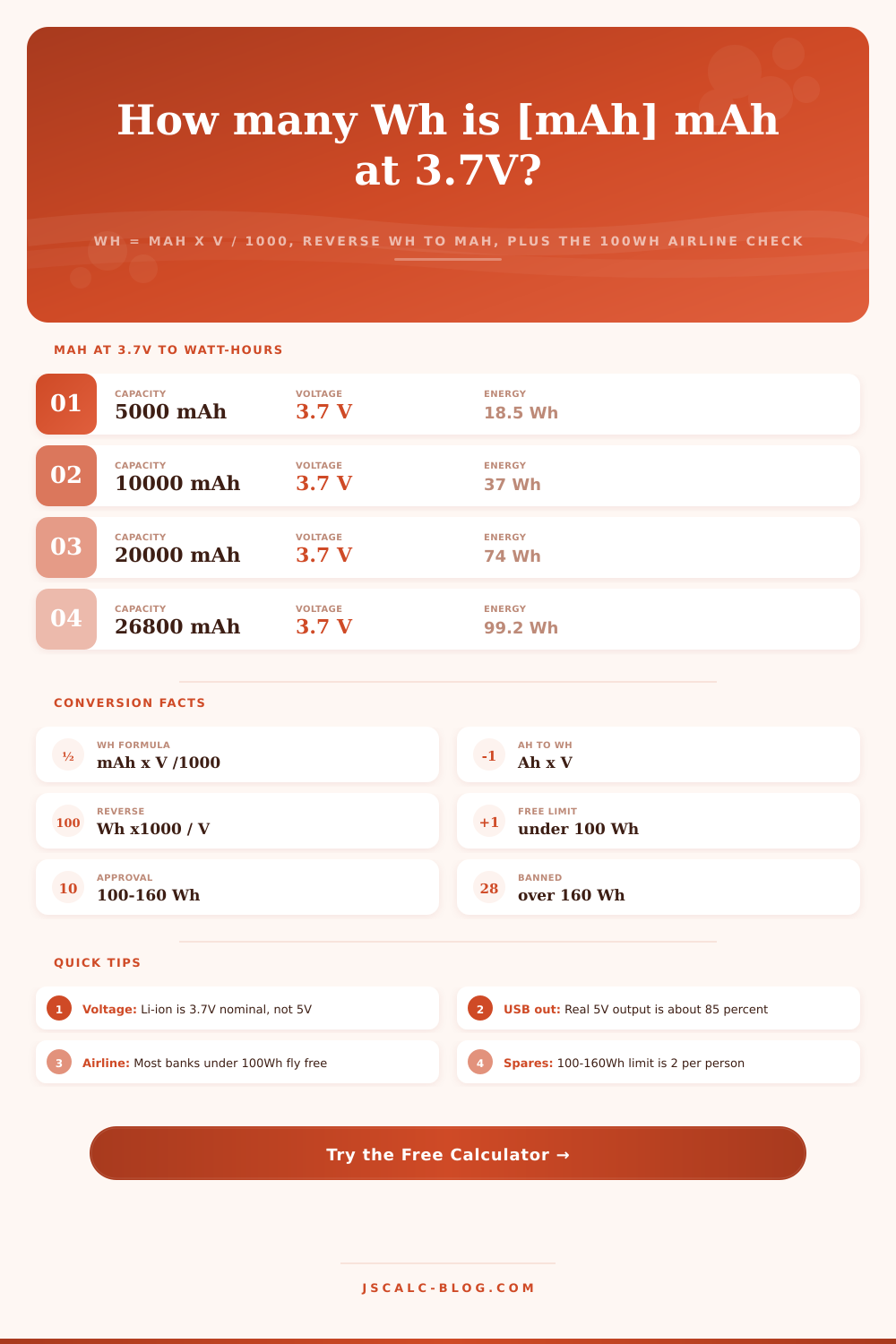
| 5000 mAh | 3.7 V | 18.5 Wh | 0.0185 kWh |
| 10000 mAh | 3.7 V | 37 Wh | 0.037 kWh |
| 20000 mAh | 3.7 V | 74 Wh | 0.074 kWh |
| 26800 mAh | 3.7 V | 99.16 Wh | 0.0992 kWh |
| 27000 mAh | 3.7 V | 99.9 Wh | 0.0999 kWh |
| 50000 mAh | 3.7 V | 185 Wh | 0.185 kWh |
✈Airline Limit Reference
| Energy Range | Cabin Status | Spare Limit | Typical Example |
|---|---|---|---|
| Under 100 Wh | Allowed freely | No fixed cap | 20000 mAh at 3.7 V = 74 Wh |
| 100 to 160 Wh | Airline approval | 2 spares max | 30000 mAh at 3.7 V = 111 Wh |
| Over 160 Wh | Not allowed in cabin | 0 spares | 50000 mAh at 3.7 V = 185 Wh |
| 99.16 Wh | Allowed freely | No fixed cap | 26800 mAh at 3.7 V |
| 99.9 Wh | Allowed freely | No fixed cap | 27000 mAh at 3.7 V |
| 133.2 Wh | Airline approval | 2 spares max | 36000 mAh at 3.7 V |
| 148 Wh | Airline approval | 2 spares max | 40000 mAh at 3.7 V |
📏Charge and Energy Unit Conversions
| Unit | Equals | In Base Unit | Note |
|---|---|---|---|
| 1 Ah | 1000 mAh | 1 Ah | Amp-hour of charge |
| 1 mAh | 0.001 Ah | 0.001 Ah | Milliamp-hour |
| 1 Wh | 3600 J | 1 Wh | Watt-hour of energy |
| 1 kWh | 1000 Wh | 1000 Wh | Kilowatt-hour, bill unit |
| 1 mAh at 3.7 V | 0.0037 Wh | 3.7 mWh | Single Li-ion cell |
| 1 mAh at 5 V | 0.005 Wh | 5 mWh | USB output rail |
🗃Real Battery Energy Comparison Grid
| Battery / Device | Capacity | Voltage | Energy (Wh) | Real mAh at 5V | Airline Status |
|---|---|---|---|---|---|
| Slim power bank | 10000 mAh | 3.7 V | 37 Wh | 6290 mAh | Free |
| Standard power bank | 20000 mAh | 3.7 V | 74 Wh | 12580 mAh | Free |
| Travel power bank | 26800 mAh | 3.7 V | 99.16 Wh | 16857 mAh | Free |
| Large power bank | 30000 mAh | 3.7 V | 111 Wh | 18870 mAh | Approval |
| Smartphone battery | 5000 mAh | 3.85 V | 19.25 Wh | 3272 mAh | Free |
| Laptop battery 3S | 5000 mAh | 11.1 V | 55.5 Wh | 9435 mAh | Free |
| Cordless tool pack | 4000 mAh | 18 V | 72 Wh | 12240 mAh | Free |
| Drone 4S pack | 5200 mAh | 14.8 V | 76.96 Wh | 13083 mAh | Free |
| Portable power station | 50000 mAh | 3.7 V | 185 Wh | 31450 mAh | Banned |
| Big station 100Ah | 100000 mAh | 3.7 V | 370 Wh | 62900 mAh | Banned |
💡Battery and Travel Tips
Milliamps per hour are tiny, but they count when its time to face the desk at airport security. Airline regulations specifies batteries by watt-hours, just like power station labels. However, battery capacities is often given in milliamp-hours (mAh). There’s a difference: the voltage. And knowing how to convert it is what makes or breaks your ability to bring your power bank on the plane.
That’s why we have a little calculator here to do the maths for you. With a couple of taps, you get a clear answer so you’ll know exactly where you stand before you put anything in your bag.
How to Check If Your Battery Can Fly
Multiply charge (in milliamp-hours) by voltage to get energy in watt-hours. Then, divide by 1000 because milliamps must be divided by 1000 to become amps. The formula is Wh = mAh x V / 1000. Most people drops the division by 1000. For example, a 20000 mAh battery isn’t 20000 watt-hours of capacity; it’s 20000 x 3.7 / 1000, or 74 Wh.
If you have capacity stated as amp-hours, you can simplify the formula to Wh = Ah x V. For instance, 4 Ah cordless tool packs rated at 18 V would contains precisely 72 Wh. The key point here is that voltage matters most: more volts carries more energy with the same amount of charge. You cannot just look at mAh to compare batteries. Having the same capacity (mAh) doesn’t mean they has the same amount of energy. You have two batteries that are both rated for 3,000 mAh but one might have more juice in it than the other.
The typical (nominal) operating voltage for a single lithium-ion cell is roughly 3.7 V, that’s its average discharge voltage, not the 4.2 V it peaks at when freshly charged off the charger. So a 5000 mAh phone battery with a 3.85 V average voltage contains just 19.25 Wh of energy, where a 5000 mAh laptop pack at 11.1 V holds 55.5 Wh, or three times the energy from identical mAh figure. The moral: Always convert your numbers to watt-hours before comparing batteries. Wh represents actual energy storage, regardless of voltage.
If the manufacturer provides only watt-hours and you need the more familiar mAh number, then this works in reverse as well. If we rearrange the equation we get mAh = Wh x 1000 / V. For instance, if someone says it’s 100 Wh at 3.7 V, then that’s 27027 mAh; which is why lots of travel power banks comes rated for 26800 mAh. That one number tells you why.
They’re sized exactly at 99.16 Wh because anything over 100 is not allowed to fly without special permission. A tiny bit, sure, but when you’re packing smart and light, it matters.
The International Air Transport Association (IATA) sets limits on lithium batteries. Almost all airlines follow these limits, which are measured in watt-hours. Lithium batteries up to 100 Wh are free to ride in your carry-on without approval, and there’s no realistic limit to how many such batteries you can have as personal use items.
Between 100 Wh and 160 Wh, you’ve reached approval land. You need airline signoff, and you are limited to a maximum of two spare batteries per flight, which must be carried in-cabin instead of checked. Anything above 160 Wh is just plain banned from the cabin of any passenger aircraft.
That’s why a 30000 mAh bank at 111 Wh requires talking to the airline, while a 185 Wh 50000 mAh station won’t be coming along at all. You won’t have any surprises at the gate because the tool marks each category with a clear result card.
Each calculation takes up four cards. One displays the headline watt-hour figure used for flying and shipping. It’s divided by 1000 to convert into kilowatt-hours, the units on your electricity bill and most portable power stations. The second card also represents same amount of energy as mAh. This is measured at a voltage that you select, which defaults to the USB rail (5 V). This allows you to see how much this device will deliver compared to, for example, a 3.7 V cell that you are carrying in a battery pack.
The fourth card is the airline verdict: Approved, Allowed or Not allowed as per IATA limits. This is the part where most people get tripped up about buying a power bank. They see a 20000 mAh bank, but that’s its rating in milliamp-hours at the 3.7 V internal cells it uses. That power gets converted to 5 V for plugging into your phone, and there’s around 10 to 15 percent loss due to heat during that process. In other words, the actual capacity you have available at the USB plug is more like 12500 mAh instead of the 20000 mAh printed on the box. It will give you a realistic idea of how many times it’ll top off your device based off a loss factor estimate from the converter inside.
And that’s why the watt-hour number never lies. That’s what this tool and regulators use to anchor everything to. The same three formulas apply to the shopper making an honest comparison between power banks and the drone pilot packing for a shoot. They also applies when a frequent flyer checks their battery just before a flight.
The calculator does all that by combining the airline check with a two-way conversion. It includes reference tables of actual batteries, a step-by-step explanation of the formula, and clear verdict cards to tell you yes or no if it’s safe to fly. You can start with a preset, match the voltage against your cells, and read off the watt-hours. You would of never again be left wondering how much juice is in your battery or whether it’s allowed in the hold. Fly safe knowing what you’ve got in your bag.