Battery Discharge Rate (C-Rate) Calculator
Convert between C-rate, discharge current, and runtime for any pack. Enter capacity in Ah or mAh, pick what to solve for, and the tool applies I = C-rate x capacity, C-rate = I / capacity, and runtime = 1 / C-rate, then flags whether your draw stays inside the safe continuous C-rate for LiPo, Li-ion, LiFePO4, NiMH, or lead-acid chemistry.
🎯Real Battery Pack Presets
🔋Battery and Load Inputs
Choose the unknown; enter the matching values below.
Sets the safe max continuous C-rate for the verdict.
Rated cell or pack capacity at the chosen unit.
1000 mAh equals 1 Ah.
Multiple of capacity per hour, used when solving current or time.
Actual load in amps, used when solving C-rate or time.
Only applies when solving for discharge time.
Fraction of capacity actually drawn before cutoff.
🔢Formula Snapshot
📋Capacity and C-Rate to Current
| Capacity | C-Rate | Current I = C x Ah | Ideal Runtime |
|---|---|---|---|
| 100 Ah | 0.5C | 50 A | 2 h |
| 100 Ah | 1C | 100 A | 1 h |
| 2.2 Ah | 25C | 55 A | 2.4 min |
| 1.5 Ah | 30C | 45 A | 2 min |
| 5.0 Ah | 2C | 10 A | 30 min |
| 50 Ah | 0.2C | 10 A | 5 h |
| 3.0 Ah | 10C | 30 A | 6 min |
| 200 Ah | 0.05C | 10 A | 20 h |
📊C-Rate to Runtime Reference
| C-Rate | Ideal Runtime | In Minutes | Typical Use |
|---|---|---|---|
| 0.05C | 20 h | 1200 min | Standby float |
| 0.2C | 5 h | 300 min | Solar storage |
| 0.5C | 2 h | 120 min | LFP cycling |
| 1C | 1 h | 60 min | Rated capacity |
| 2C | 0.5 h | 30 min | Power tools |
| 10C | 0.1 h | 6 min | RC / e-bike |
| 25C | 0.04 h | 2.4 min | Drone flight |
| 50C | 0.02 h | 1.2 min | Racing burst |
🗃Chemistry vs Safe Continuous C-Rate Grid
| Chemistry | Max Continuous C | Burst C (10-30s) | Typical Cycles | Nominal Volts/Cell | Best For |
|---|---|---|---|---|---|
| LiPo | 10-30C | 50-100C | 150-300 | 3.7 V | Drones, RC |
| Li-ion (18650) | 1-5C | 7-10C | 300-800 | 3.6 V | Packs, e-bike |
| LiFePO4 | 1-3C | 5-10C | 2000-6000 | 3.2 V | Solar, RV, EV |
| NiMH | 0.5-2C | 5-10C | 500-1000 | 1.2 V | AA, hybrids |
| Lead-acid AGM | 0.2-0.3C | 1-3C | 200-500 | 2.0 V | Cars, UPS |
| Lead-acid flooded | 0.1-0.2C | 0.5-1C | 300-1200 | 2.0 V | Deep cycle |
📏Capacity and Current Unit Conversions
| Unit | Equals | In Base Unit | Note |
|---|---|---|---|
| 1 Ah | 1000 mAh | 1 Ah | Amp-hour capacity |
| 1 mAh | 0.001 Ah | 0.001 Ah | Milliamp-hour |
| 1 A | 1000 mA | 1 A | Amp of current |
| 1 C | 1 x capacity/h | 1 per hour | Full pack in one hour |
| 1 h | 60 min | 3600 s | Runtime unit |
| 0.5C | half capacity/h | 2 h runtime | Common LFP rate |
⚙Formula Breakdown
💡Discharge Safety Tips
When an e-bike’s range evaporates on cold mornings or a drone battery swells mid-flight, that’s typically not bad luck. That’s battery trouble; specifically, a mismatch between amount of power the battery chemistry can supply and the amount you’re trying to draw. That gap is expressed by the C-rate. A C-rate ties together time, capacity, and current into a single relationship.
You’ll find a calculator here that does the math for you. You will not have to guess whether your cells are being drained efficienty or damaged by a particular load.
What Is a C-Rate and Why It Matters for Your Battery
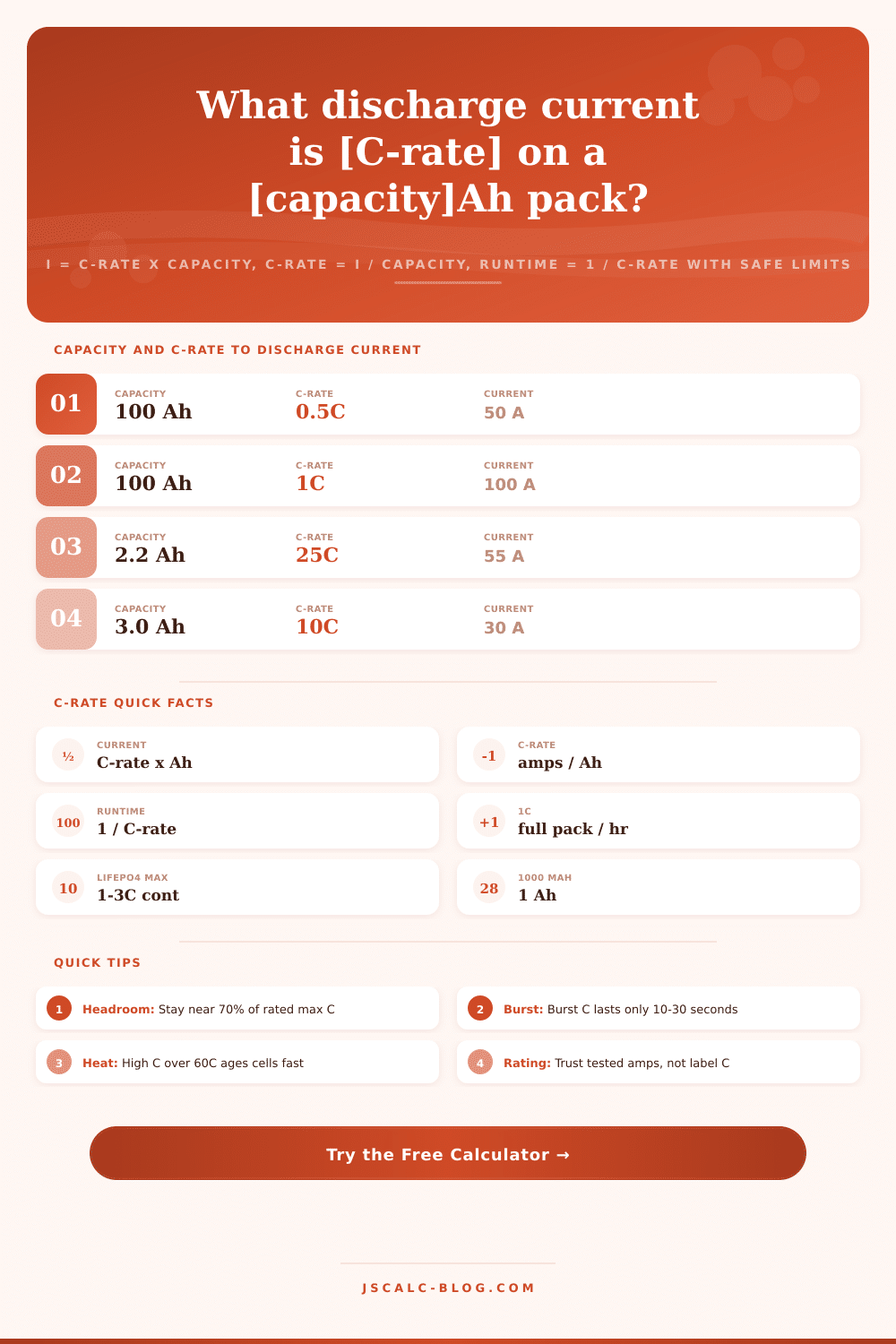
A C-rate is a multiple of the pack’s total capacity expressed per hour. It’s not an absolute number of electrons. For instance, if you have a 100Ah battery at a rate of 1C, it will discharge completely in one hour. That’s one hundred amps flowing for one hour. This means a hundred amp-hour bank are pushing one hundred amps. Half that amount over twice the time is 0.5C, meaning it flows half as many amps for twice as long.
So a big storage wall running at twenty-five C is nothing; a tiny little hobby cell at that same rate are an enormous draw. Convert the rate into real world amperage before connecting your load. Why? Because of scale effect. It’s driven by three equations. One: Current = C-rate * Capacity (in amp-hours). Two: C-rate = Current/Capacity. Three: Ideal run time = 1 / C-rate. Those three variables is tied together and with any two of them, you get the third.
Want to know what the rate calls for? Need to determine the rate the load requires? Want to know how long it lasts? We solve it for you from every angle. That way, there’s no need to remember which variable gets plugged into which spot in the equation.
To put this another way, consider distinction between storage and sport. Fifty amps for two hours from a one hundred amp-hour LiFePO4 bank is gentle on cycle life; that’s a half-C rate. But fifty-five amps for less than two minutes from a two-point-two amp-hour LiPo drone battery? That’s twenty-five C and empty fast. The math matches. The thermal load doesn’t. When cells is pushed harder then their internal resistance will permit, voltage drops and temperature also drops. But there’s a limit, and that’s because of the chemistry.
Racing LiPos handle from ten to thirty C continuously. They can bursts much higher for seconds. Cylindrical Li-ion generally top out at around five C. Lithium iron phosphate likes one to three C but will repay your patience in thousands of cycles. Lead-acid is most fragile. It wants to stay below 0.3C or it degrades quickly. You can see that clearly on the page reference table. That way you don’t guess, you match the application to the right material.
That’s where the confusion arises regarding burst ratings. On their labels, manufacturers lists continuous limits along with peak values, which are typically very short-lived bursts. While a hundred C sounds great, it’s only going to be sustainable for 10 to 30 seconds. If they runs longer, the cells will overheat. And it doesn’t matter what’s printed on the box. That’s why the calculator automatically flags this distinction. It alerts you if your draw can sustains only momentary spikes compared to extended drains.
The other thing that alters reality is depth of discharge. If you deplete the entire capacity, then your run time will be perfect. Realistically, though, you kill lead acid by going below 50% and you could of leave lithium packs down to 20% before they suffer premature death. Making the prediction in terms of usable depth keeps things honest. You don’t find yourself stranded with a seemingly full pack that’s not strong enough to get you around the last leg.
The solar panel and drone load examples are all presets so you can see how various loads will behave. It also demonstrates importance of leaving a thirty percent margin below the rated maximum to keep the packs cool and reliable. Sizing right respects both capacity and chemistry. Treating the C-rate as a speed limit instead of a suggestion is what gives you flat batteries. Get the rate right and then hit start and you’ll have more time with power on.