Subnet Splitting Calculator
Split one IPv4 network into equal-sized subnets by borrowing host bits. Enter a base network and prefix, choose how many equal subnets you want or a target new prefix, and get the new prefix length, subnet count, hosts per subnet, and a full enumeration of every child block with its network, first host, last host, and broadcast.
🌐Choose a Split Method
🎯Real Subnet Splitting Presets
📝Split Inputs
The parent block address, for example 192.168.10.0. It is realigned to the base prefix.
The prefix of the parent you want to split.
Rounded up to the next power of two if needed.
Must be longer than the base prefix.
Long splits are capped so the table stays readable.
First host and last host columns in the child list.
🔢Split Formula Snapshot
📋Bits Borrowed to Subnets and Hosts
| Bits Borrowed | New Subnets 2^b | Prefix from /24 | Block Size | Usable Hosts |
|---|---|---|---|---|
| 0 | 1 | /24 | 256 | 254 |
| 1 | 2 | /25 | 128 | 126 |
| 2 | 4 | /26 | 64 | 62 |
| 3 | 8 | /27 | 32 | 30 |
| 4 | 16 | /28 | 16 | 14 |
| 5 | 32 | /29 | 8 | 6 |
| 6 | 64 | /30 | 4 | 2 |
| 7 | 128 | /31 | 2 | 0 (2 ptp) |
📊Splitting a /24 into Equal Subnets
| New Prefix | Subnets Made | Block Size | Usable Hosts | First Two Blocks |
|---|---|---|---|---|
| /25 | 2 | 128 | 126 | .0/25, .128/25 |
| /26 | 4 | 64 | 62 | .0/26, .64/26 |
| /27 | 8 | 32 | 30 | .0/27, .32/27 |
| /28 | 16 | 16 | 14 | .0/28, .16/28 |
| /29 | 32 | 8 | 6 | .0/29, .8/29 |
| /30 | 64 | 4 | 2 | .0/30, .4/30 |
🔢Powers of Two Reference
| Exponent b | 2^b Subnets | Host Bits Left (from /24) | Addresses per Subnet |
|---|---|---|---|
| 0 | 1 | 8 | 256 |
| 1 | 2 | 7 | 128 |
| 2 | 4 | 6 | 64 |
| 3 | 8 | 5 | 32 |
| 4 | 16 | 4 | 16 |
| 5 | 32 | 3 | 8 |
| 6 | 64 | 2 | 4 |
| 8 | 256 | 0 | 1 |
🗃Split Comparison Grid
| Parent | New Prefix | Bits Borrowed | Subnets | Block Size | Usable Hosts | Example Child |
|---|---|---|---|---|---|---|
| /24 | /26 | 2 | 4 | 64 | 62 | 10.0.0.64/26 |
| /24 | /28 | 4 | 16 | 16 | 14 | 10.0.0.16/28 |
| /24 | /30 | 6 | 64 | 4 | 2 | 10.0.0.4/30 |
| /23 | /24 | 1 | 2 | 256 | 254 | 10.0.1.0/24 |
| /22 | /24 | 2 | 4 | 256 | 254 | 10.0.2.0/24 |
| /20 | /24 | 4 | 16 | 256 | 254 | 10.0.8.0/24 |
| /16 | /24 | 8 | 256 | 256 | 254 | 10.0.5.0/24 |
| /25 | /28 | 3 | 8 | 16 | 14 | 10.0.0.48/28 |
| /26 | /29 | 3 | 8 | 8 | 6 | 10.0.0.24/29 |
| /27 | /30 | 3 | 8 | 4 | 2 | 10.0.0.12/30 |
⚙Formula Breakdown
💡Subnet Splitting Tips
Imagine you fold up a piece of paper in half again and again, creating smaller and smaller equal sections. That’s what happens when you split a network. You begin with a chunk of IP space (one block), then borrow bits to divide it into equal-sized subnets in powers of two. Above is a tool that does the math for you. No need to crunch numbers yourself! If you do, you will inevitabley make little mistakes that cost hours to correct.
Using host bits, this tool break up your parent block into even-sized chunks called “subnets.” It gives back a list of each child block, how many subnets there are, and new prefix. This comes in handy whenever you want to split up a spare /24 into point-to-point links, or carve out a department block for use on VLANs.
How to Split a Network into Subnets
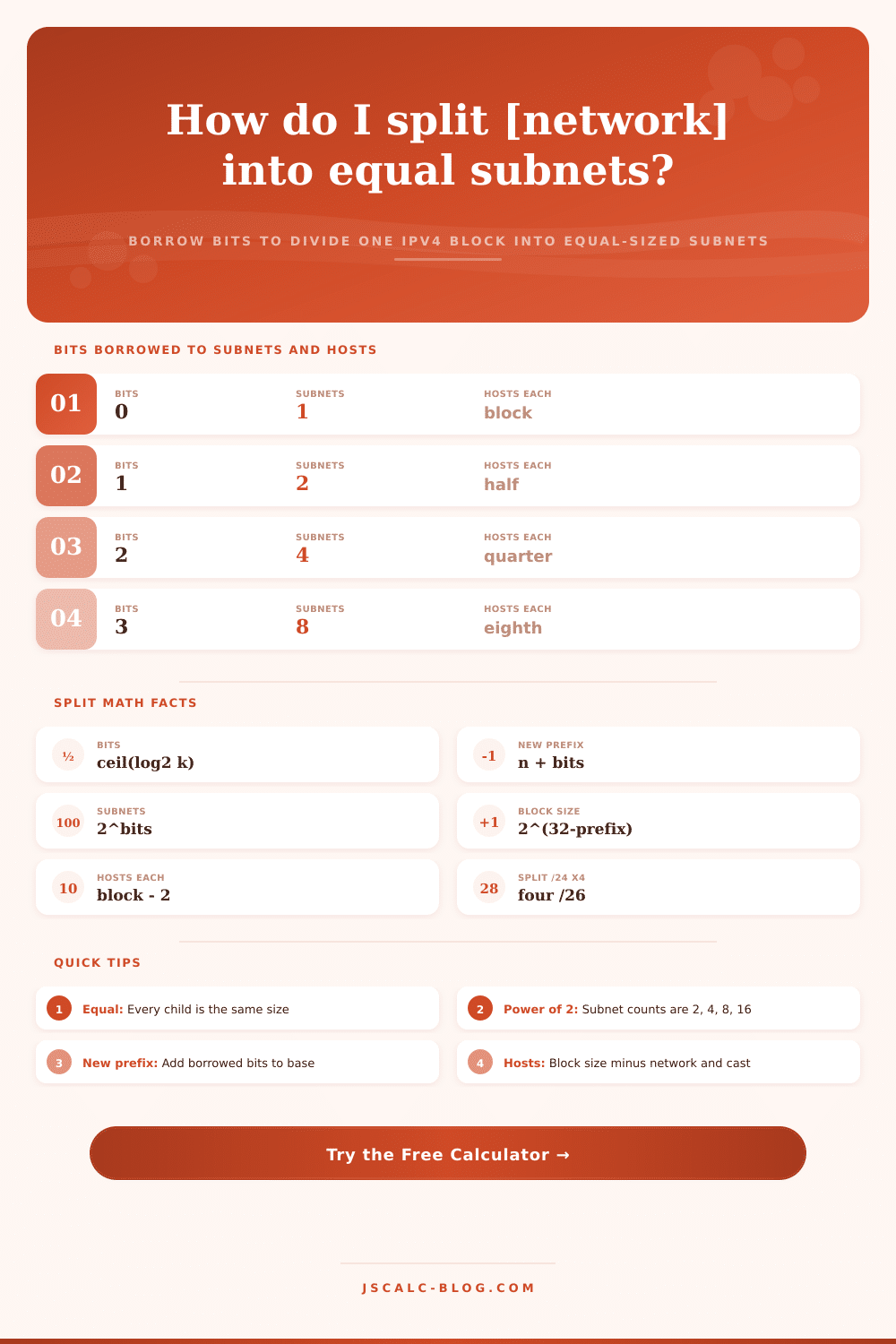
IPv4 addresses is 32 bits in length. An IPv4 address with a /24 prefix indicates that the first 24 bits define the network and the last 8 bits are used for host addresses. When you “split” an address, you take some host bits and turn them into network bits. For every bit you move from host-to-network, you double the number of subnets created. Borrowing one bit makes parent go half-half. Two bits = quarters. Three bits gives you eight subnet.
No. Because each bit is either zero or one (binary), there are always power-of-two splits: 2, 4, 8, 16… You can’t divide something into thirds with no waste. Many novices gets thrown off by this rule, imagining they’ll choose any number they want. Here’s the quick and precise math. You want to divide your parent n into k subnetworks. Let b = ceiling(log2(k)). Then your new prefix will be m = n+b and you will have 2^b subnetworks.
On the other hand, if you want to specify your new prefix first, the tool figures out how many blocks it yields: specifically, it determines the difference between your old and new prefixes. Since each block represent a fixed number of addresses, we call that the block size. It’s 2^(32-m), where m is your new prefix. Remember, the total number of usable hosts in each subnet = blocksize, 2. This may not seem important now. But once you start packing in hosts with narrow ranges, it begin to matter.
The other half is what do you plug into your router? You’re supposed to know the IP range. The calculator does it for you. It shows child number, starting from zero. Then it shows the child network address, which is parent base plus i * blocksize. So if you have a /24 subnetted into four /26s, the block size is 64. And you start from offsets 0, 64, 128, and 192.
It displays in each block the network address, the first and last usable host, and the broadcast address. A list that will turn an abstract prefix into something you can cut-and-paste directly into config files. Newcomers often make two errors. One is that subnets must start from boundary of blocks. Thus for a /26, the possible networks are those ending in.0,.64,.128, and.192… 100/26 is within a block; it doesn’t start a block. It’s not allowed to start a subnet somewhere random that doesn’t line up with the underlying binary math.
The second error is making a count that is not a power of two unless you want to waste addresses. Five equal subnets? Then you have to borrow three bits, get eight, and then throw away three. Only two bits gives you four. The calculator handles both problems automatically by rounding your desired count up to the next power of two and then adjusting your base address to the parent prefix.
You get a quick rundown of the block size, number of subnets, hosts per subnet and the new prefix from reading result cards. Then below, the breakdown panel fills out all the formulas to replace your specific numbers so you can trace the reasoning a line at a time. The reference tables include the bits-borrowed chart along with worked examples from /25 to /30. This allows you to see at a glance how rapidly your address space shrinks when borrowing more bits. Doing subnetting right here saves you from chasing after silent routing failures later.
The start of a clean network design. This tool combines exacting bit math with live enumeration of each child block to convert a parent network to a list of equal subnets, instantly ready for deployment. Use it if you’re an engineer slicing a supernet or if you’re a student learning about CIDR: You’ll get boundary-correct, accurate subnets every time. It would of helped too.