Pregnancy Due Date Calculator
Estimate an expected due date from LMP, known conception, IVF transfer, or ultrasound dating, then view gestational age, trimester, days remaining, and a date range.
Choose the method that matches the date source.
The calculator reports gestational age on this date.
Used by the LMP method as pregnancy day 0.
Enter cycle length minus 28. Example: 31-day cycle = 3.
Used when the conception or ovulation date is known.
Used with embryo age on transfer day.
EDD = transfer date + 266 - embryo age.
Use the date printed on the scan report.
Weeks
Days, 0 to 6
Formula Breakdown
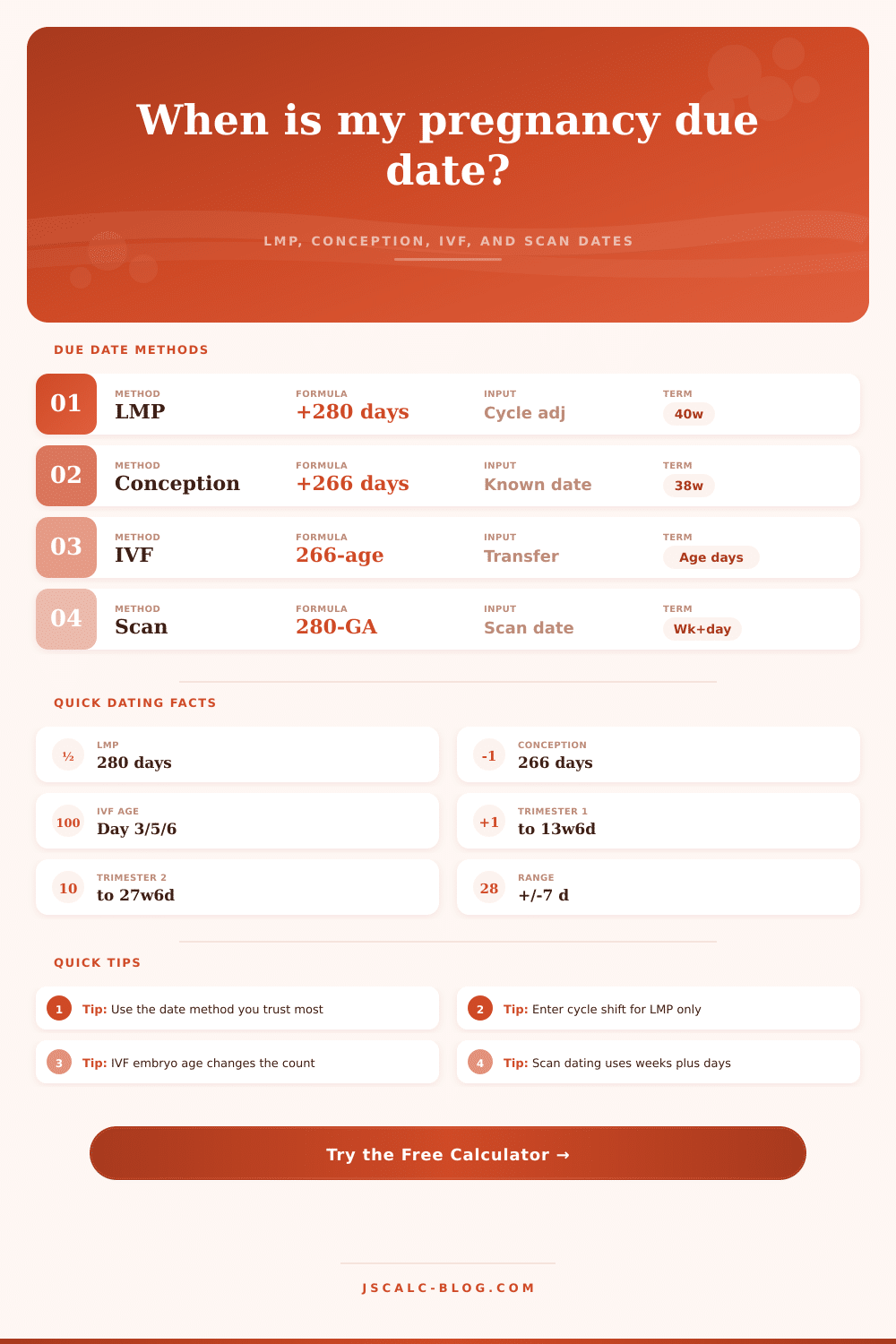
| Method | Main input | Core formula | Built-in assumption | Range used here | Best calculator use |
|---|---|---|---|---|---|
| LMP, 28-day cycle | First day of last period | LMP + 280 days | Ovulation near day 14 | EDD +/- 7 days | Common first estimate |
| LMP, adjusted cycle | LMP plus cycle shift | LMP + 280 + shift | Regular cycle not exactly 28 days | EDD +/- 7 days | Long or short regular cycles |
| Known conception | Conception or ovulation date | Date + 266 days | Fertilization date is known | EDD +/- 5 days | Tracked ovulation or IUI-style timing |
| IVF transfer | Transfer date and embryo age | Transfer + 266 - age | Embryo age is known | EDD +/- 3 days | Day 3, day 5, or day 6 transfer |
| Early ultrasound | Scan date and GA | Scan + 280 - GA | GA estimate from scan | Usually +/- 7 days | First-trimester dating reference |
| Later ultrasound | Scan date and GA | Scan + 280 - GA | Dating range widens later | +/- 10 to 21 days | Reference check when scan is later |
| Stage | Weeks and days | Day range | Calculator label |
|---|---|---|---|
| Before pregnancy start | Before 0w0d | Negative days | Before LMP equivalent |
| First trimester | 0w0d to 13w6d | 0 to 97 days | Trimester 1 |
| Second trimester | 14w0d to 27w6d | 98 to 195 days | Trimester 2 |
| Third trimester | 28w0d to 40w0d | 196 to 280 days | Trimester 3 |
| After estimate | After 40w0d | More than 280 days | Past estimated due date |
| Transfer type | Embryo age input | Days added to transfer | LMP equivalent |
|---|---|---|---|
| Day 2 embryo | 2 days | 264 days | Transfer - 16 days |
| Day 3 embryo | 3 days | 263 days | Transfer - 17 days |
| Day 5 blastocyst | 5 days | 261 days | Transfer - 19 days |
| Day 6 blastocyst | 6 days | 260 days | Transfer - 20 days |
| Milestone | Gestational age | Formula from EDD | Calculator use |
|---|---|---|---|
| Pregnancy start reference | 0w0d | EDD - 280 days | LMP equivalent |
| Second trimester start | 14w0d | EDD - 182 days | Trimester label changes |
| Third trimester start | 28w0d | EDD - 84 days | Trimester label changes |
| Full-term reference | 39w0d | EDD - 7 days | Snapshot card reference |
| Estimated due date | 40w0d | EDD | Main calculator output |
You want accuracy in a process where there’s a lot of biological variability, so you get anxious waiting for due date: one date from your wall calendar versus another date set by your body. Most people will pull out the calculator as soon as they see a positive test. A calculator gives you an anchor, but only if you know what chain the anchor is attached to. If you rely on an ultrasound scan, or laboratory timing, or trust your natural cycle, then the math look very different.
The last menstrual period (LMP) method starts with when you remember having your last period. No doctor needed; simply pull out your memory and go. Add 280 days, and there’s your baby’s expected arrival date. That’s the classic equation. This means it assumes a regular 28-day cycle and that you ovulated smack dab in the middle. Oops! Don’t fall into that trap.
How To Calculate Your Due Date Accurately
Adjusting for your cycle length corrects for earlier or later ovulation. Plug in how many days your cycle is long or short compared to average. Then the rest of the math adjust to match. If you don’t make this adjustment, you may be off by as much as a week from where your actual due date should land. This is why most people screw up this piece of the puzzle: They think that first number they punch into the calculator is their final answer. Not so. That’s just an initial guess, using averages of what average humans are like physcially.
If you’re someone who knows exactly when you conceived, say from carefully tracking your cycle or planning to have sex around your peak fertility window; then there’s an adjustment to make. You’ll count forward 266 days (rather than 280). Why? Because the first two weeks after ovulation don’t actually include any embryonic development. They are simply part of “gestational” time. This approach feels more accurate; because it relies on an actual occurrence, as opposed to a hormonal stand-in. And it applies if you conceive via IUI (intrauterine insemination). This means you would be tracking the timeline, too. Since the events were planned out, they could be recorded, too. When you know what point you’re starting at, it’s easier to guess what end point awaits.
There’s also more specificity with in vitro fertilization: Embryo age at transfer makes an enormous difference. How far along is your day-three embryo compared to your day-five blastocyst? This changes your due date. The calculator adjust for this by accounting for the embryo’s age and then subtracting it from the usual gestational count. In other words, it doesn’t double-count the first few days of embryonic development that have already passed during in-vitro fertilization. For someone who has had all aspects of her pregnancy medically managed, that detail provides comfort. You get a date based off actual fact, not some estimate based on average.
There’s another wrinkle: ultrasound dating. Early ultrasounds are surprisingly precise, often within a few days; late ones have a broader margin (which makes sense, since not all fetuses develops at the same pace, depending on their own genetic makeup and mom’s nutritional intake). And if the ultrasound shows a due date that is much earlier or much later than what your menstrual period calculated, it is usually much earlier, especially early on. You can plug in the week/days of your scan, and the calculator will show you the overlap between those figures and everything else you enter. It flags when your own timeline deviates from the bell curve.
This is where knowing these differences comes in: There’s no one that can predict the day you’ll give birth exactly, and they never do. In fact, less than 4% of all births are on your calculated due date. The rest happen either before or after. Realizing this is why calculators don’t just pick a single moment, but instead give you an estimate of a range of days.
While you might not be able to control when you go into labor, you know now how long to plan ahead (for hotel reservations, for example, or for maternity leave). It turns something unclear and vague into something concrete. It helps put your progress into context with the trimester labels and gestational age outputs. You can know that you’re moving from first to second trimester, which has a different set of physical changes than being close to full term. The snapshot metrics that reference full term and days remaining keep it front-of-mind without forcing you to mentally crunch numbers every single day. It shifts the focus from a sense of a deadline to an awareness of how far along you are. All of this comes down to lowering the stakes in an inherently uncertain process.
These are tools to help plan and track development. These tools paint a picture of what’s coming next, whether from medical imagery, laboratory logs, or memory. At the end of the day, it doesn’t matter what the date says on the calendar. It matters when the baby arrives ready (whenever that might happen). You should of known that dates can be tricky. One could of even expected different results if they used different methods.