Poker Probability Calculator
Turn your outs into equity, price a call against the pot, and compare Texas Hold'em draws with exact 5-card hand probabilities. Every result uses standard unseen-card counts and the rule of 2 and 4.
♠Real Poker Presets
🃏Odds Inputs
Outs and pot-odds modes drive the draw math; hand mode uses the frequency table.
Clean cards that give you the winning hand.
Standard Hold'em always deals two hole cards.
Sets unseen cards: 47 after the flop, 46 after the turn.
Break-even equity = call / (pot + call).
🔢Deck Snapshot
📈Outs to Equity Chart
| Outs | Flop → River (2 cards) | Turn → River (1 card) | Odds Against (Flop) | Odds Against (Turn) | Typical Draw |
|---|---|---|---|---|---|
| Enter outs above to highlight the matching row. | |||||
♥Five-Card Hand Probabilities
| Hand | Combos | Probability | Percent | Odds Against |
|---|---|---|---|---|
| Pick a target hand in hand mode to highlight its row. | ||||
💰Pot-Odds Break-Even Table
| Bet vs Pot | Ratio | Break-Even Equity | Min Outs (Flop) | Min Outs (Turn) | Read |
|---|---|---|---|---|---|
| Quarter pot | 4:1 | 20.0% | 5 outs | 10 outs | Easy call range |
| Third pot | 3:1 | 25.0% | 6 outs | 12 outs | Most flush & straight draws |
| Half pot | 2:1 | 33.3% | 9 outs | 16 outs | Big draws favored |
| Two-thirds pot | 1.5:1 | 40.0% | 11 outs | 19 outs | Combo draws only |
| Pot-sized | 1:1 | 50.0% | 14 outs | 23 outs | Need a monster draw |
| Overbet 1.5x | 0.83:1 | 60.0% | Rare | Rare | Usually fold a draw |
♦Rule of 2 and 4 Reference
| Draw | Outs | Rule x4 (Flop) | Exact Flop % | Rule x2 (Turn) | Exact Turn % |
|---|---|---|---|---|---|
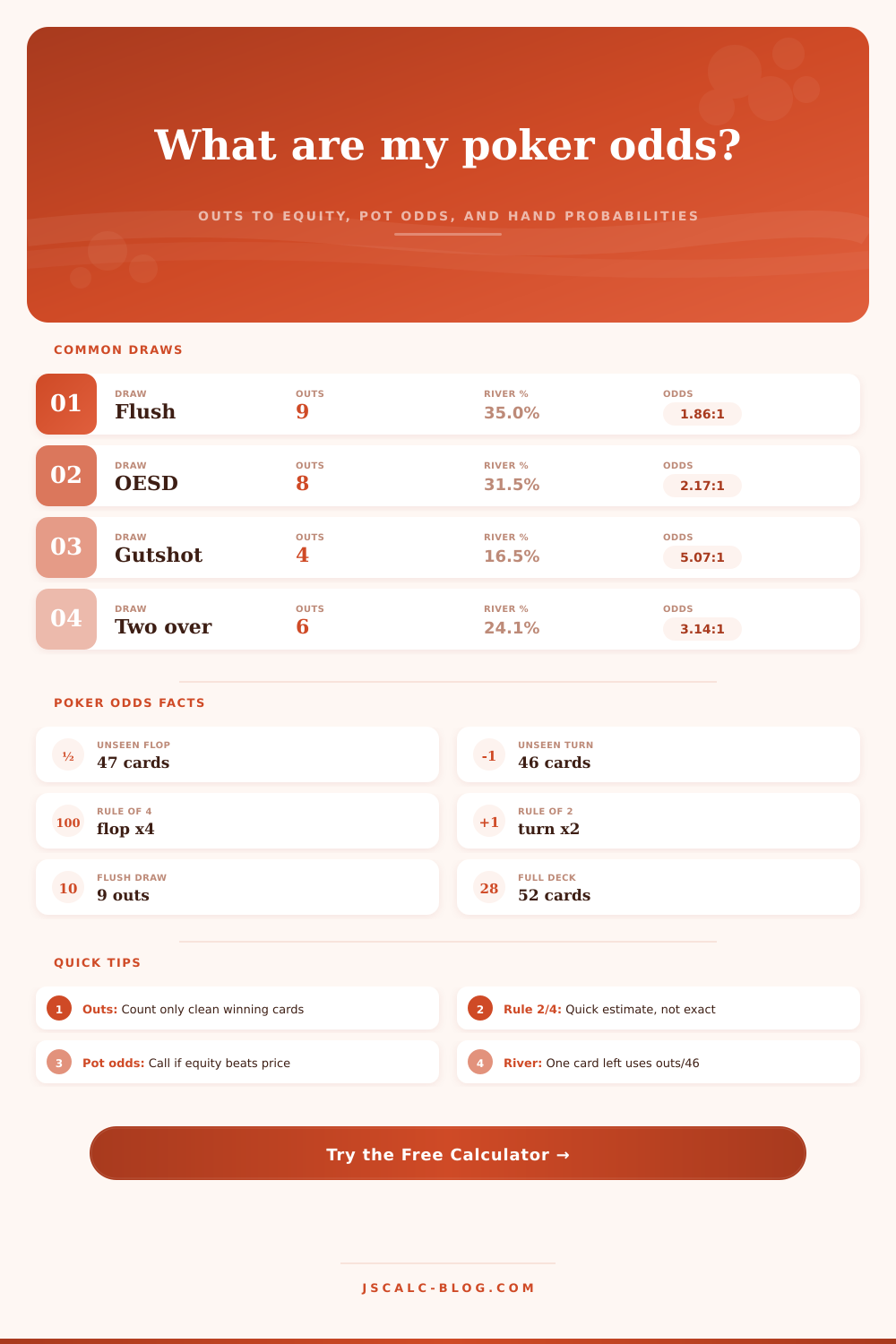
| Gutshot straight | 4 | 16% | 16.5% | 8% | 8.7% |
| Two overcards | 6 | 24% | 24.1% | 12% | 13.0% |
| Open-ended straight | 8 | 32% | 31.5% | 16% | 17.4% |
| Flush draw | 9 | 36% | 35.0% | 18% | 19.6% |
| Flush + gutshot | 12 | 48% | 45.0% | 24% | 26.1% |
| Flush + open-ended | 15 | 60% | 54.1% | 30% | 32.6% |
⚙Full Formula Breakdown
💡Practical Poker Odds Tips
On the flop: You have a flush draw and your opponent goes all in. Your heart is racing. Real tension here. You’ve got nine cards that’ll win this thing, and now you gotta decide whether you have the equity to make the call. That’s where math keeps you alive and intuition lets you down.
Everyone thinks they’re great at understanding odds, but when push comes to shove, they can’t put their hand on ’em because putting numbers in their heads while the seconds tick by are too much to process. Enter the calculator above, enter your outs, and let the calculator do the hard work for you as you get a bead on opponent instead of trying to do long division on the felt. It converts unseen odds into real decision making; it closes the gap between knowing something and doing it rightly.
Use Math to Win at Poker
This depends on understanding your clean outs; the cards that clear your path to victory. If you have two hearts in your hand and the flop shows two more, any of remaining hearts will complete your flush. So there are nine cards left in the deck that will help you win the hand, assuming no one else has anything better then a flush by the river. But not all outs is equal. Some out cards will complete your draw while also giving your opponent a stronger hand. For example, if board is coordinating heavily toward straights, then you need to discount your own straight outs because they hurts both your draw and your equity. This helps keep your equity honest and ensures you don’t make costly calls based off inflated expectations.
It’s a small adjustment, but it often separates profitable players from those who bleed chips on marginal draws. With your real out count in hand, the tool calculates your equity to make your made hand by the river. Equity is calculated based off the expected composition of a standard deck and the fact that there are still 47 unseen cards after the flop and 46 after the turn. That’s where the number come from.
It will give you the probability of improving your hand during the next few streets. It also lets you compare your actual equity against the break-even percentage derived from the pot odds. A lot of people like to use the two-and-four rule for a quick approximation; they figure twice their outs or four times their outs to arrive at a ballpark percentage. These estimations aren’t perfect; they’re very accurate up to a certain point and then they over-estimate your equity if you have many out. If you want to be precise, check the actual numbers given by the calculator; it matters more when money’s on the line.
The page has a table explaining all of this nicely. It shows how much the approximations differs from the real numbers as you increase your out count. The key counterbalance to your drawing equity is called pot odds. Put simply, this is the ratio between what the pot is worth and how much it costs you to make the call. If the pot has better odds than your draw needs to hit, then it is profitable to make the call in the long run. That isn’t because you think you’re going to win this exact hand at this moment in time. Instead, you want to make a decision that will earn money in hundreds of similar spots.
By comparing your equity percentage to the break even percentage based on pot sizes, you know if price is right. You’ll call when your equity is higher then needed, or fold otherwise. There is no element of hope involved… It’s all about finding consistent mathematical edges. Once you grasp these ideas, however, poker becomes more about skill and discipline, instead of chance.
Instead of getting emotionally caught up in a hand, you start to view it through a mathematical perspective: what are the odds? When you make that call and miss that big draw, you’re not frustrated anymore because you realize it was the proper play mathematically. When you fold that bad spot and feel relieved, you understand why you folded. You also appreciate that you protected your stack for a better opportunity. That’s something that requires practice to master; but if you have the proper tools, your learning curve would of been much less steep. No more guessing; just confident play.
But at its core, poker is an incomplete-information game. Logic trumps feelings. Using probability in your decision making process eliminates the guesswork during key situations. Even if the short-term result feels unfair, you know the numbers has your back and ultimately, that’s what separates a serious player from a non-serious one.
The next time you’re faced with that difficult post-flop decision, consider this: The math doesn’t lie. All you have to do is let it talk first.