PCB Copper Weight Calculator
Copper weight in oz/ft2 is really a thickness spec. Convert copper weight to microns, mils, and millimeters, then find the total copper mass on your board and the sheet resistance in milliohms per square from board size, layer count, and outer-layer plating.
⚡Choose an Input Mode
📌Common Copper Weight Presets
🔧Board and Copper Inputs
Foil weight before plating, e.g. 0.5, 1, 2, 3 oz.
Measured or spec thickness in the unit at right.
Converted to an equivalent copper weight.
Outer dimension of one board along X.
Outer dimension of one board along Y.
Number of copper layers of this base weight.
Extra plated copper on 2 outer layers, e.g. 0.5 oz.
Fraction of the area still copper after etching.
Controls rounding on every result card.
🔢Copper Weight Constants
📋Copper Weight to Thickness
| Copper Weight | Microns (um) | Mils | Millimeters |
|---|---|---|---|
| 0.5 oz/ft2 | 17.40 um | 0.685 mil | 0.0174 mm |
| 0.75 oz/ft2 | 26.09 um | 1.028 mil | 0.0261 mm |
| 1 oz/ft2 | 34.79 um | 1.370 mil | 0.0348 mm |
| 1.5 oz/ft2 | 52.19 um | 2.055 mil | 0.0522 mm |
| 2 oz/ft2 | 69.58 um | 2.740 mil | 0.0696 mm |
| 3 oz/ft2 | 104.4 um | 4.110 mil | 0.1044 mm |
| 4 oz/ft2 | 139.2 um | 5.480 mil | 0.1392 mm |
| 5 oz/ft2 | 174.0 um | 6.850 mil | 0.1740 mm |
| 6 oz/ft2 | 208.7 um | 8.220 mil | 0.2087 mm |
📊Sheet Resistance by Weight
| Copper Weight | Thickness | Sheet Rs | 1 mm-Wide Trace |
|---|---|---|---|
| 0.5 oz/ft2 | 17.40 um | 0.988 mohm/sq | 0.988 mohm/mm |
| 1 oz/ft2 | 34.79 um | 0.494 mohm/sq | 0.494 mohm/mm |
| 1.5 oz/ft2 | 52.19 um | 0.330 mohm/sq | 0.330 mohm/mm |
| 2 oz/ft2 | 69.58 um | 0.247 mohm/sq | 0.247 mohm/mm |
| 3 oz/ft2 | 104.4 um | 0.165 mohm/sq | 0.165 mohm/mm |
| 4 oz/ft2 | 139.2 um | 0.124 mohm/sq | 0.124 mohm/mm |
| 6 oz/ft2 | 208.7 um | 0.082 mohm/sq | 0.082 mohm/mm |
🧩Typical Copper Weight by Application
| Application | Base Weight | Finished Outer | Layer Type | Notes |
|---|---|---|---|---|
| Consumer signal board | 0.5 oz | 1 oz plated | Inner and outer | Fine pitch routing |
| Standard 4-layer | 1 oz | 1.5 oz plated | Outer with plating | Most common build |
| Power supply plane | 2 oz | 2.5 oz plated | Inner plane | Higher current |
| Automotive control | 2 oz | 2 oz | Inner and outer | Thermal cycling |
| Heavy copper drive | 3 oz | 3 oz | Bus and plane | Wide spacing needed |
| Motor and inverter | 4 oz | 4 oz | Busbar layer | Very high current |
| Battery and welding | 6 oz | 6 oz | Bus layer | Extreme current |
| Flex circuit | 0.5 oz | 0.5 oz | Rolled foil | Bend endurance |
🗃Copper Weight Comparison Grid
| Copper Weight | Microns | Mils | Millimeters | Sheet Rs | Mass per dm2 |
|---|---|---|---|---|---|
| 0.5 oz/ft2 | 17.40 um | 0.685 mil | 0.0174 mm | 0.988 mohm/sq | 1.56 g |
| 0.75 oz/ft2 | 26.09 um | 1.028 mil | 0.0261 mm | 0.659 mohm/sq | 2.34 g |
| 1 oz/ft2 | 34.79 um | 1.370 mil | 0.0348 mm | 0.494 mohm/sq | 3.12 g |
| 1.5 oz/ft2 | 52.19 um | 2.055 mil | 0.0522 mm | 0.330 mohm/sq | 4.68 g |
| 2 oz/ft2 | 69.58 um | 2.740 mil | 0.0696 mm | 0.247 mohm/sq | 6.23 g |
| 2.5 oz/ft2 | 86.98 um | 3.425 mil | 0.0870 mm | 0.198 mohm/sq | 7.79 g |
| 3 oz/ft2 | 104.4 um | 4.110 mil | 0.1044 mm | 0.165 mohm/sq | 9.35 g |
| 4 oz/ft2 | 139.2 um | 5.480 mil | 0.1392 mm | 0.124 mohm/sq | 12.47 g |
| 5 oz/ft2 | 174.0 um | 6.850 mil | 0.1740 mm | 0.099 mohm/sq | 15.59 g |
| 6 oz/ft2 | 208.7 um | 8.220 mil | 0.2087 mm | 0.082 mohm/sq | 18.71 g |
⚙Formula Breakdown
💡PCB Copper Design Tips
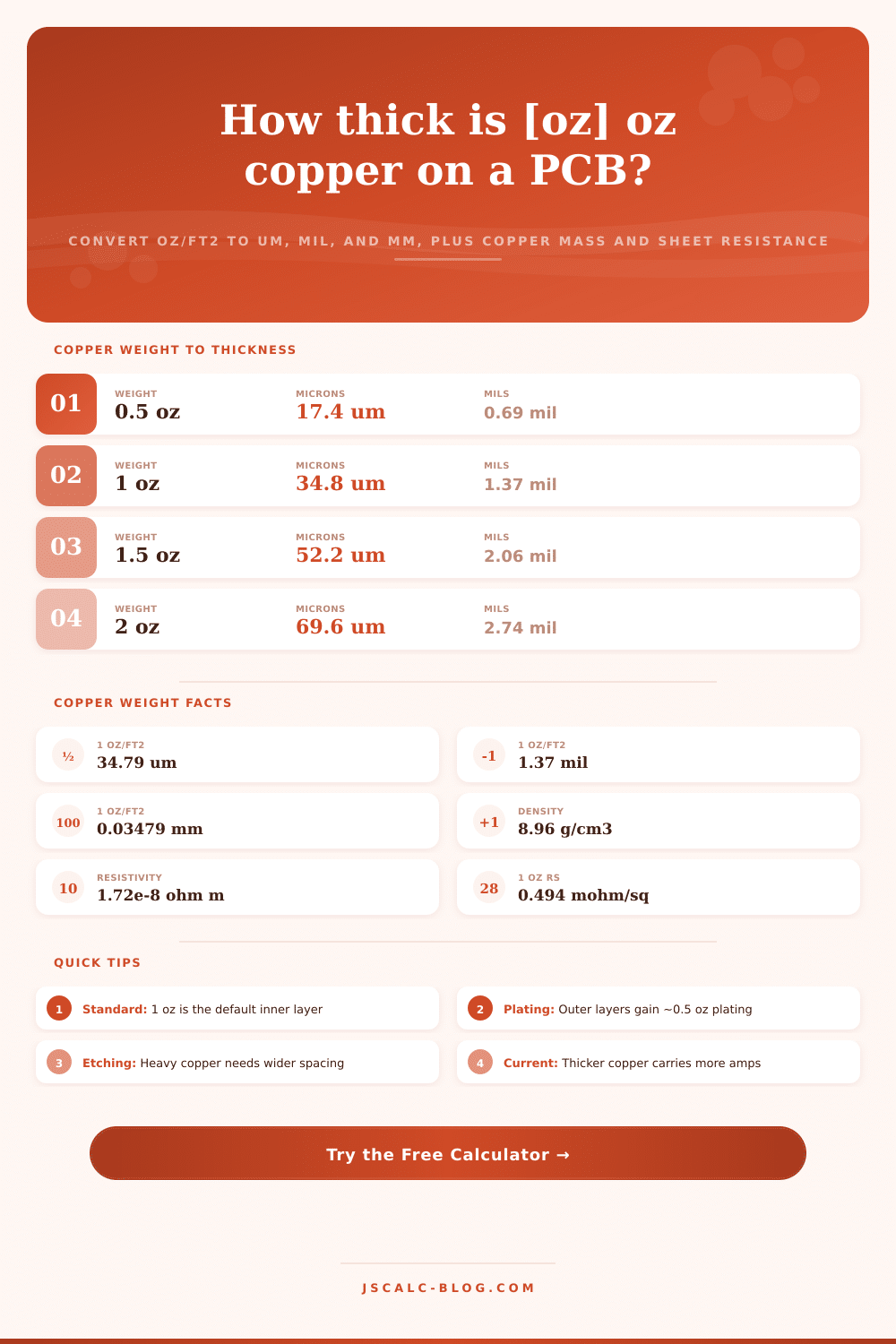
You may have seen the terms “1 oz” or “2 oz” listed as copper weight specifications on a circuit board drawing. However, those terms might confuse you. Those are actualy thicknesses; they aren’t referring to mass. This is simply because if I spread out one ounce of metal over a square foot of area, it ends up being roughly 34.79 microns (or 1.37 mils) thick.
The calculator uses this convention and calculates real values based off it. Specifically, it converts copper weight into mils, microns, and millimeters. And then it can calculate the sheet resistance and total mass of your board.
Understanding Copper Weight and Thickness
From a manufacturing perspective, foil is still sold and made by the ounce per square foot. As a spec for a moddern board, that becomes a thickness spec. A given ounce of copper spread out over a square foot are a uniform layer 34.79 um thick. Therefore, 0.5 oz is approximately 17.4 um, and 2 oz would be 69.6 um. It’s a linear relationship. To find the micron (um) thickness of copper, multiply weight times 34.79.
For example, if layer is 70 um thick, dividing 70 by 34.79 gives approximately 2 oz copper. Note: folks tend to confuse ounces with weight. Ounces are used to specify thickness, even though they’re actualy a unit of weight. Units don’t match datasheet to fabricator. Mil is in one and micron another. Millimeter might be used for mechanical models.
Your calculator takes either thickness (or copper weight) in whatever unit you like, then show them all at once. Entering 35 um shows that as roughly 1 oz copper. Type in 2.74 mil and it’s 2 oz. That eliminates guessing. It makes it easier to reconcile a supplier chart with a fab drawing or match an impedance stackup.
Thermal and cost calculations relies on copper mass. Mass equals area times thickness times density. The density of copper is 8.96 grams per cubic centimeter. Your board dimensions are provided in millimeters. Convert this into square centimeters, then multiply it by the density and the layer thickness (both in centimeters). Then it is scaled by the number of copper layers specified.
Any electroplated copper on outer layers is added. Etching is accounted for with a coverage percentage. A solid ground plane weighs more than a layer with just signal with sixty percent coverage.
The amount of electrical performance relates back to thickness of the copper. The relationship between thickness and electrical performance is called sheet resistance. This is calculated by taking the resistivity of the material (1.72e-8 ohm-meters for copper) and dividing it by its thickness. In the end you get it in units of ohms per square. For 1 oz of standard copper (at 34.79 um), this equals ~0.494 milliohms per square. If you double the copper (i.e., go from 1 oz to 2 oz), your resistance is cut in half to approximately 0.247 milliohms per square. That’s why power designs tend to have thicker copper.
Because sheet resistance isn’t dependent upon trace width, you can use it to estimate DC resistance. Count up the squares along the path of current flow. A trace with a length equal to ten squares will have a resistance of ten times the sheet resistance, independent of width.
What about finished copper vs. What about base foil? Finished copper will have plating deposited on it (typically ~0.5 oz), which also fills through holes. Generally boards start with 1 oz of foil and finish at ~1.4 to 1.5 oz of copper on the topside and bottomside layers. For this reason there’s an input for adding plating in the calculator. Enter how much copper you’re starting with as the base and what you want to add back via plating. Then all the weight, resistance, and thickness outputs is based on the finished stackup instead of just the raw material.
The weight of copper varies from application to application. Inner Layers: 0.5 oz Standard: Four-Layer General-Purpose Boards: Typically 1 oz Automotive boards & power supplies ramp up to 2 oz for reduced resistance Heavy Copper: Battery systems and motor drives push out to 3 oz, 6 oz where copper is used like a busbar. Here, heavier copper equals wider traces (minimum) and higher spacing between traces. Adding each ounce thickens the copper by about a mil (one to two). If you know thickness in advance, you can set sensible design rules. This prevents you from violating fabrication rules later on.
For common builds, select one of the presets. From there, tweak the layer count, board size, coverage, and plating to fit your design. With this tool, you get accurate numbers in seconds. You’ll convert a vague amount into something real.