Parallel Resistance Calculator
Combine up to eight resistors wired in parallel using 1/Rtotal = 1/R1 + 1/R2 + ... + 1/Rn, then read total current, per-branch current, branch power, and total power from a shared supply. Remember the golden rule: the parallel total is always smaller than the smallest single branch. Includes a mode to find the exact resistor to add in parallel with a known one to reach any target value.
⚡Choose a Mode
🎯Real Parallel Wiring Presets
🔌Resistor Inputs
Branches from R1 down are used; extras are ignored.
Applies to every resistor field below.
First parallel branch resistance.
Second parallel branch resistance.
Third parallel branch resistance.
Fourth parallel branch resistance.
Fifth parallel branch resistance.
Sixth parallel branch resistance.
Seventh parallel branch resistance.
Eighth parallel branch resistance.
Same voltage sits across every parallel branch.
Trim mode: the resistor you already have fitted.
Trim mode: must be below the known resistor.
Controls rounding on every result card.
🔢Formula Snapshot
📋Parallel Rules and Properties
| Property | In a Parallel Group | Formula | Why It Happens |
|---|---|---|---|
| Voltage | Same across every branch | V1 = V2 = V | All branches share two common nodes |
| Total resistance | Below the smallest branch | 1/Rt = Σ 1/Ri | Extra paths var more current flow |
| Total current | Sum of branch currents | It = Σ Ii | Current divides among the paths |
| Branch current | Highest in smallest R | Ii = V / Ri | Least resistance carries most current |
| Branch power | Highest in smallest R | Pi = V² / Ri | Same V, so lower R means more watts |
| Conductance | Adds directly | Gt = Σ Gi | Conductance G is 1 / R |
📊Two-Resistor Product Over Sum
| R1 | R2 | R1 × R2 | R1 + R2 | Rtotal |
|---|---|---|---|---|
| 1 k | 1 k | 1,000,000 | 2,000 | 500 Ω |
| 1 k | 2 k | 2,000,000 | 3,000 | 667 Ω |
| 2.2 k | 3.3 k | 7,260,000 | 5,500 | 1.32 kΩ |
| 10 Ω | 10 Ω | 100 | 20 | 5 Ω |
| 220 Ω | 330 Ω | 72,600 | 550 | 132 Ω |
| 8 Ω | 8 Ω | 64 | 16 | 4 Ω |
| 1 k | 10 k | 10,000,000 | 11,000 | 909 Ω |
| 4.7 k | 4.7 k | 22,090,000 | 9,400 | 2.35 kΩ |
🧮Equal Resistors R Divided by n
| Each R | 2 in Parallel | 3 in Parallel | 4 in Parallel | Rule |
|---|---|---|---|---|
| 100 Ω | 50 Ω | 33.3 Ω | 25 Ω | R / n |
| 220 Ω | 110 Ω | 73.3 Ω | 55 Ω | R / n |
| 470 Ω | 235 Ω | 156.7 Ω | 117.5 Ω | R / n |
| 1 kΩ | 500 Ω | 333.3 Ω | 250 Ω | R / n |
| 4.7 kΩ | 2.35 kΩ | 1.567 kΩ | 1.175 kΩ | R / n |
| 10 kΩ | 5 kΩ | 3.333 kΩ | 2.5 kΩ | R / n |
📏Parallel Versus Series Contrast
| Quantity | Series Circuit | Parallel Circuit | Key Point |
|---|---|---|---|
| Rtotal | R1 + R2 + ... | 1 / Σ(1/Ri) | Series adds, parallel reciprocal |
| Total value | Above the largest R | Below the smallest R | Opposite directions |
| Current | Same through all | Splits per branch | Parallel divides current |
| Voltage | Divides per resistor | Same on all | Series divides voltage |
| Two 1k | 2 kΩ total | 500 Ω total | 4x difference here |
| If one opens | Whole circuit stops | Other paths keep working | Parallel is more robust |
🗃Parallel Combination Comparison Grid
| Combination | Rtotal | Itotal at 12 V | Smallest Branch | Total Power at 12 V | Note |
|---|---|---|---|---|---|
| 1k || 1k | 500 Ω | 24 mA | 1 kΩ | 0.288 W | Equal pair halves R |
| 1k || 2k | 667 Ω | 18 mA | 1 kΩ | 0.216 W | Below smaller 1 k |
| 4.7k x3 | 1.567 kΩ | 7.66 mA | 4.7 kΩ | 0.092 W | R over 3 branches |
| 100 x4 | 25 Ω | 480 mA | 100 Ω | 5.76 W | Low R, high current |
| 8 || 8 | 4 Ω | 3 A | 8 Ω | 36 W | Two speakers on amp |
| 10 x3 | 3.333 Ω | 3.6 A | 10 Ω | 43.2 W | Load sharing paths |
| 220 || 330 | 132 Ω | 90.9 mA | 220 Ω | 1.09 W | Unequal current split |
| 1k || 10k | 909 Ω | 13.2 mA | 1 kΩ | 0.158 W | Big R barely helps |
| 2.2k || 3.3k | 1.32 kΩ | 9.09 mA | 2.2 kΩ | 0.109 W | Trim toward a value |
| 50 x2 | 25 Ω | 480 mA | 50 Ω | 5.76 W | Power resistors bank |
⚙Formula Breakdown
💡Parallel Design Tips
This behavior of resistance through parallel circuits is unintuitive, but it’s what happens. Resistors wired in series combine linearly, just like chaining them together. Current doesn’t like this and it become more difficult.
Wiring them in parallel, however, are akin to opening up your road and adding more lanes. A wider road with less traffic mean lower overall resistance. In fact, the effective resistance goes below the lowest value. And that seems odd until you consider what’s really going on: it is the equivalent of conductance.
Why Parallel Circuits Have Lower Resistance
This is why it applies to things like LED arrays, speaker wiring, and everything else in between. For example, two resistors wired together, one at 220 ohms, another at 330, won’t be halfway between. No, it will be 132. That number feels wrong if you expect addition. It makes sense if you stop thinking in terms of opposition and start thinking in terms of conductance.
This works like this: There’s a little bit of back-and-forth math here, which tends to stump most folks. Don’t fret: there’s no need to invert all those fractions manually, nor bother with decimal point placement mistakes. Just punch it into the box up top. It will give you the power being drawn per branch, the total current draw at the supply end, and the total resistance as presented to the supply.
Because this is important. Parallel circuits aren’t just a matter of calculating one combined resistance figure. It’s about where the current divides. It’s also about what heats up. Each resistor see the full supply voltage. This is why the smallest resistor draws the biggest current and creates most heat. Each one draws 1.5 amps. The amp has a 4 ohm load on its output, but each speaker are drawing too much power, melting 18 watts apiece.
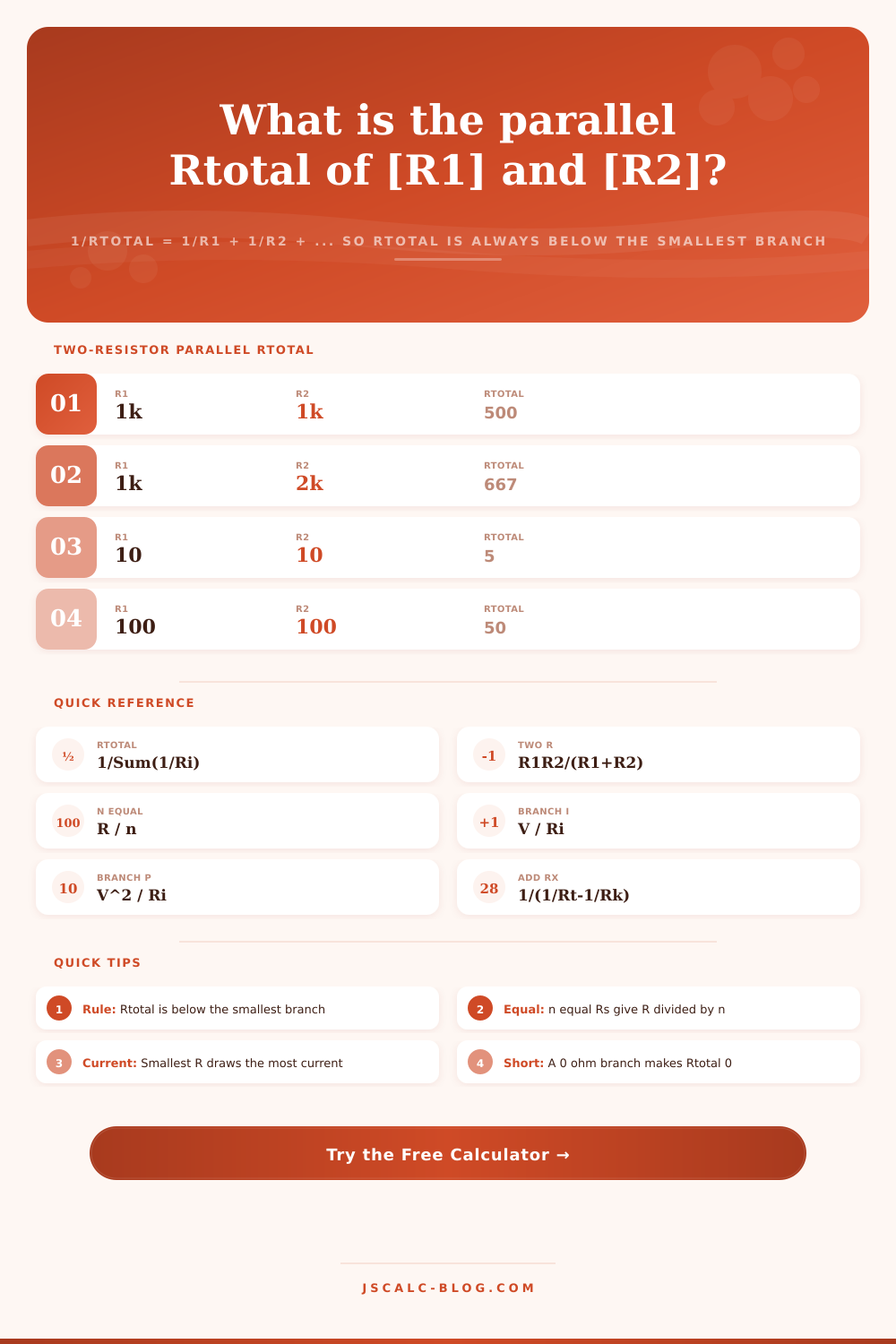
The trick that most people apply to all problems (the product-over sum shortcut) goes like this: Multiply the resistors together, and then divide by the sum. Two kiloohms, one kiloohm? That’s 667 ohms, pretty easy. But the moment you put in a third arm, it falls apart. The general formula involve reversing each resistor value, adding up the results, and then reversing that number again. Ugh. It is messy math for a pocket calculator.
There’s a simpler method if all the resistors are equal. Three 4.7 kiloohm resistors just become 4700 ÷ 3. If only the tool knew about that. Turns out, it does. It knows when to apply which formula and shows you how it gets there. This way, you can double check its answer against what you wrote down yourself.
Where parallel builds frequently stumble is in power ratings. Resistors are too frequently sized by taking average power over all components in the set. Bad idea. Thermal loading is inversely proportional to resistance. The smallest resistor carry the largest thermal load. Given 1 kiloohm, 2 kiloohms, and 4.7 kiloohms in parallel to 12 volts, the 1k is seeing 0.144 watts. The 4.7k is seeing roughly 0.03 watts. You stick in three quarter-watt resistors because you think they evenly divide the load, and you have a fire hazard.
The calculator will show you power for each individual branch, not just total, so you know precisely what has to be rated to a higher wattage. Now there’s also a real-world use for this: What if you want to trim resistors down because you don’t have an exact one. Let’s say you have a 1 kiloohm resistor and you want the circuit to see 750 ohms to everything else. Well, you can’t add more resistance in parallel, it’ll go down. All you can do is reduce it. To find the value of the parallel resistor, you would add a 3 kiloohm resistor in parallel to reach exactly 750 ohms. This is a nice little trick for tweaking things when normal E-series resistor values just aren’t quite right for what you’re trying to accomplish.
Always remember that the target resistance should be smaller than what you currently have or the math will give you negative resistance which isn’t physically possible here. But this relationship will help you build better and more efficient circuits. You’re learning how to match impedance with your audio components or split current among several LED. The voltage remains equal throughout the branches. Current divides based on the path of least resistance. Follows power follows that current divide. More paths reduce the overall resistance.
That’s a little mind-shift from “oh, there’s something standing in my way” to “there’s more room for flow here,” but it transforms the entire mindset when approaching a circuit design. When you stop seeing parallel wiring as stacked walls and realize it’s widening the road, then the math begin to make sense all by itself.