LED Power Dissipation Calculator
Work out how much power an LED turns into heat, how many watts the series resistor burns off and what wattage rating it needs, the total circuit draw, and the drive efficiency. Enter your supply voltage, forward voltage, current and PWM duty to see the full power and heat budget in milliwatts.
💡Real LED Circuit Presets
⚡LED and Supply Inputs
Pick a color to load typical Vf and If, or Custom to type your own.
The DC rail feeding the LED and its resistor.
Voltage across one lit LED at the drive current.
Target current through the string, in milliamps.
LEDs wired end to end share the same current.
Auto sizes the resistor for the exact current, or set your own.
Only used when the selector above is set to manual.
100 is always on; lower values scale average power down.
🔢Power Formula Snapshot
📋Common LED Types and Typical Power
| LED Type | Typical Vf | Typical If | LED Power | Common Use |
|---|---|---|---|---|
| Red 5 mm | 1.8 V | 20 mA | 36 mW | Panel indicator |
| Amber 5 mm | 2.0 V | 20 mA | 40 mW | Marker, status |
| Green 5 mm | 2.2 V | 20 mA | 44 mW | Ready light |
| Blue 5 mm | 3.2 V | 20 mA | 64 mW | Accent, display |
| White 5 mm | 3.2 V | 20 mA | 64 mW | Small lighting |
| IR 940 nm | 1.4 V | 50 mA | 70 mW | Remote, sensor |
| UV 395 nm | 3.4 V | 20 mA | 68 mW | Curing, checking |
| 1 W star | 3.4 V | 350 mA | 1190 mW | Torch, spotlight |
🔥Standard Resistor Wattage Packages
| Rating | Watts | Safe at 50% | Typical Package | Where Used |
|---|---|---|---|---|
| 1/8 W | 0.125 W | 63 mW | 0805 / 0.125 W axial | Small SMD, logic |
| 1/4 W | 0.25 W | 125 mW | Through-hole axial | Most indicator LEDs |
| 1/2 W | 0.5 W | 250 mW | Larger axial | Higher current LEDs |
| 1 W | 1 W | 500 mW | Ceramic / axial | Strips, drops of Vs |
| 2 W | 2 W | 1 W | Metal oxide | Big headroom loss |
| 3 W | 3 W | 1.5 W | Wirewound | Power LED ballast |
| 5 W | 5 W | 2.5 W | Cement wirewound | High current strings |
📈LED Type Power Comparison at 5 V
| LED Type | Vf | If | LED mW | Resistor mW | Efficiency |
|---|---|---|---|---|---|
| Red | 1.8 V | 20 mA | 36 mW | 64 mW | 36% |
| Amber | 2.0 V | 20 mA | 40 mW | 60 mW | 40% |
| Green | 2.2 V | 20 mA | 44 mW | 56 mW | 44% |
| Blue | 3.2 V | 20 mA | 64 mW | 36 mW | 64% |
| White | 3.2 V | 20 mA | 64 mW | 36 mW | 64% |
| IR | 1.4 V | 50 mA | 70 mW | 180 mW | 28% |
| UV | 3.4 V | 20 mA | 68 mW | 32 mW | 68% |
| 2x Red series | 3.6 V | 20 mA | 72 mW | 28 mW | 72% |
| High red | 2.2 V | 70 mA | 154 mW | 196 mW | 44% |
| Cool white | 3.0 V | 30 mA | 90 mW | 60 mW | 60% |
🌓PWM Duty Cycle vs Average Power
| Duty Cycle | Factor | LED 64 mW On | Avg LED Power | Perceived |
|---|---|---|---|---|
| 100% | 1.00 | 64 mW | 64 mW | Full bright |
| 75% | 0.75 | 64 mW | 48 mW | Bright |
| 50% | 0.50 | 64 mW | 32 mW | Half power |
| 33% | 0.33 | 64 mW | 21 mW | Dimmed |
| 25% | 0.25 | 64 mW | 16 mW | Low glow |
| 10% | 0.10 | 64 mW | 6.4 mW | Faint |
| 5% | 0.05 | 64 mW | 3.2 mW | Standby dot |
⚙Formula Breakdown
💡Practical Power and Heat Tips
How much power is lost as heat in an LED circuit? Where does all that energy realy go? That’s the question that stumps beginners and traps more experienced builder too.
An LED doesn’t burn away any of its power as a resistor would along the entire rail. Instead, it drop a set amount of forward voltage and converts product of that current and voltage into light and heat. The remaining excess just gets burned away by series resistor without fanfare or fuss.
How to Calculate LED Heat and Power
This site lets you break those two forms of heat apart and sum total load. This helps with sizing components, estimating cooling requirements, and understanding your battery budget.
Many LED tutorials end here: choose a resistor to limit the current flow. Sure enough, you’ve got your LED lit, but now what? How does this affect how hot individual parts get?
The answer is power dissipation. Each resistor and LED is being stressed by power dissipation. Each milliwatt they dissipate becomes heat that has to leave through the package, the board, or a heatsink.
While a small indicator LED running 36 milliwatts is no problem by itself, a star LED running more than a watt will burn out within seconds if not properly heatsunk. This is exactly where current-only calculators falls short regarding heat and efficiency.
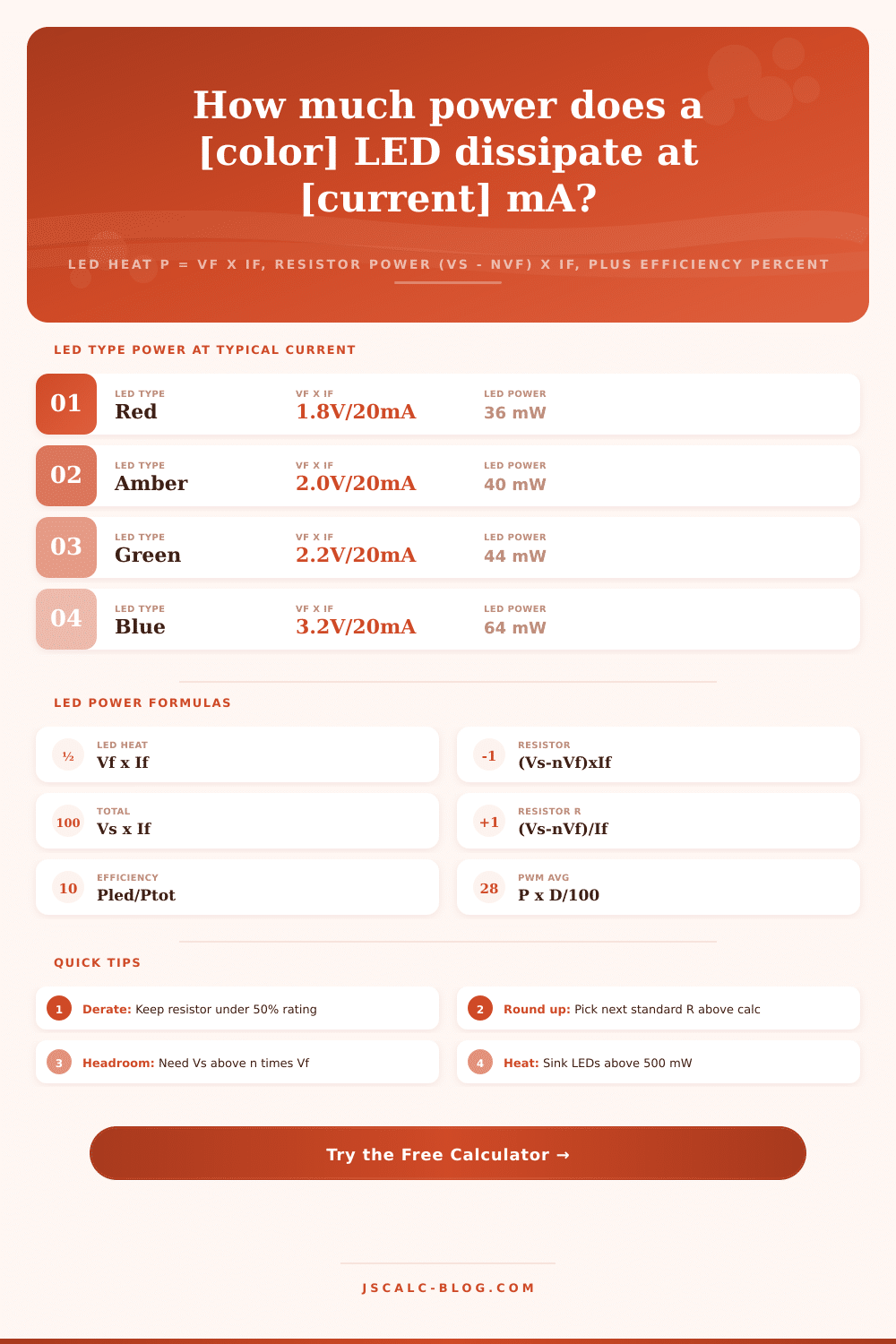
A few simple relationships underlie all of the math. Power through an LED itself is Vf times If, where If is the forward current and Vf is the forward voltage. When you have multiple LEDs in series, there’s only one current for the whole string, so it’s just n times Vf times If for the LED power. The series resistor consumes whatever voltage the LEDs do not, so the resistor power is (Vs minus n times Vf) times If, where Vs is supply voltage. Total power delivered by the supply to the branch is just Vs times If. This is always equal to the resistor power plus the LED power. Efficiency is expressed as a percentage, which is just LED power divided by total power.
For example, you have a single red LED that draws 20 milliamps (current must be in amps for watts) and has a forward drop of 1.8 volts when driven from a 5 volt supply. So, the LED consumes 1.8 times 0.02, or 36 milliwatts, which equals 0.036 watts. At the same current of 0.02 amps, the resistor needs to drop 5 minus 1.8, or 3.2 volts. That’s 0.064 watts, or 64 milliwatts. Total is 36 plus 64, or 100 milliwatts, or 5 times 0.02, precisely 0.1 watts. The efficiency is 36 divided by 100, only 36 percent.
That’s why a high rail driving a low forward voltage LED results in so much wasted power in its resistor. R = (Vs minus n times Vf) divided by If. That works out as R =.2 /.02 = 160 ohms 160 ohms may not be available in stock. Your best bet is to round up to the nearest standard resistor, which is typically 180 ohms. This reduces current just a little bit, but it keeps you on the safe side.
Just as critical is the resistor wattage rating. A resistor will want a rating of double what it is called upon to dissipate, so this 64 milliwatt resistor above would of need a minimum rating of 128 milliwatts. A standard quarter watt resistor at 250 milliwatts gives comfortabley margin and runs cool. The tool also outputs the suggested standard package based on available range of choices.
The numbers also teach one of the most obvious things: Series connections make it more efficient to power LEDs. From 9 volts, driving two red LEDs in series requires a combined forward voltage drop of 3.6 volts. When you connect two in series, the string forward voltage is 3.6 volts. Your resistor only has to drop 5.4 volts, instead of each LED dropping its own voltage on a lower rail. Less of the supply voltage goes to waste as resistor heat and more hits light producing junctions. That’s why LED modules and strips will chain multiple diodes onto each resistor. As shown in calculation comparison table, efficiency increases as forward voltage gets closer to the supply voltage.
Many LED circuits use pulse width modulation (PWM) to dim, not to change current. That’s because it turns the LED totally on and off rapidly. Its brightness follows how long it’s on compared to total time, which is its duty cycle. Even though current during the on time stays the same, the average LED and resistor heat decreases as much as the duty cycle. For example a 50% duty cycle drops the average LED and resistor heat by half, yet maximum current during the on time doesn’t change.
Therefore the calculator takes your duty cycle into account when calculating all powers, and resulting cards show the average loss in a realistic fashion. Note that both the resistor and LED still see full peak current during each pulse (pick parts for the peak), but budget for the average, which will be lower.
After running it returns four summary result cards: LED power; Resistor power (with a suggested minimum wattage); Total circuit power; Drive efficiency. It also includes a complete breakdown panel of all the numbers plugged in so you can verify the math yourself.
It also prevents an illegal circuit. If the supply voltage is not greater than the total forward voltage of the string then there’s no headroom for any current to pass through and the LED won’t illuminate, which the calculator warns about before giving you some false value.
Common situations include a single indicator, part of a strip, driving an MCU pin, or driving an IR emitter. Other examples include driving a high power star or one half of a PWM dimming channel. There are presets for these that fill out form and compute immediately.
A LED power dissipation calculator will help you figure out how much it realy takes to get an LED going. It takes your forward voltage, current and duty cycle and crunches them into those numbers that count: heat and efficiency.