LED Forward Voltage Drop Calculator
Pick an LED color to load its typical forward voltage Vf, then set your supply voltage and target current. The tool sizes the series resistor with R = (Vs - n x Vf) / If, snaps it to the nearest E24 value, finds how many LEDs you can stack in series, and checks the real current your chosen resistor delivers.
💡Real LED Circuit Presets
🔌LED and Supply Inputs
Selecting a color loads its typical Vf below.
Use the value from the LED datasheet if you have it.
The rail or battery driving the LED string.
Common indicators run at 10-20 mA.
How many LEDs share this one resistor.
Series adds the drops; total = n x Vf.
Used to check actual current with a resistor you own.
Controls rounding on the result cards.
🔢Formula Snapshot
🌈LED Color to Forward Voltage and Wavelength
| LED Color | Material | Typical Vf Range | Wavelength |
|---|---|---|---|
| Red | AlGaInP / GaAsP | 1.8 - 2.2 V | 620 - 750 nm |
| Amber | AlGaInP | 2.0 - 2.2 V | 590 - 620 nm |
| Yellow | AlGaInP | 2.0 - 2.2 V | 570 - 590 nm |
| Green (standard) | GaP | 2.0 - 2.4 V | 550 - 570 nm |
| Green (pure) | InGaN | 2.8 - 3.4 V | 500 - 540 nm |
| Blue | InGaN | 3.0 - 3.4 V | 450 - 490 nm |
| White | InGaN + phosphor | 3.0 - 3.4 V | broadband |
| Infrared | GaAs | 1.2 - 1.6 V | 850 - 950 nm |
| Ultraviolet | InGaN | 3.1 - 4.0 V | 365 - 400 nm |
📡Typical Forward Current by LED Size
| LED Type | Typical If | Max If | Notes |
|---|---|---|---|
| 3 mm through-hole | 10 - 20 mA | 30 mA | Panel indicators |
| 5 mm through-hole | 20 mA | 30 mA | Most common hobby LED |
| 10 mm through-hole | 20 - 30 mA | 50 mA | Large jumbo indicators |
| 0603 / 0805 SMD | 5 - 20 mA | 25 mA | PCB status lights |
| 1206 SMD | 20 mA | 30 mA | Backlight and indicators |
| 1 W power LED | 350 mA | 500 mA | Needs a heatsink |
| 3 W power LED | 700 mA | 1000 mA | Constant-current driver |
📊Resistor Comparison Grid by Color and Supply
| Color | Typical Vf | Recommended If | R at 5 V | R at 12 V | Nearest E24 at 5 V |
|---|---|---|---|---|---|
| Red | 2.0 V | 20 mA | 150 ohm | 500 ohm | 150 ohm |
| Amber | 2.1 V | 20 mA | 145 ohm | 495 ohm | 150 ohm |
| Yellow | 2.1 V | 20 mA | 145 ohm | 495 ohm | 150 ohm |
| Green (std) | 2.2 V | 20 mA | 140 ohm | 490 ohm | 150 ohm |
| Blue | 3.2 V | 20 mA | 90 ohm | 440 ohm | 91 ohm |
| White | 3.2 V | 20 mA | 90 ohm | 440 ohm | 91 ohm |
| Warm white | 3.1 V | 20 mA | 95 ohm | 445 ohm | 100 ohm |
| Infrared | 1.4 V | 50 mA | 72 ohm | 212 ohm | 75 ohm |
| UV 395nm | 3.5 V | 20 mA | 75 ohm | 425 ohm | 75 ohm |
📏E24 Standard Resistor Values
| Decade | Low Values | Mid Values | High Values |
|---|---|---|---|
| Base E24 | 10, 11, 12, 13 | 15, 16, 18, 20 | 22, 24, 27, 30 |
| Base E24 | 33, 36, 39, 43 | 47, 51, 56, 62 | 68, 75, 82, 91 |
| x10 | 100, 110, 120 | 150, 180, 200 | 220, 270, 330 |
| x10 | 390, 430, 470 | 510, 560, 620 | 680, 750, 910 |
| x100 | 1k, 1.2k, 1.5k | 1.8k, 2.2k, 2.7k | 3.3k, 4.7k, 6.8k |
⚙Formula Breakdown
💡LED Wiring Safety Tips
There are two questions. With each circuit, the LED forward voltage drop calculator on JSCalc-Blog.com answers two questions: How much does that light drop? What size should the resistor be to protect against too much current?
LEDs is not bulbs or resistors. They’re light emitting diodes. Each one has a forward voltage, or Vf, below which they draw almost zero current. Above that, current rise sharply. Make sure you have the right Vf and series resistor and the LED will glow steadily for years. Mess up either of those and it will burn out immediately or stay dark.
How to Calculate Resistor Size for LEDs
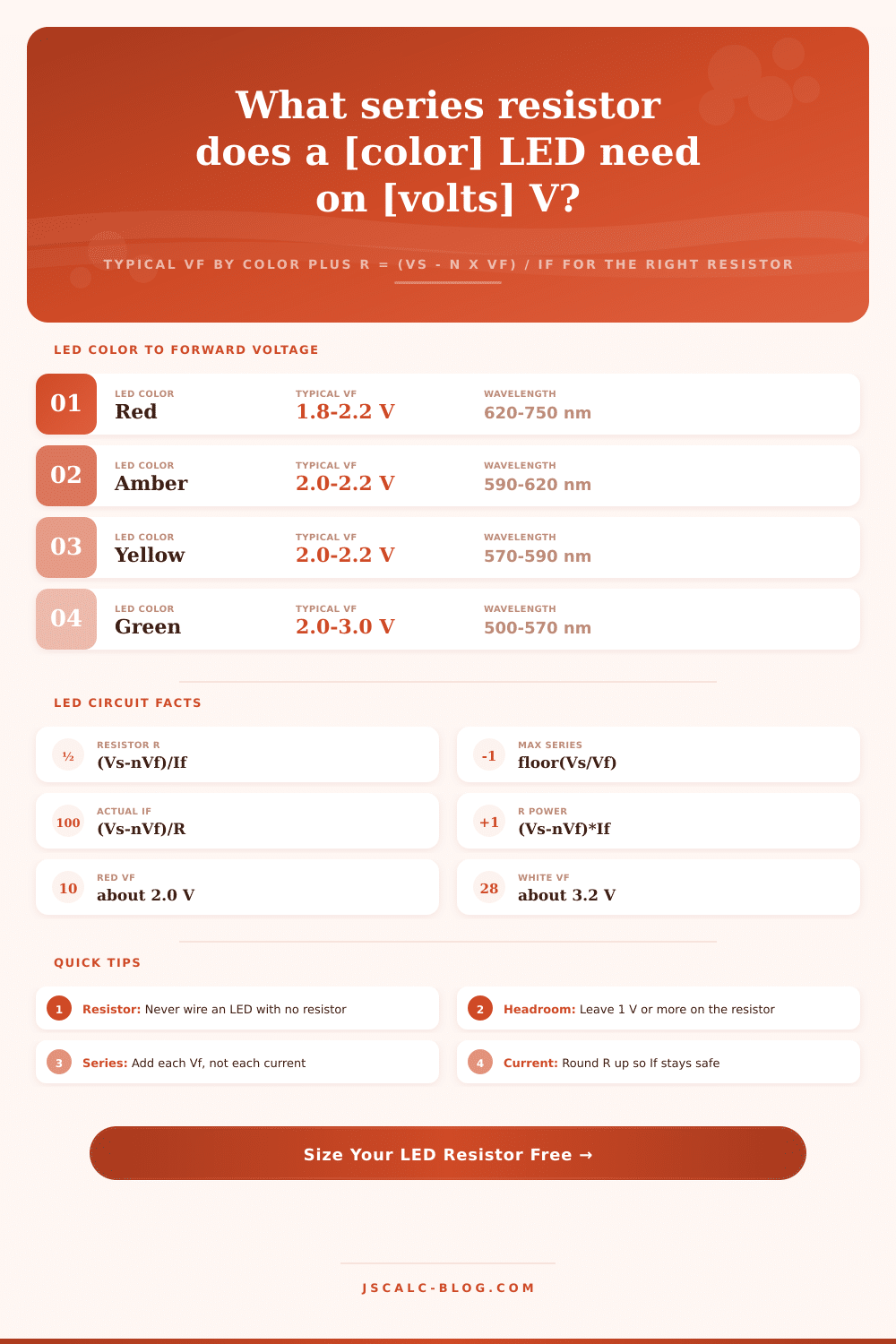
The tool simply loads a typical Vf based off your choice of color. Then it calculates the actual resistor size. The other side of the equation is called forward voltage. This is the voltage dropped by the diode while conducting in the forward direction. This largely depends on semiconductor material used to make the LED. That’s why color is such a good indicator here.
LEDs that are red (made with AlGaInP) range from 1.8 to 2.2 volts. Right after them come amber and yellow which is close to 2.0 to 2.2 volts. Standard green can be about 2.2 volts. And those pure green, blue, and white LEDs that are built on indium gallium nitride jump right up to 3.0 to 3.4 volts. At the low end are infrared emitters dropping about 1.2 to 1.6 volts. Ultraviolet LEDs have the largest drop, reaching as high as 4 volts.
These numbers are preloaded into the calculator so you can begin with a reasonable number. Then you can type in your actual datasheet number if available. This also means that current rise at Vf is very high, not what we want. If you take a red LED and plug it directly into a 5 volt power source, there’s no stopping current other than the intrinsic resistance of the LED. The current will spike way above the rated 20 milliamp rating, frying the junction.
One solution is a series resistor which can absorbs the excess voltage (supply minus LED drop). The remaining voltage across the resistor, divided by the value of the resistor, determines the current. With just one resistor, it turns something sensitive into something steady. This makes it the most critical part of the circuit.
Ohm’s law used with the leftover voltage gives us the resistor value. R = (Vs… N x Vf) / If Vs is the supply voltage, n is the number of LEDs in series, Vf is the forward voltage of one LED and If is the target current in amps. With a 5 volt supply, a single red LED at 2.0 volts running 20 milliamps requires an R of 150 ohms. Because current needs to be expressed in amps rather then milliamps, 20 milliamps gets converted to 0.02. The calculator does this conversion for you in the breakdown panel and it shows the substituted numbers too.
When you calculate the resistance you want it will never be exactly what you purchase. Resistors you purchase are a favorite series like E24 which has 24 options per decade: 100, 110, 120, 150, 180, 220 ohms. This online calculator intentionally rounds up to the next available E24 number. Rounding up increases the resistance a bit and reduces the current a bit. That keeps the LED under its spec by a comfortabley margin. Your desired 145 ohm resistor turns into the available 150 ohm resistor. A blue LED requiring 90 ohms ends up at the 91 ohm value in the E24 series. Every time you round-up you take the safer path.
The way to wire LEDs so they share a single current (and have their forward voltages added) is in series. If your LEDs are, say, 3.2 volts each, then three white LEDs in series will drop 9.6 volts. There will only be 2.4 volts for the resistor if your supply is 12 volts. The calculator tells us how many we can put in series; it’s the floor of Vs / Vf. With 3.2 volt LEDs on 12 volts that’s three. For practical purposes you’ll want fewer so there’s at least a volt of headroom for the resistor. Every LED gets the same current, which makes series wiring efficient. It requires a comfortable gap above the sum of the drops from the supply.
The question can go the other direction, too. You got a resistor in your drawer and you want to calculate what current it will deliver? Just rearrange the equation to get If = (Vs (n × Vf) / R). Plug in a 150 ohm resistor on 5 volts with a 2.0 volt red LED and you find that it will draw 20 milliamps. And there is that fourth result card on the calculator that does just that. It lets you check if the resistor is good for the job before you solder it in. Also calculates the remaining voltage times current to see how much power the resistor has to dissipate. It tells you if a common quarter watt part will do.
Four cards are filled with calculations. One provides the usual forward voltage for that color, as well as the cumulative drop across all LEDs in a string. Another card displays the needed series resistor and the closest E24 value to purchase. Third, it tells how many LEDs can be strung in series on your supply. Fourth, it reports what real current will flow through your selected resistor. A list of replaced numbers is shown below the cards.
A status line alerts you if you have insufficient supply to power the entire LED drop. It also alerts you if you have less than one volt of headroom over the resistor. These warnings trap common errors before they cause you to lose a part.
The presets apply to the circuits you make all the time. One example is a blue LED off of a 12 volt rail, or a 5 volt red 5mm indicator. There is a white LED on a 3.3 volt microcontroller pin. There are three green LEDs in series on 12 volts. And there’s a UV LED from a 3.7 volt lithium cell, and a 940 nanometer emitter operating at 5 volts, infrared. Each one fills in the form and recalculates immediately, giving you a starting point that you can tweak as needed.
This tool helps if you are working with an indicator array or a status panel. It takes the datasheet number and the supply voltage and within seconds spits out the precise resistor required. The light is steady, not a burnt junction.