Parallel Inductance Calculator
Add coils in parallel with 1/L total = 1/L1 + 1/L2 + ... + 1/Ln, use the product-over-sum shortcut for two inductors, drop to L/N for equal coils, and find the stored energy E = 0.5 L I squared. The parallel total is always smaller than the smallest inductor in the bank.
⚡Real Inductor Bank Presets
🔢Inductor Bank Inputs
Relabels every coil field and the energy output.
Extra coil fields appear or hide to match this count.
First coil in the parallel branch.
Second coil in the parallel branch.
Third coil, used when count is 3 or more.
Fourth coil, used when count is 4 or more.
Fifth coil, used when count is 5 or more.
Sixth coil, used when count is 6.
Total current for the stored energy E = 0.5 L I squared.
Controls rounding on every result card.
📈Formula Snapshot
📋Two Inductors in Parallel
| Inductor L1 | Inductor L2 | Product / Sum | L total |
|---|---|---|---|
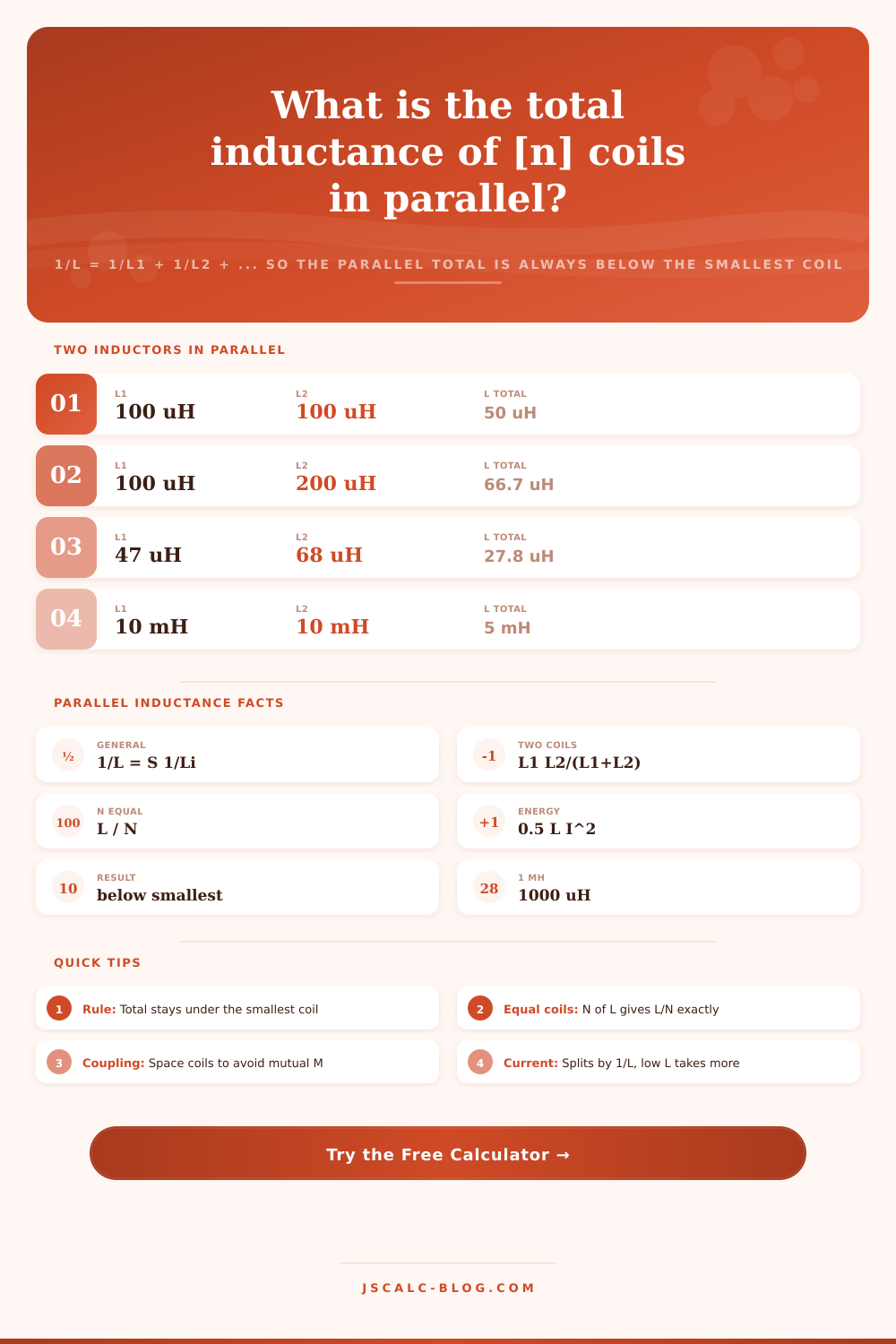
| 100 uH | 100 uH | 10000 / 200 | 50 uH |
| 100 uH | 200 uH | 20000 / 300 | 66.7 uH |
| 47 uH | 68 uH | 3196 / 115 | 27.8 uH |
| 220 uH | 330 uH | 72600 / 550 | 132 uH |
| 10 mH | 10 mH | 100 / 20 | 5 mH |
| 1 mH | 2 mH | 2 / 3 | 0.667 mH |
| 150 uH | 470 uH | 70500 / 620 | 114 uH |
| 1 H | 3 H | 3 / 4 | 0.75 H |
🔢N Equal Inductors Give L / N
| Each Coil L | Count N | Formula L / N | L total | Fraction of L |
|---|---|---|---|---|
| 100 uH | 2 | 100 / 2 | 50 uH | 0.500 |
| 100 uH | 3 | 100 / 3 | 33.3 uH | 0.333 |
| 100 uH | 4 | 100 / 4 | 25 uH | 0.250 |
| 10 mH | 4 | 10 / 4 | 2.5 mH | 0.250 |
| 33 uH | 3 | 33 / 3 | 11 uH | 0.333 |
| 22 uH | 5 | 22 / 5 | 4.4 uH | 0.200 |
| 1 mH | 6 | 1 / 6 | 0.167 mH | 0.167 |
📏Inductance Unit Conversions
| Unit | Symbol | Equals | In Henries |
|---|---|---|---|
| Henry | H | 1 H | 1 H |
| Millihenry | mH | 0.001 H | 1e-3 H |
| Microhenry | uH | 0.001 mH | 1e-6 H |
| Nanohenry | nH | 0.001 uH | 1e-9 H |
| 1 mH | mH | 1000 uH | 1e-3 H |
| 1 H | H | 1000 mH | 1 H |
🗃Parallel Inductor Bank Comparison Grid
| Bank Setup | Values | Smallest Coil | L total | vs Smallest | E at 2 A |
|---|---|---|---|---|---|
| Two equal | 100 + 100 uH | 100 uH | 50 uH | 50 percent | 100 uJ |
| Two unequal | 47 + 68 uH | 47 uH | 27.8 uH | 59 percent | 55.6 uJ |
| Three unequal | 47/68/100 uH | 47 uH | 21.5 uH | 46 percent | 43.0 uJ |
| Three equal | 33 uH x 3 | 33 uH | 11 uH | 33 percent | 22.0 uJ |
| Four equal | 10 mH x 4 | 10 mH | 2.5 mH | 25 percent | 5.00 mJ |
| Five equal | 22 uH x 5 | 22 uH | 4.4 uH | 20 percent | 8.80 uJ |
| Six equal | 1 mH x 6 | 1 mH | 167 uH | 17 percent | 333 uJ |
| Two chokes | 1 + 3 H | 1 H | 0.75 H | 75 percent | 1.50 J |
| Filter pair | 150 + 470 uH | 150 uH | 114 uH | 76 percent | 227 uJ |
| SMPS pair | 4.7 + 4.7 uH | 4.7 uH | 2.35 uH | 50 percent | 4.70 uJ |
⚙Formula Breakdown
💡Parallel Inductor Design Tips
One question that trips up nearly every power-supply or filter design: What single inductance does it behave like if coils are placed in parallel and share the same two nodes? Resistors seem intuitive; the parallel combination of branches is obvious. But inductors are different. Parallel inductor have a surprising result: The combined value will always be less than the smallest coil you began with.
This tool takes the actual formula and includes a handy trick for two coils. It simplifies to a nice division for equal ones. Then, it calculates how much magnetic energy the bank can store. Let the tool handle the math while you think if its an appropriate value for your circuit.
How Parallel Inductors Work
If all the inductor’s magnetic fields uncouple from one another, as they would if they were wired in parallel, then the total inductance is the inverse of the combined inverse of all the individual inductances: The inverse of the total is the sum of the inverses of the individual coils. This works just like parallel resistors and for the exact same physical reason. More paths means less opposition to a change in current, because each of those parallel paths provides another route for current.
Plug in three parallel-connected inductances of 47, 68, and 100 microhenries, and the calculator will tell you about 21.5 microhenries, which is nicely below the 47-microhenry smallest of the lot, just as we’d expect. The biggest take-away here is that you cannot ever make the combined inductance higher by putting a coil in parallel! Because you add reciprocals every new branch increases the total reciprocal. This lowers the final value because you are dividing by a larger number.
This is the opposite of series inductance, where values merely add and the total goes up. This calculator for parallels operates on the reciprocal angle and thus the answers trend downward, whereas your Series Inductance Calculator would just add ’em up and go the other direction. In practical terms, that means one low-valued inductor dominates a parallel bank. Stick a 10-microhenry coil in parallel with a 1000-microhenry coil, and they combine to about 9.9 microhenries. The little guy is path of least resistance to any change in current, and therefore gets its way.
There’s also a neater expression when you have just two inductances that doesn’t involve reciprocals at all. Multiply them together and divide by the sum; it’s mathematically the same as the general formula but easier to do in your head. Take 47 and 68 microhenries and multiply them: 47×68=3196, then divide by 47+68 or 115 for 27.8 microhenries. That is the same calculation the calculator performs because it automatically uses the product-over-sum formula whenever there are exactly two coils with values assigned to each.
Try it (you’ll see! For multiple coils), it reverts to the full-blown reciprocal sum, which handles even more than six coils with no trouble. In actual hardware, there’s always one special case: more than one coil in parallel that happens to be the same. If all those inductors has the same value (L), then the inverse sum reduces to N over L, and the total collapses down to L over N. Four 10 millihenry coils in parallel will yield 10/4, or precisely 2.5 millihenries. Five power coils with values of 22 microhenrys give you 4.4 microhenrys.
This trick is how designers divide up current between multiple smaller parts. This distributes heat and increases the overall current rating while reaching a predictable value of inductance. The calculator lists this as the L over N pattern for common counts in its reference tables, so you can pick a count and size your bank without firing up a spreadsheet.
If you know what the equivalent inductance is, it’s easy to calculate how much energy is stored in the total magnetic field because it’s based off a simple formula in terms of current squared. Once you have the output in henries (which the calculator will translate for you), the calculator will read your branch current and show the resulting energy in joules. With 2.5 millihenries and 2 amps through it, the stored energy is 5 millijoules. This is important for snubber and switching converter coils, which has to give up this stored energy on each cycle. The stored energy scales as the square of current: if double the current, then four times the stored energy.
The current field is typically most sensitive parameter in the whole calculation. Inductance values of real inductors vary across a huge range from several henries (on a power-line choke) down to just a few nanohenries (as a feature of a circuit board trace). This tool allows you to enter any coil in henries, millihenries or microhenries. The values are internally converted to henries and summed up. They are then reported in all three units.
The tool will also label each field clearly. So if you have a datasheet quoted in millihenries but you’ve written it down on your bench as microhenries, there’s no chance of slipping between units, because all three units will agree in that triple card. And that triple card does save you slipping between units, something that can happen even with experienced users. It is a little thing, but it is important.
Each run returns four result cards that show the total in your selected unit, its equivalent in millihenries, then henries and finally the stored energy. A breakdown panel shows the values you entered and the sum of their reciprocals. It also shows the inverse of the total and a shortcut version for when there are only two coils. Finally, it shows how the total compares as a percentage to the smallest coil.
The presets pre-load actual banks that engineers have built: two 100-microhenry coils in parallel, four equal 10-millihenry chokes, an unequal 47, 68 and 100-microhenry bank, and six 1-millihenry audio coils. When you select one, the form gets filled in for you and calculates on the fly, providing a working example to tinker with.
The second (reciprocal) formula assumes no mutual inductance between the windings. That changes when we get two inductors near enough together that they couple their fields. A mutual term adjusts the actual combined value upward or downward based on which winding has which polarity. Parallel inductors need a separation of one coil diameter or more, and mounting them at a right angle will have minimal coupling, both making the calculated result honest.
For best current-sharing balance (the lower value branch handles the most of the change), try to stay within a factor of three or four. Work through the worked examples, along with the comparison grid, where you can see how every selection moves the total. Then tweak the parameters until it matches the real coils on your bench. Total is never greater than the lowest coil, but knowing by how much makes the difference between a guess and a design.