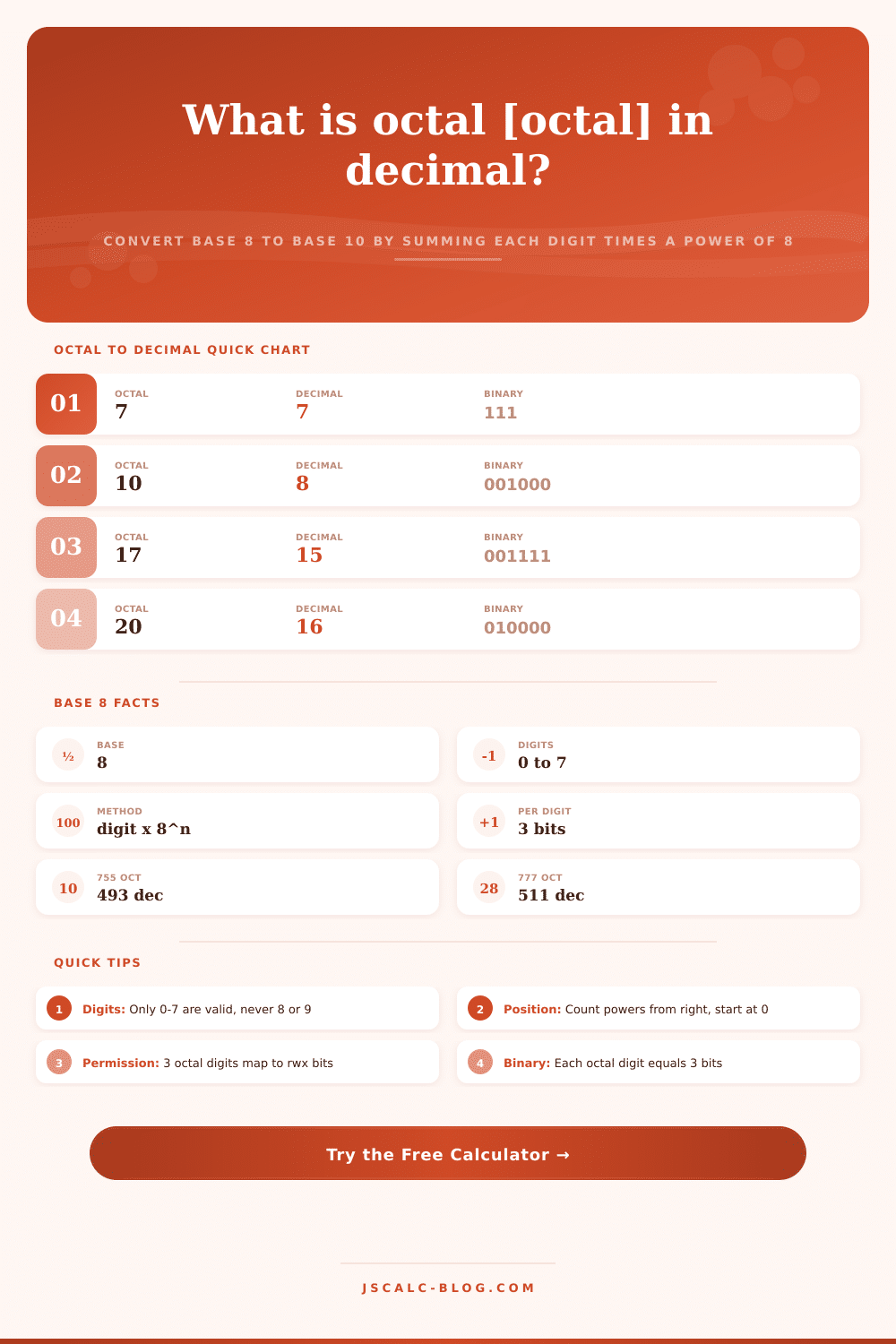
Octal to Decimal Calculator
Convert any octal (base 8) number into decimal by expanding each digit as digit × 8 raised to its position, counted from the right starting at zero. See the full step-by-step breakdown, plus binary, hexadecimal, and the classic Unix file-permission string for three-digit codes like 755.
🎯Real Octal Presets
🔢Octal Number Inputs
An optional 0o or 0 prefix is allowed and ignored. Example: 755, 0o755, or 0755.
Both compute the same value; this only orders the breakdown rows.
Controls the case of the hex result card, e.g. 1FB vs 1fb.
Each octal digit maps exactly to three binary bits, e.g. 7 becomes 111.
Turns 755 into rwxr-xr-x for owner, group, and other.
Displays each digit × 8^position line inside the breakdown panel.
📋Powers of 8 Snapshot
🔢Single Octal Digit to Decimal and Bits
| Octal Digit | Decimal | 3-Bit Binary | Permission Bits |
|---|---|---|---|
| 0 | 0 | 000 | --- |
| 1 | 1 | 001 | --x |
| 2 | 2 | 010 | -w- |
| 3 | 3 | 011 | -wx |
| 4 | 4 | 100 | r-- |
| 5 | 5 | 101 | r-x |
| 6 | 6 | 110 | rw- |
| 7 | 7 | 111 | rwx |
📊Place Value Weights in Base 8
| Position (from right) | Power | Weight (decimal) | Digit 7 Contributes |
|---|---|---|---|
| 0 | 8^0 | 1 | 7 |
| 1 | 8^1 | 8 | 56 |
| 2 | 8^2 | 64 | 448 |
| 3 | 8^3 | 512 | 3584 |
| 4 | 8^4 | 4096 | 28672 |
| 5 | 8^5 | 32768 | 229376 |
| 6 | 8^6 | 262144 | 1835008 |
🗃Octal Cross-Base Comparison Grid
| Octal | Decimal | Binary | Hex | Permission | Note |
|---|---|---|---|---|---|
| 7 | 7 | 111 | 7 | --- --- rwx | One digit |
| 10 | 8 | 001 000 | 8 | - | Base itself |
| 17 | 15 | 001 111 | F | - | Max nibble |
| 100 | 64 | 001 000 000 | 40 | --x --- --- | 8 squared |
| 600 | 384 | 110 000 000 | 180 | rw- --- --- | Owner rw |
| 644 | 420 | 110 100 100 | 1A4 | rw- r-- r-- | Default file |
| 700 | 448 | 111 000 000 | 1C0 | rwx --- --- | Private dir |
| 755 | 493 | 111 101 101 | 1ED | rwx r-x r-x | Exec script |
| 777 | 511 | 111 111 111 | 1FF | rwx rwx rwx | Wide open |
| 1000 | 512 | 001 000 000 000 | 200 | - | 8 cubed |
🔑Common Unix Permission Codes
| Octal Code | Decimal | rwx String | Typical Use |
|---|---|---|---|
| 400 | 256 | r-- --- --- | Read-only for owner |
| 600 | 384 | rw- --- --- | Private key or config |
| 644 | 420 | rw- r-- r-- | Standard shared file |
| 664 | 436 | rw- rw- r-- | Group-writable file |
| 700 | 448 | rwx --- --- | Private folder |
| 750 | 488 | rwx r-x --- | Group-readable dir |
| 755 | 493 | rwx r-x r-x | Scripts and web dirs |
| 775 | 509 | rwx rwx r-x | Shared project dir |
| 777 | 511 | rwx rwx rwx | Everyone, avoid it |
⚙Formula Breakdown
💡Octal Conversion Tips
Octal is decimal in disguise. Humans has ten fingers, which is why we do everything in base 10 every day, but computers think in sequence of ones and zeros, known as binary. In between is octal. It is a compressed shorthand used by computers. It makes long series of binary code easy for humans to read without losing any information in the conversion.
Once you plug your number into the calculator above, it do the math for you, no more guessing at conversions or coefficients. It converts a number from base 8 into friendly base 10 numbers. It displays all the steps along the way so that you can see how it got there and the final result never feels like a black box.
How Octal Works
Every positional system operate this way. Each column to the left of another is worth more. Columns are ones, tens, hundreds in decimal; ones, eights, sixty-fours in octal. Multiply the octal digit by eight to the power of its position number (that is, 8 raised to the power of that position). Start at position zero on the right and add up results.
For example, for octal 17: The 7 is in position zero on the right, which is worth 7 × 1. The 1 is in position one, which is 1 × 8. So 8 + 7 = 15 in decimal. It’s basic arithmetic. But the logic drive it all.
755 turns out to be one of more frequent octal numbers. When broken down by its power-of-8 meaning, it’s 7*64+5*8+5*1. In decimal that’s 493. It is not a random number at all. In fact it’s one of the most frequently encountered permission codes on Unix and Linux files. It is used for web directories and scripts.
It provides full read/write/execute permissions for owner, read and execute for the group, and the same thing for everyone else (the first digit). It packs four potentially useful interpretations into one octal number.
Why did octal survive on computer? Because eight is two to the third power. Each octal digit correspond directly to a block of exactly three binary bits. Digit 7 = 111. Digit 5 = 101. Digit 0 = 000. So every octal number can be re-written as a binary number simply by replacing each digit with its 3-bit block, without performing any arithmetic whatsoever. Just look at the ones and zeros, and you have your permission pattern. (It worked because early computers used word sizes that were multiples of three.)
That page explains it all. The reference table lay out how those digits map to the permissions. But you have to look beyond the numbers to understand what they mean. To do that we use the permission decoder. It view any three-digit number as a collection of flags for owner, group, and other categories. It turns each digit’s bits into read, write, and execute permissions. All ones (7) is all on. Read/write (6). Read/execute (5). This pattern continue.
That’s why 750 decodes to rwxr-x… -. It’s giving the owner everything but locking everybody else out. That’s the part people get wrong. They don’t understand the bits behind the numbers; they just memorize the numbers themselves.
Little things matter, including validation. By far the most frequent mistake is entering a nonexistent digit in base 8. (The symbols 8 and 9 aren’t valid; octal ends with 7.) When you enter them, the calculator will flag them right away. It doesn’t return an incorrect result. That’s one of those handy mental guardrails: any sane three-digit permission number can never be greater then 777, which is 511 in decimal. Any larger value for your file mode means something has gone wrong. Look again and accept with care.
Students taught about number systems sees a clear example of positional notation. For system administrators, it provides an at-a-glance decoder so they don’t have to second guess the number under a chmod command. If you’re taking an exam, then this is a self-checking scratchpad. The full working is shown. The expansion in powers-of-8, along with the hexadecimal and binary views, makes arithmetic a reliable reference that you can use within seconds. It brings alien digits back down to plain decimal sense.