Moon Phase Date Calculator
Pick any calendar date to see the real lunar phase, the Moon's age in days, its illumination percent, and the dates of the next new and full Moon, all from the standard synodic-cycle astronomy formula.
🌙Quick Date Presets
📝Date Inputs
Only used when time handling is set to specific time.
Example: -5 for US Eastern, +1 for Central Europe.
Flips the lit side shown in the phase symbol.
🔢Cycle Snapshot
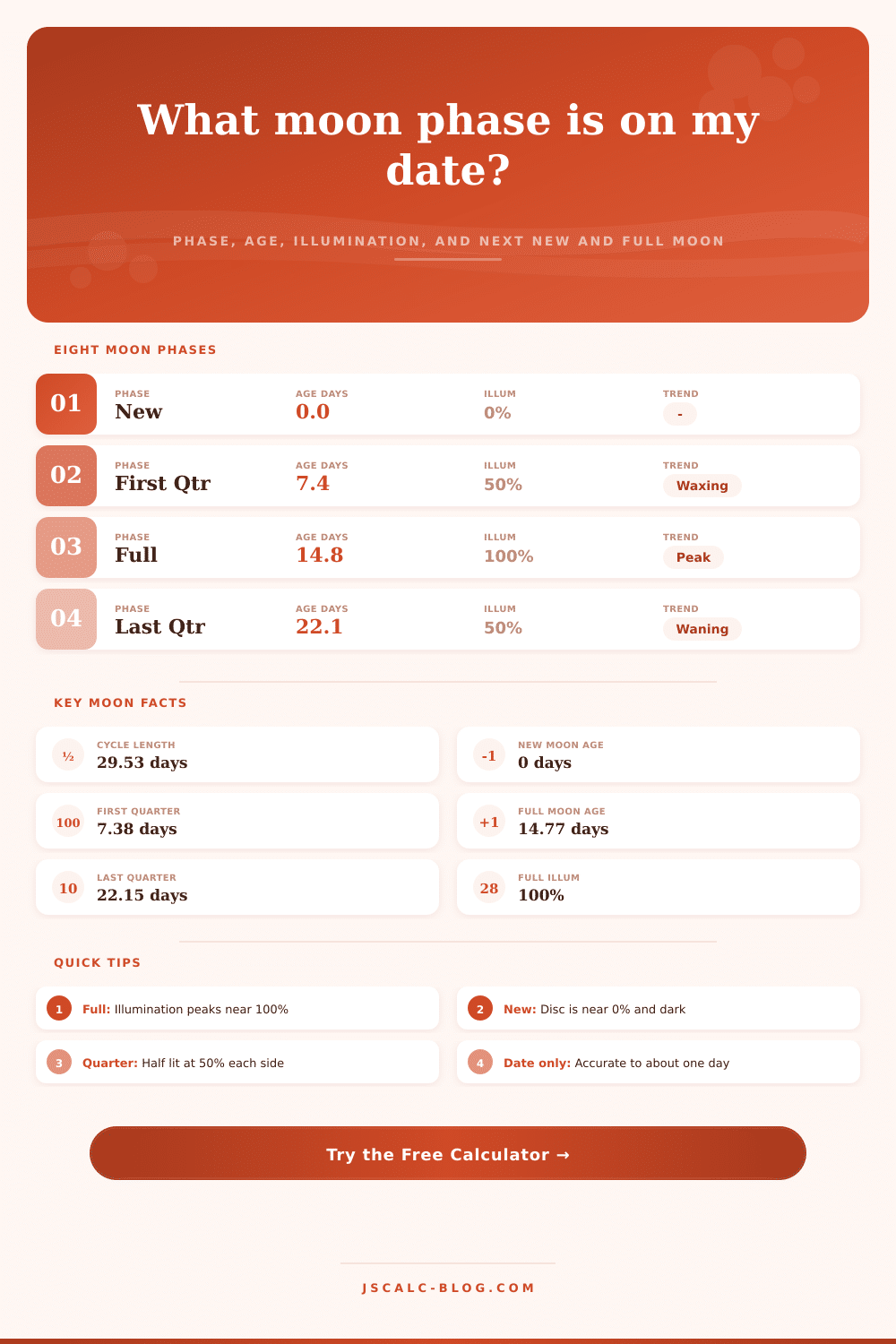
📊Eight Phases and Illumination
| Phase | Age Range (days) | Approx Illumination | Trend | Symbol |
|---|---|---|---|---|
| New Moon | 0.00 – 1.85 | 0% to 4% | Dark | 🌑 |
| Waxing Crescent | 1.85 – 5.54 | 4% to 35% | Growing | 🌒 |
| First Quarter | 5.54 – 9.23 | ~50% | Growing | 🌓 |
| Waxing Gibbous | 9.23 – 12.91 | 65% to 96% | Growing | 🌔 |
| Full Moon | 12.91 – 16.61 | 96% to 100% | Peak | 🌕 |
| Waning Gibbous | 16.61 – 20.30 | 96% to 65% | Shrinking | 🌖 |
| Last Quarter | 20.30 – 23.99 | ~50% | Shrinking | 🌗 |
| Waning Crescent | 23.99 – 29.53 | 35% to 0% | Shrinking | 🌘 |
🗓2025 Full Moon Dates
| Month | Full Moon (UTC) | Popular Name | Illumination |
|---|---|---|---|
| January | Jan 13, 2025 | Wolf Moon | ~100% |
| February | Feb 12, 2025 | Snow Moon | ~100% |
| March | Mar 14, 2025 | Worm Moon | ~100% |
| April | Apr 13, 2025 | Pink Moon | ~100% |
| May | May 12, 2025 | Flower Moon | ~100% |
| June | Jun 11, 2025 | Strawberry Moon | ~100% |
| July | Jul 10, 2025 | Buck Moon | ~100% |
| August | Aug 9, 2025 | Sturgeon Moon | ~100% |
| September | Sep 7, 2025 | Harvest Moon | ~100% |
| October | Oct 7, 2025 | Hunter's Moon | ~100% |
| November | Nov 5, 2025 | Beaver Moon | ~100% |
| December | Dec 4, 2025 | Cold Moon | ~100% |
🌑2025 New Moon Dates
| Month | New Moon (UTC) | Best For | Illumination |
|---|---|---|---|
| January | Jan 29, 2025 | Dark-sky viewing | ~0% |
| February | Feb 28, 2025 | Deep-sky imaging | ~0% |
| March | Mar 29, 2025 | Partial solar eclipse | ~0% |
| April | Apr 27, 2025 | Meteor watching | ~0% |
| May | May 27, 2025 | Faint object viewing | ~0% |
| June | Jun 25, 2025 | Milky Way season | ~0% |
| July | Jul 24, 2025 | Summer dark skies | ~0% |
| August | Aug 23, 2025 | Pre-Perseid dark | ~0% |
| September | Sep 21, 2025 | Partial solar eclipse | ~0% |
| October | Oct 21, 2025 | Orionids peak | ~0% |
| November | Nov 20, 2025 | Autumn dark skies | ~0% |
| December | Dec 20, 2025 | Geminids tail | ~0% |
🗂Date vs Phase Comparison Grid
| Date | Moon Phase | Age (days) | Illumination | Trend | Note |
|---|---|---|---|---|---|
| Jan 13, 2025 | Full Moon | 14.0 | ~99% | Peak | Wolf Moon |
| Jan 29, 2025 | New Moon | 0.4 | ~0% | Dark | Cycle start |
| Feb 14, 2025 | Waning Gibbous | 16.5 | ~96% | Shrinking | Valentine's Day |
| Jun 21, 2025 | Waxing Crescent | 25.4 | ~11% | Growing | Summer solstice |
| Jul 10, 2025 | Full Moon | 14.8 | ~100% | Peak | Buck Moon |
| Sep 7, 2025 | Full Moon | 14.7 | ~100% | Peak | Harvest Moon |
| Oct 31, 2025 | Waxing Gibbous | 10.0 | ~78% | Growing | Halloween |
| Dec 25, 2025 | Waxing Crescent | 5.2 | ~30% | Growing | Christmas Day |
⚙Full Formula Breakdown
📋Phase Meaning Reference
| Phase | What You See | Rises Around | Sky Use |
|---|---|---|---|
| New Moon | Invisible dark disc | Sunrise | Darkest skies |
| Waxing Crescent | Thin sliver in the west | Mid-morning | Early evening view |
| First Quarter | Right half lit (north) | Noon | Evening viewing |
| Waxing Gibbous | Most of disc lit | Afternoon | Bright evenings |
| Full Moon | Whole disc lit | Sunset | All-night, washes out stars |
| Waning Gibbous | Shrinking bright disc | After sunset | Late-night viewing |
| Last Quarter | Left half lit (north) | Midnight | Pre-dawn viewing |
| Waning Crescent | Thin sliver in the east | Before dawn | Early morning view |
💡Practical Moon Tips
The moon’s cycle doesn’t match your calendar. For centuries, we’ve let that change dictate our tides, farming schedule, and even ritual. While there are certain days that coincide with a moon phase, lunar pattern isn’t as linear as what you see on a digital clock. Without an assist, it’s hard to keep in mind which date corresponds to which phase.
When it comes to how space works, your brain isn’t built for remembering stuff like this. A calculator can takes away all that frustration by doing all the math for you, all you need to do is input the date and time, and it’ll spit out the answer for that very night.
Why You Need a Moon Phase Calculator
It base its calculation on what’s called the synodic month: the interval of time from one new moon to the next. On average, that’s twenty-nine point five days. It can fluctuate by several hours because the Moon doesn’t move in a perfect circle around Earth, but rather along an ellipse. Based off that average, the tool calculates how many days has elapsed since the previous new moon started.
“Age” sounds strange for a celestial object, I know, but it’s the best measure for tracking where a moon’s phase falls day-to-day. A new moon is zero days old, and you don’t see it at all because it’s hidden behind the glare of the sun. Then as the days pass, more and more of it gets illuminated until finally, about fourteen point eight days after new, you spot the brilliant disc. From then on, it dims again till once more you’re looking into darkness.
Knowing this age measurement will let you predict the level of skyglow when taking shots or out stargazing. The other output that tends to trip people up is illumination percentage. If you’re under a first quarter moon, for example, you may assume that’s going to equal 50 percent brightness (meaning half the Moon is illuminated). That’s not the case; it just says you are halfway through that orbit.
From an illumination standpoint, however, half of visible Moon is reflecting sunlight (as opposed to the dark side). For photographers, this distinction is important since they must make up for this amount when exposing their shots. The closer a waxing or waning moon gets to being full, more it resembles a full moon visually, but it’s much less well-lit. The calculator outputs the illumination percentage, which should of give you a good idea of how bright the nighttime sky will be beforehand.
The timing is more complicated: Because the Moon’s motion against the stars is swift, it changes its position roughly every dozen degrees per day. That means that a phase shift can occur at any hour. A new moon may cross time zones at such a pace that your friends in London and New York observe it on different days on the calendar.
To be more accurate, tool will let you enter both a time and an offset from your time zone. This avoids assuming the phase shift happened at midnight. Since the lunar transition doesn’t respect either our clock setting or our political borders, adjusting for your local meridian ensures that you’re seeing what they show you out of your window.
It is more than just curiosity. Gardeners sometimes look up moon-phase calendars, believing that roots grows in response to gravity and light and sap follows. Fishermen consult tide tables, based on both the position of the Sun and the Moon in relation to Earth, before heading out. Artists also seek out information about moon phases to set the nighttime light in their scenes.
Many of those practices border on folklore, but the astronomy is still sound stuff. If your timing is right, waxing or waning… You’ll know what to expect from nature, such as stronger nighttime light or water currents caused by tides.
It’s important to remember that these cycles are not new; they’re just obscured by moddern living. The Moon is one of the most visible indicators of time’s passage and many ancient societies structured their calendar around it. In fact, we know from our own language that our timekeeping relies on the Moon: the word month derives from moon. By checking its phase on Halloween or Valentine’s Day, you’re tapping into a thousand-year-old tradition of watching and recording.
The calculator brings you straight to information that used to take weeks to get via bare eye, and so ties you into the past. The Moon is always there and always changes, even though it never really changes. It illustrates how some rhythms in our lives are bigger than human ones. They have their own schedules, which do not bend to ours.
Knowing what phase the moon is in helps us understand what to expect when planning an outdoor activity, taking a long exposure photograph, or simply wondering what’s going on up above tonight. The tools will tell you how those changes manifest; the thing is looking up.