Leap Year Checker
Enter any year and check Gregorian leap-year status, Julian comparison, days in the year, Feb 29 validity, and the next or previous leap year.
Leap Year Result
| Year | Gregorian | Julian | Days | Feb 29 | Reason |
|---|
| Test Year | Gregorian Rule | Julian Rule | Agreement | Why It Matters |
|---|
| Century Year | Divisible by 4 | Divisible by 100 | Divisible by 400 | Gregorian Result |
|---|
| Output | Formula or Test | Calendar | Selected Year Value |
|---|
To determine if a year are a leap year, you don’t simply divide by four.
Not quite: all of the century years gets skipped (e.g., 1900 doesn’t count as a leap year even though it is divisible by four). That’s because calendar shifts by a day every few centuries, meaning seasons will stay in line with the sun’s year, which is ever-so-slightly shorter then our rough estimate of 365.25 days. Without this shift, the calendar would drift over time. The algorithm here account for that subtlety.
How to Find a Leap Year
And it untangles the difference between Julian and Gregorian calendars, so you can see specific rules at play. Today, the Gregorian calendar is used by most people around the globe. It was adopted in 1582 after centuries of accumulatted error had been allowed to build up on previous calendar, the Julian calendar.
The Julian calendar’s simplicity stemmed from its rule: if a year is divisible by four, it is a leap year. That formula did well for many century. But it overcompensated. A solar year is slightly shorter (about 365).2422 days long. That slight difference accumulate over centuries. To correct this, the Gregorian reformation included two additional clauses.
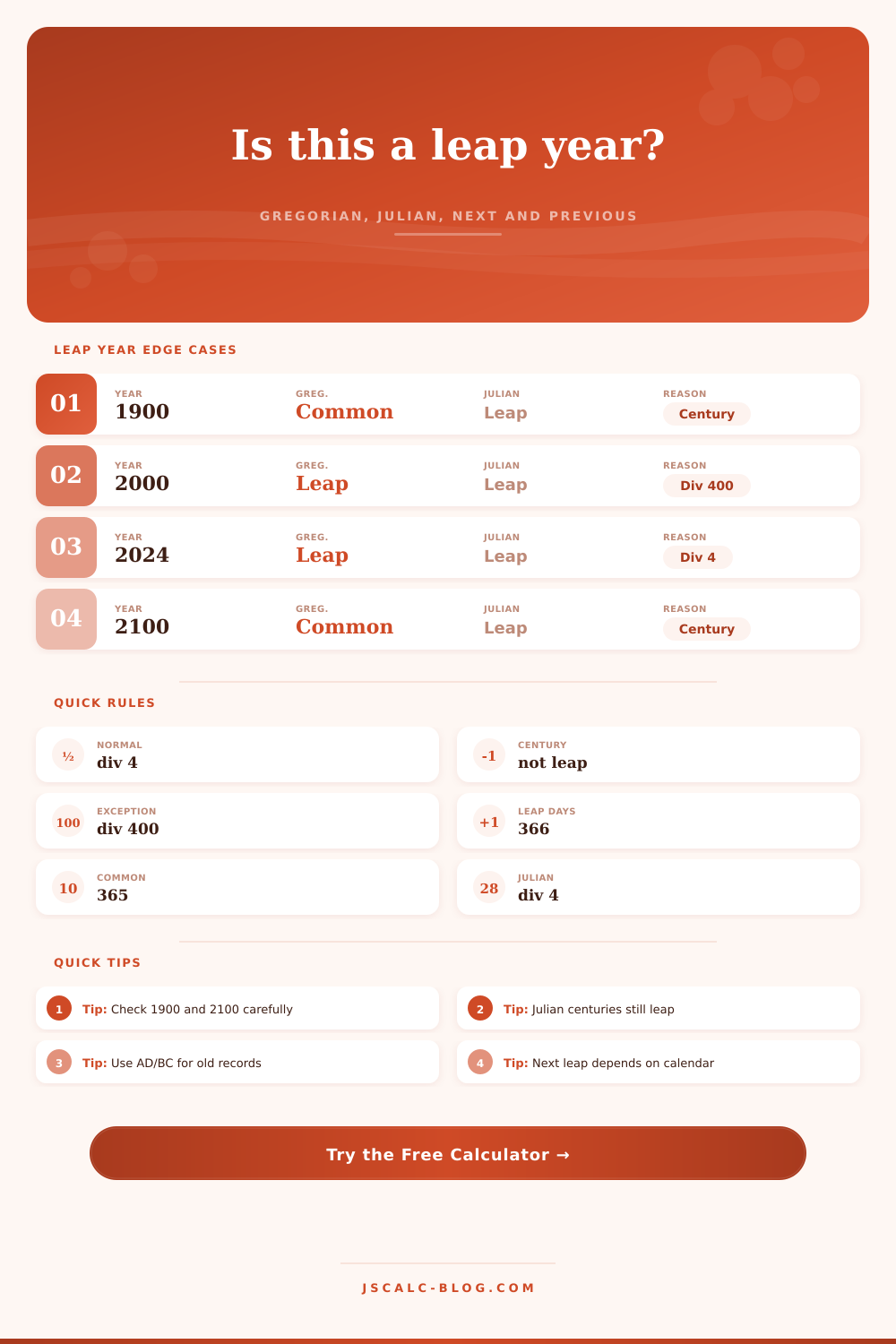
First, century years aren’t leap years unless they is divisible by 400. So 2000 was a leap year; 1900 wasn’t, nor will 2100 be. This means the calendar lose three leap days every four-hundred years, ensuring that the calendar stays accurate. It is a small adjustment, but it is significant for historians and astronomers.
Beyond just a yes/no answer it will tell you the underlying breakdown of that calculation when you input a year. Does this year divide by four? Does it divide by a century (hundred)? Does it divide by four hundred? That gives you some insight into how all those rules actualy work and what makes a given year tick.
You can also change the context to display both Gregorian and Julian results at once. This is handy if you’re working with historical texts prior to 1582, or for countries like Russia where they only adopted the Gregorian calendar in 1918. Since each place did there own thing, getting your dates wrong can offset an event by over ten days.
It’s also smart about dealing with BC dates. In astronomical year numbers, there is such a thing as year zero. This makes it easier for math to make sense. Historical years jump straight from 1 BC to 1 AD skipping over number zero. To deal with this, the calculator converts your BC values to their astronomical equivalent for the math and then shows results back to you as they would of appeared in that time period.
So not only will it tell you if February 29 is valid (which is nice for checking old documents or when programming), but if someone says February 29, 1900 on a document, you’ll know right away it must be a mistake or the person was using Julian calendar.
In addition to looking up a single year, it illustrates surrounding leap years as well. In fact, it will scan around from there forward or back and illustrate pattern. You see the rhythm of every four years broken by the century rule. And then it puts that into comparison table so you can see when they’re in sync and when they’re not.
When they aren’t in sync, we get confused as genealogists. Someone who was born on 1 November in 1752 in England has his/her birthday moved eleven days over because of the calendar switch. If that date were a leap year in one calendar but not the other, the day of the week for that birthday change too. Those are all examples of edge cases that this helps illustrate using presets rather than having to do the math yourself.
For example, choosing 1900 will show you a normal year (by Gregorian rules) but a leap year (by Julian rules). 2000 shows a leap year by both. This makes it easier to understand the reasoning behind it all side-by-side.
The cycle details explain what’s going on: why there’s a 400 year cycle and why that cycle repeat. Why does the calendar need to remain accurate for millennia? It’s not as simple as every fourth year we add a day. It’s about getting it right over time.
When you understand these rules, it becomes easier to trust the date you’re working with. Maybe you’re writing some software application, digging into your family history, or just wondering why there’s an extra day in February.
The calendar is a human creation meant to help us measure a natural cycle. Where numbers don’t divide cleanly, things get messy. Understanding the rules allows us to manage that mess.