How Many Hours Did I Work Calculator
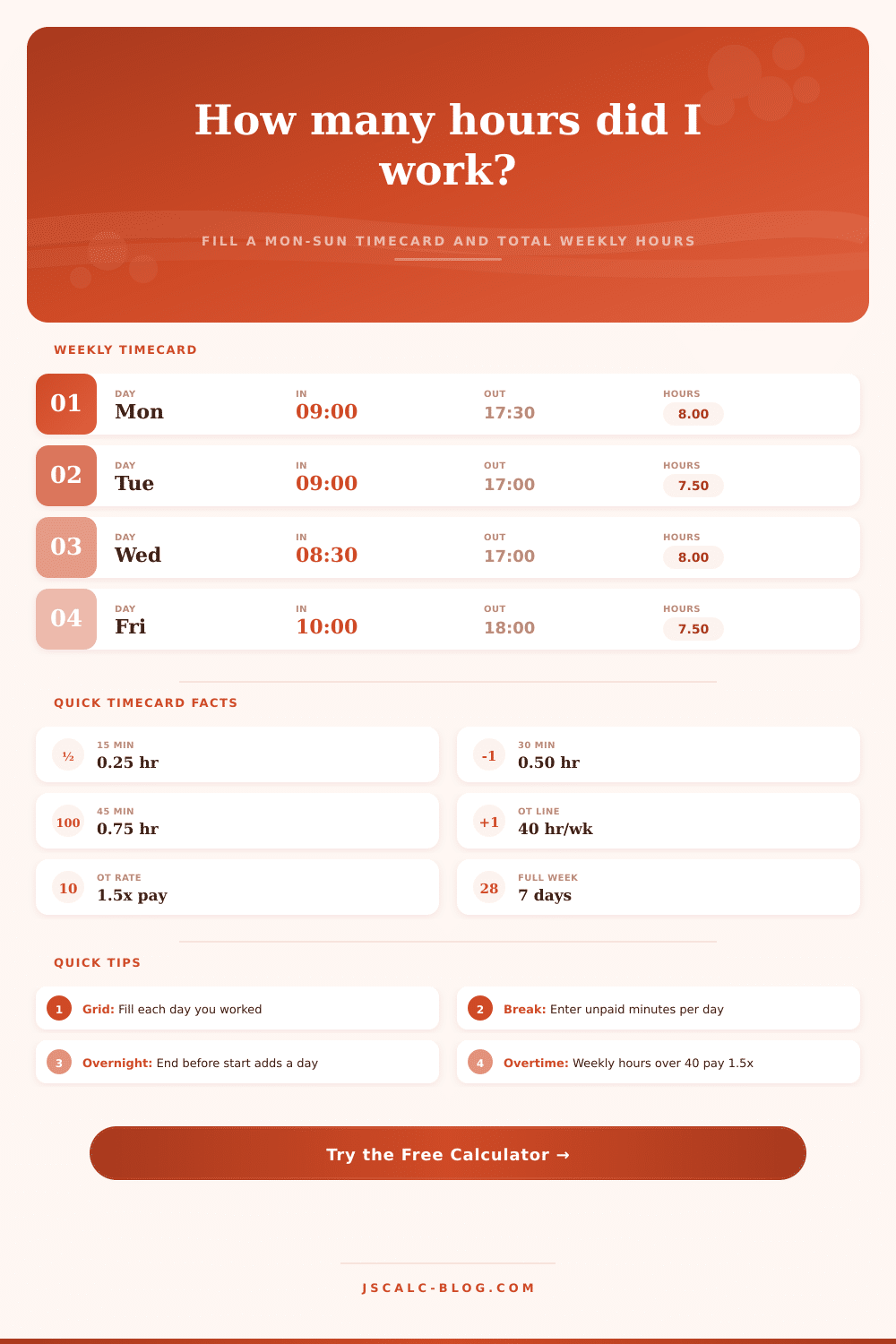
Fill in a Monday through Sunday timecard with clock in, clock out, and unpaid break minutes for each day. The tool totals your weekly hours, splits regular and overtime, and estimates gross pay.
🗓Quick Week Presets
🕑Weekly Timecard
| Day | Clock In | Clock Out | Break (min) | Hours |
|---|---|---|---|---|
| Monday | 0.00 | |||
| Tuesday | 0.00 | |||
| Wednesday | 0.00 | |||
| Thursday | 0.00 | |||
| Friday | 0.00 | |||
| Saturday | 0.00 | |||
| Sunday | 0.00 |
Leave a day blank if you did not work. If clock out is earlier than clock in, the day is treated as an overnight shift and 24 hours are added.
🔢This Week At A Glance
📊Per-Day Hours Summary
| Day | In | Out | Break | Paid Hours | Decimal |
|---|---|---|---|---|---|
| Enter your times above to build the per-day summary. | |||||
🕛Minutes To Decimal Hours
| Minutes | Decimal Hours | Minutes | Decimal Hours |
|---|---|---|---|
| 5 min | 0.08 hr | 35 min | 0.58 hr |
| 10 min | 0.17 hr | 40 min | 0.67 hr |
| 15 min | 0.25 hr | 45 min | 0.75 hr |
| 20 min | 0.33 hr | 50 min | 0.83 hr |
| 25 min | 0.42 hr | 55 min | 0.92 hr |
| 30 min | 0.50 hr | 60 min | 1.00 hr |
📅Weekly To Annual Reference
| Hours / Week | Hours / Month | Hours / Year | At $22/hr Year |
|---|---|---|---|
| 10 hr | 43 hr | 520 hr | $11,440 |
| 20 hr | 87 hr | 1,040 hr | $22,880 |
| 30 hr | 130 hr | 1,560 hr | $34,320 |
| 32 hr | 139 hr | 1,664 hr | $36,608 |
| 40 hr | 173 hr | 2,080 hr | $45,760 |
| 45 hr | 195 hr | 2,340 hr | $51,480 |
⚙Overtime Rules And Pay Comparison
| Weekly Hours | Regular | Overtime | Reg Pay $22 | OT Pay 1.5x | Gross |
|---|---|---|---|---|---|
| 35.00 hr | 35.00 hr | 0.00 hr | $770.00 | $0.00 | $770.00 |
| 40.00 hr | 40.00 hr | 0.00 hr | $880.00 | $0.00 | $880.00 |
| 42.50 hr | 40.00 hr | 2.50 hr | $880.00 | $82.50 | $962.50 |
| 45.00 hr | 40.00 hr | 5.00 hr | $880.00 | $165.00 | $1,045.00 |
| 48.00 hr | 40.00 hr | 8.00 hr | $880.00 | $264.00 | $1,144.00 |
| 50.00 hr | 40.00 hr | 10.00 hr | $880.00 | $330.00 | $1,210.00 |
| 55.00 hr | 40.00 hr | 15.00 hr | $880.00 | $495.00 | $1,375.00 |
| 60.00 hr | 40.00 hr | 20.00 hr | $880.00 | $660.00 | $1,540.00 |
📐Full Formula Breakdown
💡Timecard Tips
When you look at your timesheet and don’t recognize the number of hours, do you wonder what happened? How can there be so many hours on this sheet? Did I work late? Did I take a long lunch? Do I get paid for all my hours?
If you’re confused by how many hours you have on your timesheet, it’s important to know that how you track time impact whether you’ll get paid for each hour you’ve worked. And if you aren’t being paid for overtime, you want to make sure those overtime rules was followed correctly.
How to Check Your Timesheet and Get Paid Correctly
Many people forget to take their breaks. Taking a 15-minute coffee break might not seem like much but that’s an hour every week if you repeat it over and over again. If you don’t account for breaks, then you’re deducting an entire hour of every single week. Plug in your unpaid break minutes into the calculator so they’re kept separate from your paid time. This difference is minor, but it makes a big difference on how much money you earn each month.
The math can get tricky for overtime hours and that’s where arguments begin. Here is how it works in the United States: Overtime kicks in at 40 hours per week (not 8 hours per day). So if you’re working four days of ten hours each, then you’ve worked forty hours overall. That means no overtime for you. However, once you go over 40 hours, your fifth day would trigger overtime. Knowing this ahead of time will save you the frustration of seeing a low paycheck.
The tool takes out the guessing game, does that mean I’m crossing the line? It shows you how many regular and overtime hour you worked.
Another twist involves night shifts. Because it spans a midnight, the end time will frequently be less than the beginning time and manual arithmetic may produce negatives. To avoid that, it simply adds 24h to the sum if the end time is before the begin time. So it automatically assumes that’s an overnighter. There is no need for you to account for the date shift yourself, a plus in those early morning hours when you’re still groggy.
The rounding of practice impacts your payday too. Do they round up/down to the next 1/4 hour? Or do they round to exact minutes? If it’s the former and you lose some small amount everyday, at the end of a month you will miss out on some hours. There is tables on this page that help convert minutes to decimal hours so you can plug into their payroll system. Now you know that 35 minutes is equal to 0.58 hours. This lets you check what you entered. Then when you submit your timesheet you can double-check your math.
The system is always the same. They pay different amounts per hour, but formula is the same. Divide up your overtime and normal working hours. Then, multiply each group of numbers by your hourly base plus your overtime premium. Let’s say that you worked 50 hours this week. Ten of those were overtime, so they’ll pay you an additional 1.5x what you usually earn for that time. Over the course of a year, that adds up to a lot of money. That is enough to cover your rent and save some extra cash.
Self-advocating means keeping track of your time. It’s showing them with numbers which shows all the work you’re doing for them. A time clock that tracks by the minute, day or night helps keep it accurate. It will record every minute so you would of known exactly what is happening. It’s fair as it gets.