E96 Nearest Standard Resistor Calculator
Snap any target resistance to the closest value in the 96-value-per-decade E96 series with 1 percent tolerance, see the error percent above and below, check whether it lands inside the 1 percent band, and search two-resistor series and parallel combinations to hit awkward non-standard targets almost exactly.
🎯Real E96 Design Presets
🔌Target Resistance Inputs
The exact resistance your design needs, in the unit chosen at right.
Scale of the target; results are shown back in this unit.
Nearest minimizes error; up or down forces a direction for margins.
Combos pair two E96 parts to beat a single value on odd targets.
Sets the acceptable band checked against the target.
Wider spans find closer combos but use more varied parts.
Controls rounding shown on the result cards and breakdown.
Percent for everyday work, ppm for precision analog design.
🔢E96 Formula Snapshot
📋E96 Base Values by Decade Sample
| Base Value | x10 (ohm) | x100 (ohm) | x1k (kohm) | Reads As |
|---|---|---|---|---|
| 1.00 | 10.0 | 100 | 1.00k | Decade start |
| 1.21 | 12.1 | 121 | 1.21k | Common divider |
| 1.50 | 15.0 | 150 | 1.50k | LED series |
| 2.00 | 20.0 | 200 | 2.00k | Gain leg |
| 2.49 | 24.9 | 249 | 2.49k | Feedback |
| 4.99 | 49.9 | 499 | 4.99k | Half-scale ref |
| 6.04 | 60.4 | 604 | 6.04k | Bias divider |
| 8.06 | 80.6 | 806 | 8.06k | Filter leg |
| 9.76 | 97.6 | 976 | 9.76k | Decade end |
📊E96 vs E24 vs E12 Series
| Series | Values / Decade | Typical Tolerance | Step Ratio | Best Used For |
|---|---|---|---|---|
| E96 | 96 | 1% | ~2.3% | Precision analog, references |
| E48 | 48 | 2% | ~4.7% | Mid precision, some ADC |
| E24 | 24 | 5% | ~10% | General purpose, pull-ups |
| E12 | 12 | 10% | ~21% | Non-critical, LED, timing |
| E6 | 6 | 20% | ~47% | Coarse, decoupling scale |
🧮Single vs Two-Resistor Error Examples
| Target | Nearest E96 | Single Error | Two-Resistor Combo | Combo Error |
|---|---|---|---|---|
| 3.14k | 3.16k | 0.64% | 2.10k + 1.05k series | 0.32% |
| 12.34k | 12.4k | 0.49% | 10.0k + 2.32k series | 0.16% |
| 1.23k | 1.23k | 0.00% | 1.23k single is exact | 0.00% |
| 7.77k | 7.68k | 1.16% | 4.99k + 2.80k series | 0.39% |
| 2.718k | 2.74k | 0.81% | 1.62k + 1.10k series | 0.15% |
| 333Ω | 332Ω | 0.30% | 1.00k || 499Ω parallel | 0.08% |
📏1% Tolerance Band Reference
| E96 Value | Low (x0.99) | High (x1.01) | Band Width | Note |
|---|---|---|---|---|
| 1.00k | 990Ω | 1.01k | 20Ω | Gaps to 1.02k next |
| 4.99k | 4.94k | 5.04k | 99.8Ω | Popular half ref |
| 10.0k | 9.90k | 10.1k | 200Ω | Overlaps 9.76k high |
| 49.9k | 49.4k | 50.4k | 998Ω | ADC input scale |
| 100k | 99.0k | 101k | 2.00k | Common feedback |
| 1.00M | 990k | 1.01M | 20.0k | Bias, timing |
🗃Target to E96 Comparison Grid
| Target | Nearest E96 | Single Error | Best Combo | Combo Error | Note |
|---|---|---|---|---|---|
| 1.00k | 1.00k | 0.00% | Single is exact | 0.00% | On-grid |
| 3.14k | 3.16k | 0.64% | 2.10k + 1.05k | 0.32% | Pi divider |
| 4.99k | 4.99k | 0.00% | Single is exact | 0.00% | Half ref |
| 6.04k | 6.04k | 0.00% | Single is exact | 0.00% | Bias leg |
| 8.06k | 8.06k | 0.00% | Single is exact | 0.00% | Filter leg |
| 12.34k | 12.4k | 0.49% | 10.0k + 2.32k | 0.16% | Odd target |
| 2.49k | 2.49k | 0.00% | Single is exact | 0.00% | Gain leg |
| 49.9k | 49.9k | 0.00% | Single is exact | 0.00% | ADC scale |
| 7.77k | 7.68k | 1.16% | 4.99k + 2.80k | 0.39% | Combo wins |
| 1.23k | 1.23k | 0.00% | Single is exact | 0.00% | Sense leg |
⚙Formula Breakdown
💡Precision Selection Tips
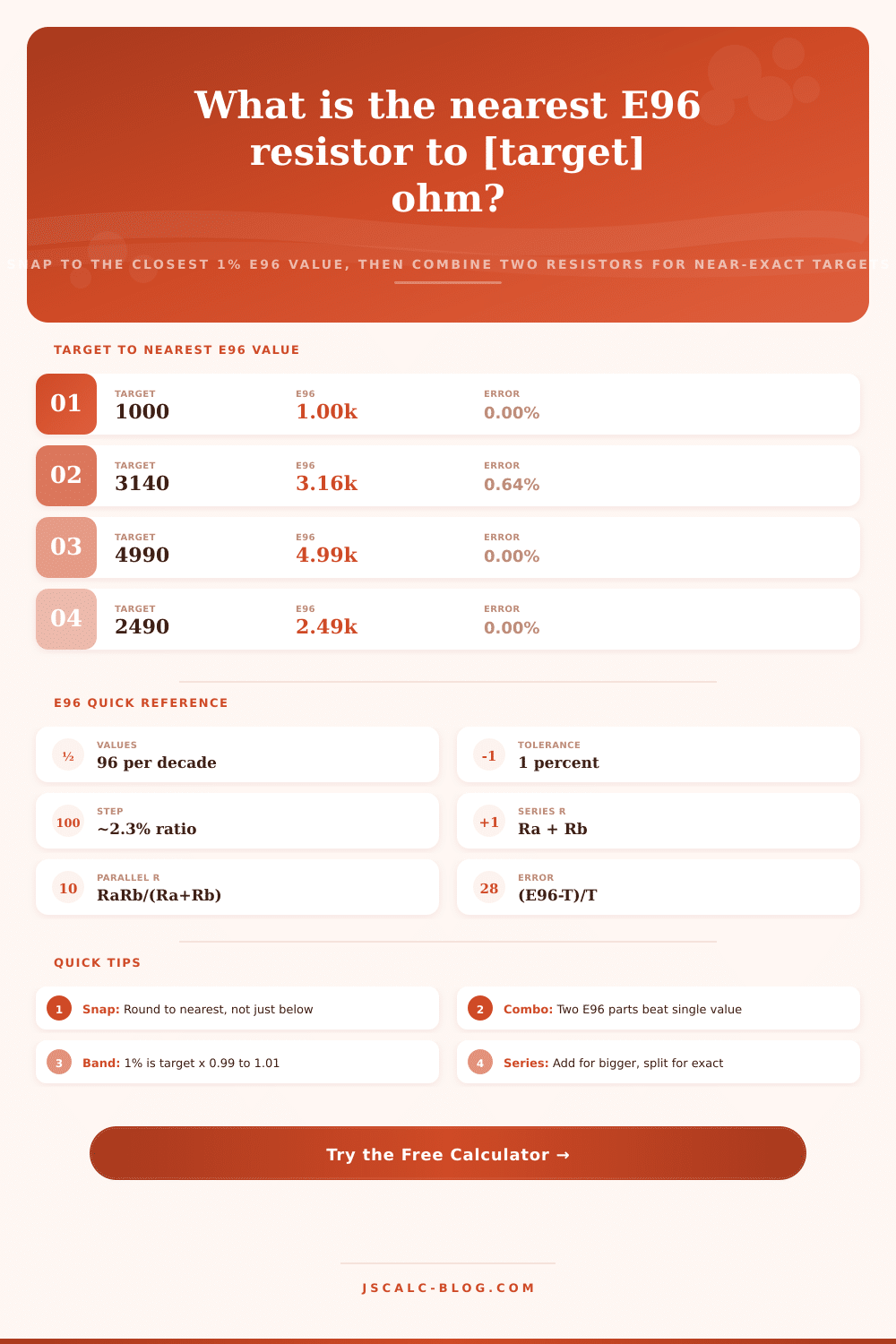
But engineers make trade-offs. They often try to match whatever parts are actualy available with whatever the theory says they need. In your schematic there may be three thousand one hundred forty ohm resistor needed. But instead, you might only find a value like three thousand one hundred sixty ohms in standard stock. So now what? That’s where the engineering decision come into play.
The E96 nearest standard resistor calculator on this page will help close that gap and show you which 1 percent component is the next best thing. What the error is in using that component. It even locates pairs of resistors if just one isn’t enough. This allows you to create an actual working assembly out of commonly available component.
How to Choose the Best Resistor
For precise analog applications, the go-to standard are the E96 series. According to the IEC 60063 standard, there is a set of preferred values for every decade of resistor. These cover only about two point three percent between them which happens to be close to one-percent tolerance resistors as well. By comparison, the E12 series are much coarser: just a dozen numbers that would be good enough for a timing circuit or an LED driver type use where absolute accuracy isn’t as important.
For things like gain settings on amplifiers, or voltage divider ratios, there’s not much wiggle room with the E96 series. That means less head-scratching and more time spent wondering if the tolerance fits your specs. (The calculator does all the math for you.)
Rounding alone isn’t enough to find the closest one. To make a proper comparison with parts at various sizes, you have to look at the decade structure too. So the calculator looks at the power of ten that you want (the size of the resistor) and scales the base set of E96 resistors appropriately. Next it looks for the lowest absolute difference from the number you want. It reports back the error as a signed percent.
This tells us whether the standard part has a higher or lower resistance than what we wanted. If the number is positive then the resistor will add additional resistance; if the number is negative then the resistor will subtract some resistance. That’s important when designing bias networks since moving voltage in either direction have a different effect on how transistors operate.
A final test provided by the calculator is a one-percent tolerance band check. Resistors are manufactured with a range called a spread; for example, an E96 resistor’s spread will usually be between 99% and 101% of its nominal value. The tool checks whether the normal value is within that margin compared to your desired value. Otherwise, even though it may be the correct nominal value, it could still fail when pushed to the limits of manufacturing variations. That eliminates very slight drifts which can mess up precise references down the line.
This will not always work with a single resistor. Here’s where the two-resistor combinations comes into play. Pairs in series will add resistors together, providing more precise adjustment upwards in value from a baseline standard part. And pairs in parallel will drop the total resistance down, which can be used for adjusting resistors slightly below the nearest standard part.
To do this, the tool searches across neighboring decades to find valid pairs, then looks through those all at once until it identifies the pair with the smallest error. So if we’re trying to get something close to twelve point three-four kilohms with an E96 part alone, maybe it’ll end up being almost half-a-percent off. If we use a series pair of a ten kilohm and a two point three-two kilohm, that drops the error more than a bit. Sometimes it provides as much precision as costly zero-point-one-percent resistors, but uses common stock instead.
The tradeoffs are easily demonstrated with a few clicks through other presets. A random input of, say, four point nine-nine kilohms will display zero error (that’s an exact E96 member). Zero error means we’ve entered something exactly in the E96 set. Changing the search mode from series to parallel, or to both at once (mixed), shows how each topology fits your layout constraints. Series combinations handle power well but take up more room. Parallel pairs save room but complicate impedance matching.
The physical properties makes the math applicable. Getting it right makes the whole thing better over time A lazy round-off in a gain stage might shift an amplifier response by more than the entire rest of the signal chain combined. So, getting the resistors precise is helpful. If you pick the closest standard resistor values and make sure the tolerances are within the expected ranges, there is no guesswork before you start soldering. Let the calculator do the math but know how/why the rounding affects the amplifier so that the circuit behaves as planned. Use the Target Value, then determine the best match. Follow the numbers to choose your components, knowing you aren’t sacrificing accuracy.