E24 Nearest Standard Resistor Calculator
Type any target resistance and this tool snaps it to the closest E24 standard value, the 24-value 5 percent series used across most through-hole and surface-mount parts. It reports the nearest value above and below, the percent error, the plus or minus 5 percent tolerance band, and an optional two-resistor series or parallel pair that lands even closer.
⚡Real Design Target Presets
🔍Resistor Target Inputs
The exact resistance your circuit math calls for.
Multiplier applied to the target value above.
Round up suits pull-ups; down suits current limits.
Combine two E24 parts to shrink the error.
Sets the low and high edges around each value.
Flag the match as pass or fail against this percent.
How the nearest values are labeled on the cards.
Precision of the reported percent error.
🔢E24 Formula Snapshot
📋Full E24 Values 1 Ω to 1 MΩ
| Base Digit | x1 (Ω) | x10 (Ω) | x100 (Ω) | x1k (kΩ) | x10k (kΩ) | x100k (kΩ) |
|---|---|---|---|---|---|---|
| 1.0 | 1.0 | 10 | 100 | 1.0k | 10k | 100k |
| 1.1 | 1.1 | 11 | 110 | 1.1k | 11k | 110k |
| 1.2 | 1.2 | 12 | 120 | 1.2k | 12k | 120k |
| 1.3 | 1.3 | 13 | 130 | 1.3k | 13k | 130k |
| 1.5 | 1.5 | 15 | 150 | 1.5k | 15k | 150k |
| 1.6 | 1.6 | 16 | 160 | 1.6k | 16k | 160k |
| 1.8 | 1.8 | 18 | 180 | 1.8k | 18k | 180k |
| 2.0 | 2.0 | 20 | 200 | 2.0k | 20k | 200k |
| 2.2 | 2.2 | 22 | 220 | 2.2k | 22k | 220k |
| 2.4 | 2.4 | 24 | 240 | 2.4k | 24k | 240k |
| 2.7 | 2.7 | 27 | 270 | 2.7k | 27k | 270k |
| 3.0 | 3.0 | 30 | 300 | 3.0k | 30k | 300k |
| 3.3 | 3.3 | 33 | 330 | 3.3k | 33k | 330k |
| 3.6 | 3.6 | 36 | 360 | 3.6k | 36k | 360k |
| 3.9 | 3.9 | 39 | 390 | 3.9k | 39k | 390k |
| 4.3 | 4.3 | 43 | 430 | 4.3k | 43k | 430k |
| 4.7 | 4.7 | 47 | 470 | 4.7k | 47k | 470k |
| 5.1 | 5.1 | 51 | 510 | 5.1k | 51k | 510k |
| 5.6 | 5.6 | 56 | 560 | 5.6k | 56k | 560k |
| 6.2 | 6.2 | 62 | 620 | 6.2k | 62k | 620k |
| 6.8 | 6.8 | 68 | 680 | 6.8k | 68k | 680k |
| 7.5 | 7.5 | 75 | 750 | 7.5k | 75k | 750k |
| 8.2 | 8.2 | 82 | 820 | 8.2k | 82k | 820k |
| 9.1 | 9.1 | 91 | 910 | 9.1k | 91k | 910k |
📊E24 vs E12 vs E96 Series
| Series | Values / Decade | Tolerance | Ratio Step | Typical Use |
|---|---|---|---|---|
| E6 | 6 | 20 percent | 1.47x | Coarse, legacy |
| E12 | 12 | 10 percent | 1.21x | Hobby, general |
| E24 | 24 | 5 percent | 1.10x | Most standard parts |
| E48 | 48 | 2 percent | 1.05x | Tighter designs |
| E96 | 96 | 1 percent | 1.024x | Precision analog |
| E192 | 192 | 0.5 percent | 1.012x | Metrology grade |
📏Nearest Value Error Examples
| Target | Below E24 | Above E24 | Nearest | Error |
|---|---|---|---|---|
| 5100 Ω | 5.1k | 5.6k | 5.1k | 0.0 percent |
| 2400 Ω | 2.4k | 2.7k | 2.4k | 0.0 percent |
| 6500 Ω | 6.2k | 6.8k | 6.2k | -4.6 percent |
| 7500 Ω | 7.5k | 8.2k | 7.5k | 0.0 percent |
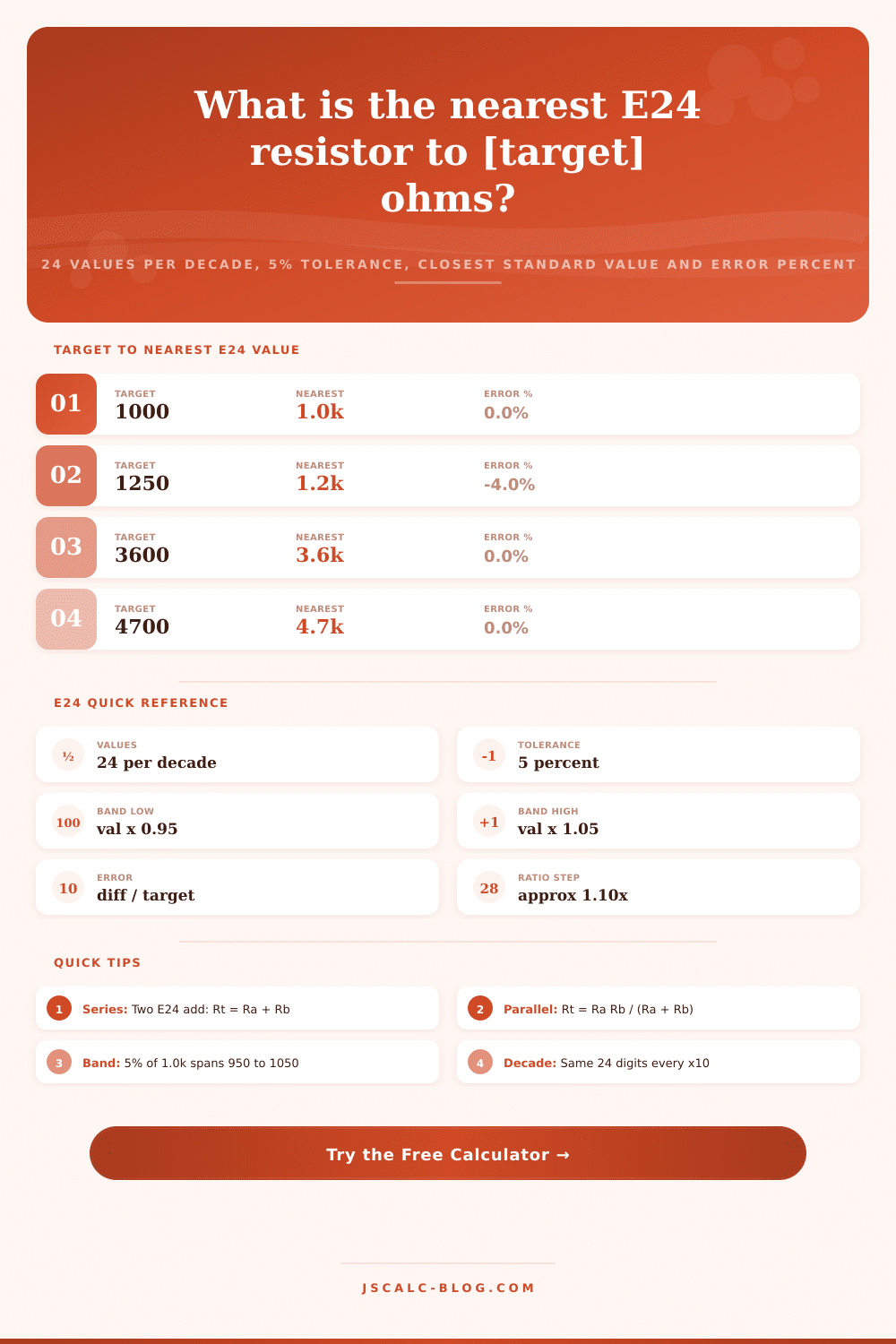
| 1250 Ω | 1.2k | 1.3k | 1.2k | -4.0 percent |
| 3400 Ω | 3.3k | 3.6k | 3.3k | -2.9 percent |
| 4500 Ω | 4.3k | 4.7k | 4.3k | -4.4 percent |
| 8800 Ω | 8.2k | 9.1k | 9.1k | 3.4 percent |
📐5 Percent Tolerance Band Explained
| E24 Value | Low (x0.95) | High (x1.05) | Band Width | Overlaps Next? |
|---|---|---|---|---|
| 1.0k | 950 Ω | 1050 Ω | 100 Ω | No, next is 1.1k |
| 1.1k | 1045 Ω | 1155 Ω | 110 Ω | Touches 1.0k high |
| 2.2k | 2090 Ω | 2310 Ω | 220 Ω | No gap to 2.4k |
| 4.7k | 4465 Ω | 4935 Ω | 470 Ω | Meets 5.1k low |
| 10k | 9500 Ω | 10500 Ω | 1000 Ω | No, next is 11k |
| 47k | 44650 Ω | 49350 Ω | 4700 Ω | Meets 51k low |
🗃Target to Nearest E24 Comparison Grid
| Target | Nearest E24 | Error % | Band Low | Band High | In Band? |
|---|---|---|---|---|---|
| 470 Ω | 470 Ω | 0.0% | 446.5 Ω | 493.5 Ω | Yes |
| 1.0k | 1.0k | 0.0% | 950 Ω | 1050 Ω | Yes |
| 1.3k | 1.3k | 0.0% | 1235 Ω | 1365 Ω | Yes |
| 2.4k | 2.4k | 0.0% | 2280 Ω | 2520 Ω | Yes |
| 3.6k | 3.6k | 0.0% | 3420 Ω | 3780 Ω | Yes |
| 5.1k | 5.1k | 0.0% | 4845 Ω | 5355 Ω | Yes |
| 6.5k | 6.2k | -4.6% | 5890 Ω | 6510 Ω | Yes |
| 7.5k | 7.5k | 0.0% | 7125 Ω | 7875 Ω | Yes |
| 9.1k | 9.1k | 0.0% | 8645 Ω | 9555 Ω | Yes |
| 43k | 43k | 0.0% | 40850 Ω | 45150 Ω | Yes |
⚙Formula Breakdown
💡E24 Selection Tips
On paper, circuit equations is precise. You work them out, and maybe end up with 7420 ohms for a voltage divider. You might also get 6500 ohms for a bias network. But then reality happen.
You cannot buy a 6500-ohm resistor off the shelf because manufacturers produce parts in fixed ladders called standard values. Most common is E24 series. For each decade it provide twenty-four different values with a five percent tolerance.
How to Find Standard Resistor Values
So this tool snaps your desired target onto the closest available part, computes the inherited error and identifies two-resistor combo if the individual component are not close enough. Numbers are spaced out by a constant ratio in E24 system. Tolerance bands fill in most of the gaps on the number line. Twenty four base numbers repeat at each power of ten. From 1.0 to 9.1, you’ve got all the digits and once you learn the order there, you know all the standard E24 resistors from fractions of an ohm through megohms and beyond.
The calculator does this automaticly across decades. To do that, it takes logarithm of whatever value you want. That tells it what decade is relevant. Then it runs up and down around that value and holds onto the closest value with least absolute difference. You can make it round up or down as well. LED current limiters gets rounded down because you don’t want to go past the max safe current. Pullup resistors typically get rounded up so they’re guaranteed to be high.
There’s always some amount of error in substituting a stock value. The calculator calculate this as distance from the nearest value to yours, all divided by that nearest value. So if you have a positive percent then your resistor is higher than desired. If it’s negative then it’s lower.
Resistor values come in a bunch of different steps. Roughly speaking, E24 step sizes are about ten percent apart. That’s why each individual part has around a 4.8 percent worst-case error. That occurs when your target value is halfway between the two closest available part values. For example, you want a 6500 ohm resistor. That’s between 6.2k and 6.8k. The best-fit single value is 6.2k, with a -4.6 percent error.
Common sense tell you that it’s good enough to go with the nearest possible value. In high-precision analog stuff, though, that change can push a bias point off-kilter or throw a timing circuit out of whack. The E24 resistor is a five percent part. That means it has a resistance anywhere between ninety-five to one hundred and five percent of what its mark says. The calculator tells you exactly which band that is. The band of a 1.0k resistor covers 950, 1050 ohms. Even if there is a small difference, the part is in spec as long as the resistance is within that range.
Why not more? With only twenty-four values per decade, the spacing allow each part’s tolerance window to nearly overlap with the next. There aren’t many resistances that dont fall within the range of some standard part. If you don’t have one that is close enough, chances are you can get it by using two. Series resistors simply adds. Parallel ones combine to a lower number than any single component. So it scans through all possible combinations of those common parts to locate closest match.
The missing 4.6 percent off that 6500 ohm resistor can be matched dead-on using a 300 ohm and a 6.2k in series. An expensive precision part is replaced by a couple pennies worth of resistors. And how does this work? Because you trade more components for precision to stay within what is in stock. It’s sort of like a ladder, the tool scans pairs of values from the ladder until the combination best matches your need.
E24 sits between coarser and finer series. E12 is common in hobby kits with a tolerance of ten percent. E96 is used for precision work with one percent and it packs ninety-six values. The fewer the values, the larger rounding error. With E12 you can be off by as much as ten percent. With E96 you can be off by about 1.2 percent.
For power and digital applications, five percent parts are good enough and they’re cheap so that’s what gets made all the time, E24. As tolerance gets tighter, the step size gets smaller. That reference table on the page demonstrates this.
Select any one of the presets such as 9.1k timing resistor or 5.1k reference resistor. Set the target for whatever your application requires. View the percentage error. Is it inside the tolerance band? Did you select the wrong standard value because the error was too large? Refer to the parallel or series pair recommendation.
This calculator pairs exact math with the entire ladder to change an ideal resistance to a buildable part number in seconds. Not after three rounds of tweaking, your prototype matches your design the very first time around.