E12 Nearest Standard Resistor Calculator
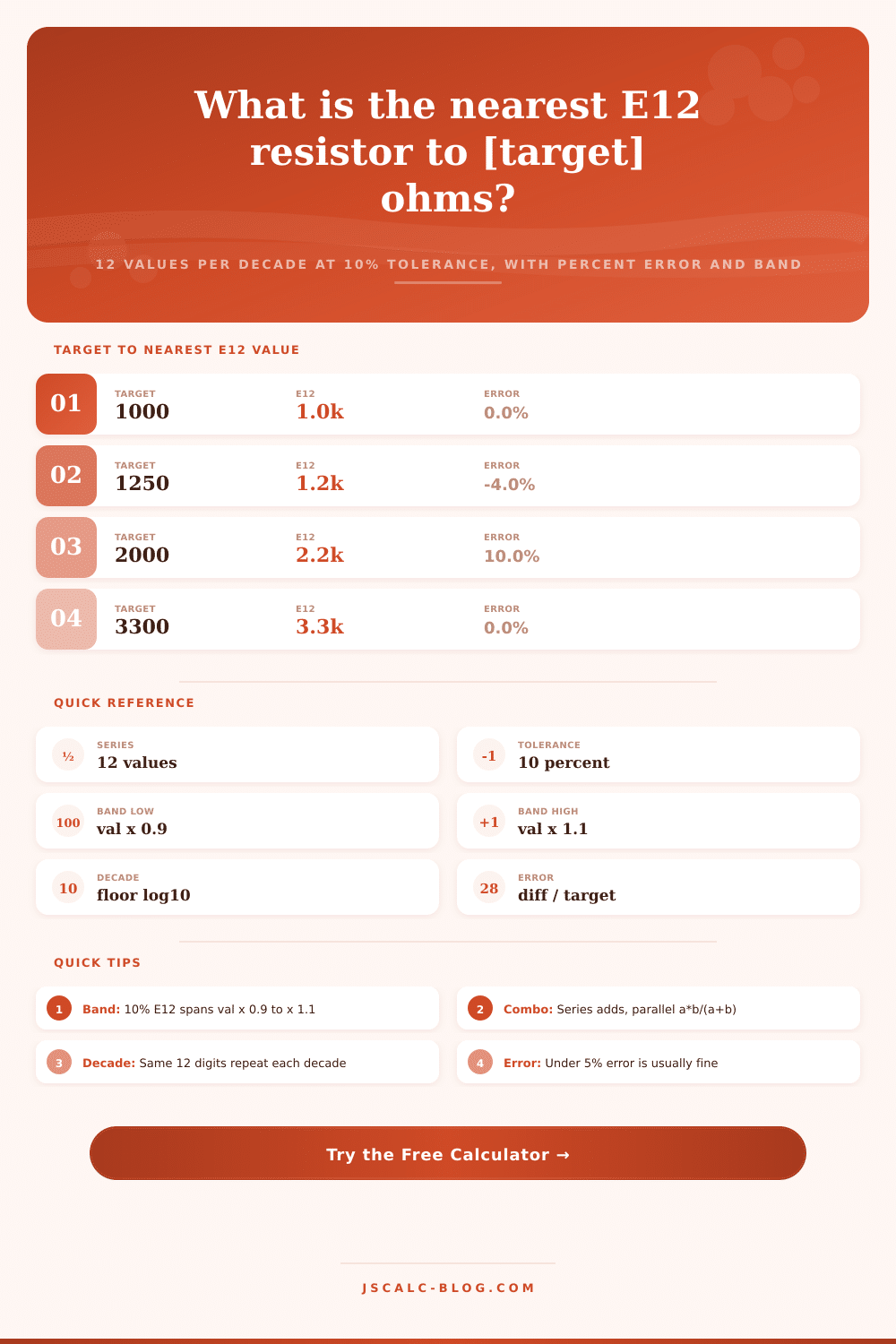
Enter any target resistance and this tool snaps it to the closest value in the E12 series, the 12-value-per-decade set used for 10 percent tolerance resistors. It reports the nearest E12 part, the nearest-above and nearest-below neighbours, the percent error, the full 10 percent tolerance band, and a two-resistor series or parallel combination that lands even closer.
🎯Common Target Presets
📝Target Resistance Inputs
The exact resistance your design calls for.
Unit for the target field above.
Rounding up suits pull-ups and current limits.
E12 parts are 10 percent; others are illustrative.
Finds two E12 parts that beat the single fit.
Controls error and band rounding.
Wider span finds closer pairs, more parts.
Volts across the part, used for a wattage hint.
🔢Formula Snapshot
📋Full E12 Values, 1 Ω to 1 MΩ
| Base | ×1 (Ω) | ×10 (Ω) | ×100 (Ω) | ×1k (kΩ) | ×10k (kΩ) | ×100k (kΩ) |
|---|---|---|---|---|---|---|
| 1.0 | 1.0 | 10 | 100 | 1.0k | 10k | 100k |
| 1.2 | 1.2 | 12 | 120 | 1.2k | 12k | 120k |
| 1.5 | 1.5 | 15 | 150 | 1.5k | 15k | 150k |
| 1.8 | 1.8 | 18 | 180 | 1.8k | 18k | 180k |
| 2.2 | 2.2 | 22 | 220 | 2.2k | 22k | 220k |
| 2.7 | 2.7 | 27 | 270 | 2.7k | 27k | 270k |
| 3.3 | 3.3 | 33 | 330 | 3.3k | 33k | 330k |
| 3.9 | 3.9 | 39 | 390 | 3.9k | 39k | 390k |
| 4.7 | 4.7 | 47 | 470 | 4.7k | 47k | 470k |
| 5.6 | 5.6 | 56 | 560 | 5.6k | 56k | 560k |
| 6.8 | 6.8 | 68 | 680 | 6.8k | 68k | 680k |
| 8.2 | 8.2 | 82 | 820 | 8.2k | 82k | 820k |
📊E12 vs E24 vs E96 Series
| Series | Values / Decade | Tolerance | Step Ratio | Typical Use |
|---|---|---|---|---|
| E6 | 6 | 20 percent | 1.47x | Rough, legacy parts |
| E12 | 12 | 10 percent | 1.21x | General hobby and jelly-bean |
| E24 | 24 | 5 percent | 1.10x | Standard 5 percent stock |
| E48 | 48 | 2 percent | 1.05x | Precision analog |
| E96 | 96 | 1 percent | 1.02x | Precision, dividers, filters |
| E192 | 192 | 0.5 percent | 1.012x | Metrology, references |
📏Nearest-Value Error Examples
| Target | Nearest E12 | Error | Nearest Above | Nearest Below |
|---|---|---|---|---|
| 1000 Ω | 1.0k | 0.0% | 1.2k | 820 |
| 1250 Ω | 1.2k | -4.0% | 1.5k | 1.2k |
| 2000 Ω | 2.2k | +10.0% | 2.2k | 1.8k |
| 2400 Ω | 2.2k | -8.3% | 2.7k | 2.2k |
| 5500 Ω | 5.6k | +1.8% | 5.6k | 4.7k |
| 8000 Ω | 8.2k | +2.5% | 8.2k | 6.8k |
| 10000 Ω | 10k | 0.0% | 12k | 8.2k |
| 75000 Ω | 68k | -9.3% | 82k | 68k |
📐Tolerance Band Explained
| E12 Value | Low (×0.9) | High (×1.1) | Band Width | Next E12 Up |
|---|---|---|---|---|
| 1.0k | 900 | 1.10k | 200 | 1.2k |
| 1.2k | 1.08k | 1.32k | 240 | 1.5k |
| 2.2k | 1.98k | 2.42k | 440 | 2.7k |
| 3.3k | 2.97k | 3.63k | 660 | 3.9k |
| 4.7k | 4.23k | 5.17k | 940 | 5.6k |
| 6.8k | 6.12k | 7.48k | 1.36k | 8.2k |
| 8.2k | 7.38k | 9.02k | 1.64k | 10k |
🗃Target to E12 Comparison Grid
| Target | Nearest E12 | Error % | Band Low | Band High | In Band? |
|---|---|---|---|---|---|
| 330 Ω | 330 | 0.0% | 297 | 363 | Yes |
| 470 Ω | 470 | 0.0% | 423 | 517 | Yes |
| 1.0k | 1.0k | 0.0% | 900 | 1.10k | Yes |
| 2.0k | 2.2k | +10.0% | 1.98k | 2.42k | Yes |
| 3.3k | 3.3k | 0.0% | 2.97k | 3.63k | Yes |
| 4.7k | 4.7k | 0.0% | 4.23k | 5.17k | Yes |
| 5.5k | 5.6k | +1.8% | 5.04k | 6.16k | Yes |
| 8.0k | 8.2k | +2.5% | 7.38k | 9.02k | Yes |
| 12k | 12k | 0.0% | 10.8k | 13.2k | Yes |
| 27k | 27k | 0.0% | 24.3k | 29.7k | Yes |
⚙Formula Breakdown
💡Selection Tips
Your math likely gives you a resistance that’s nearly but never exacty right. Reality is a bit messy; component shelves dont hold clean numbers like those in textbooks. That’s where E12 series comes in: it provides 12 standard values per decade, evenly spaced such that they accommodates parts with 10 percent tolerance.
There’s no need to commit these to memory. Simply know what value is close enough for your application and what level of error you’re willing to accept. This calculator finds the closest available value (snapping to the nearest) and computes how far off it is. If you fall short using a single resistor, the tool will recommend combining two. What was once a time-consuming lookup becomes an instant decision.
How to Use the E12 Resistor Calculator
Why those particular numbers? Why should you believe it? This standard is based off a geometric progression with a factor of approximately one-twelfth the square-root of ten between steps. In other words, they are evenly distributed based on their logarithm. This happens to be how most electronic components and humans perceive things.
Each mantissa is 1.0, 1.2, 1.5, 1.8, 2.2, 2.7, 3.3, 3.9, 4.7, 5.6, 6.8, and 8.2. They repeat across every power of ten. How do I know that’s not just random? Because the spacing isn’t random: it’s designed so that tolerance band for any given resistor slightly overlaps the tolerance band of the next. There’s never a gap into which an intended value might slip completely outside the target range. The slight overlap is the entire purpose of the standard.
This is the log table. To find the nearest value, you first have to know what decade it’s in (base-ten logs). If you need 5500 ohms, the calculator finds the appropriate table (E12) and reads across from there until it finds the closest match. Then, it calculates the percent error, so you can see how far off you’re going. The error will be positive (meaning your part is bigger than needed), or negative (smaller).
For 5500 ohms, the closest E12 value would of been 5.6k, resulting in an error of approximately 1.8 percent. Depending on your application, this may be perfectly fine for general use. But if you’re designing something sensitive, that difference may be unacceptable. That’s where the tolerance band comes into play. As a side note, each 10 percent resistor is actualy rated at between 90 percent and 110 percent of the stated value. So, for example, a 10k resistor may be as low as 9k or as high as 11k, all perfectly legitimate values. You’ll notice this band on the calculator; this lets you determine whether your desired value lands within the range. In other words, any randomly selected example of that resistor will (in theory) meet your requirements. Remember: resistors are specified with a nominal value but they’re real-world components, and there’s a spread of possible values. Designing based on the worst-case limits avoids nasty surprises when manufacturing things in volume.
Two resistors don’t get along? Try two! You add resistors together in series (directly) or reduce them via product-over-sum in parallel. The calculator finds those two closest to your goal without being a single E12 value itself. In fact, a series of 4.7k and 820 is 5.52k. That’s within 0.36 percent of our 5.5k goal, much closer then we’d be with a single 5.6k. Keep in mind that you’re still combining parts with 10 percent tolerance. That doesn’t magically make the whole thing have 10 percent tolerance; it only narrows down the nominal value. You’ll still have lots of range, but at least it will be around the right spot.
So what does all this mean? If you want timing networks where precision isn’t critical, or maybe limit the current through LEDs, or just want something that works well as a pull-up, E12’s got it covered: they’re plentiful, inexpensive, and will work just fine. On the other hand, precision voltage dividers or very sharp filter corners suffers from the wide spacing. For those applications, you’ll want to step up to one of the denser series, E24, or even E96, which have tighter tolerances and more values-per-decade.
The calculator bridges that gap. Simply enter your desired value (or select from one of the presets) and see how close you get. Then see how far off you are and decide whether to upgrade to a denser part or just slap on a partner resistor. This tool handles all of that math, including decade math, neighbor search, and error calculation. There is no struggle in selecting components. Just plug it in, scan the result, know the tradeoff, and get building. It doesn’t matter if it’s a hobby project where you need to size a resistor, or if you’re checking stock for a prototype build; sometimes knowing every digit by heart isn’t as good as getting the right number in a few seconds. There might not be exactly what you want, but there’s always something close enough to be practical.