Capacitor Energy Storage Calculator
Find the energy stored in a capacitor with E = 0.5 x C x V squared in joules, the stored charge Q = C x V in coulombs, and the equivalent in watt-hours. Switch to the usable-energy mode to see how much energy a capacitor delivers between an upper and lower voltage, and add a load power to estimate backup runtime.
⚡Real Capacitor Presets
🔌Capacitor Inputs
Single voltage gives total stored energy; the other gives deliverable energy.
Enter the rated capacitance value.
1 uF = 0.000001 F, 1 mF = 0.001 F.
Charged voltage, kept at or below the rated voltage.
Fully charged starting voltage.
Minimum voltage your circuit still works at.
Average draw of the load, for a runtime estimate.
Controls rounding on every result card.
🔢Formula Snapshot
📋Stored Energy for Common Capacitors
| Capacitance | At 12 V | At 25 V | At 50 V |
|---|---|---|---|
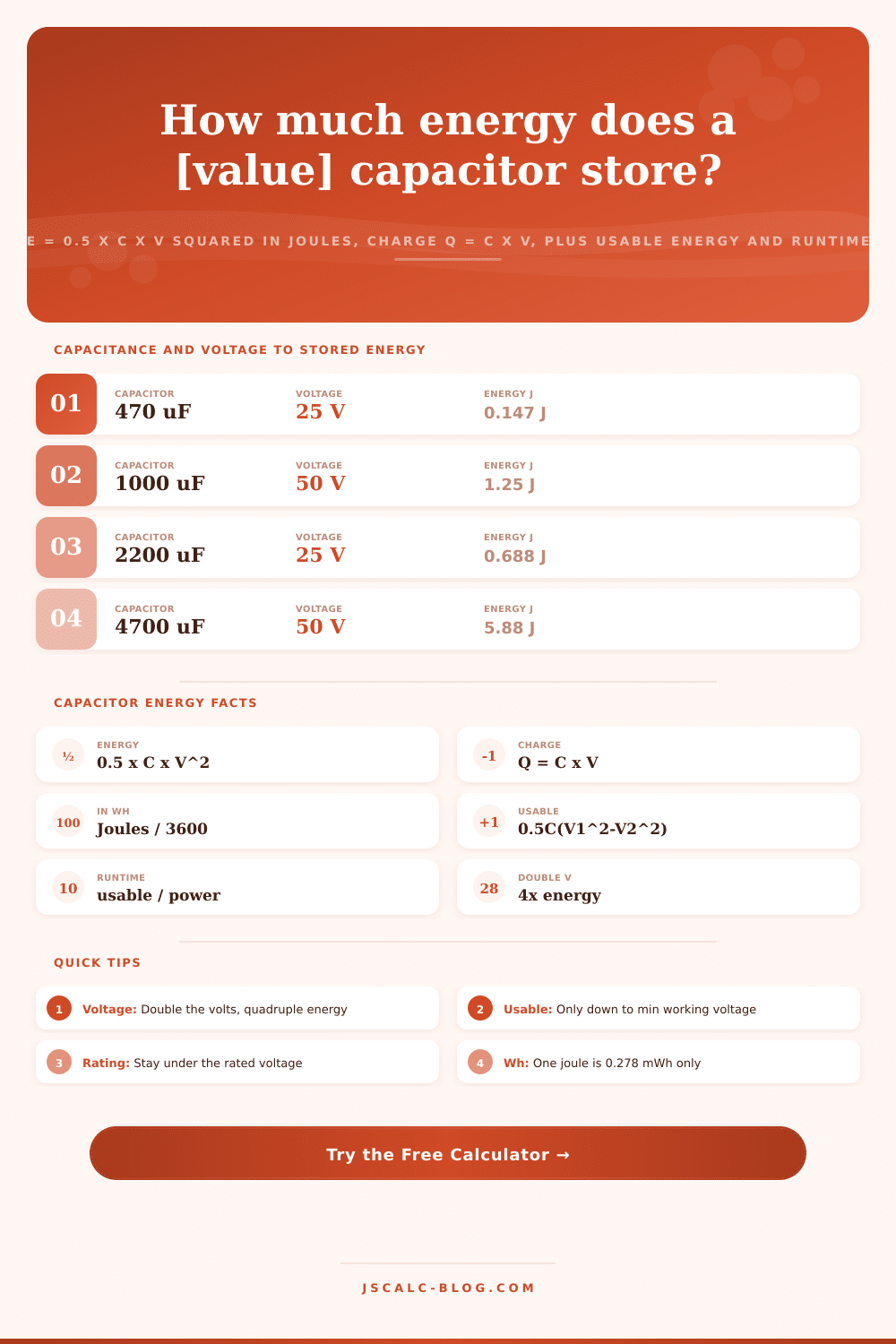
| 470 uF | 0.0338 J | 0.1469 J | 0.5875 J |
| 1000 uF | 0.0720 J | 0.3125 J | 1.2500 J |
| 2200 uF | 0.1584 J | 0.6875 J | 2.7500 J |
| 4700 uF | 0.3384 J | 1.4688 J | 5.8750 J |
| 6800 uF | 0.4896 J | 2.1250 J | 8.5000 J |
| 10000 uF | 0.7200 J | 3.1250 J | 12.500 J |
| 22000 uF | 1.5840 J | 6.8750 J | 27.500 J |
📊Joules to Watt-Hours Conversion
| Energy (Joules) | Watt-hours (Wh) | Milliwatt-hours (mWh) | Powers a 1 W Load |
|---|---|---|---|
| 0.5 J | 0.000139 Wh | 0.139 mWh | 0.5 s |
| 1 J | 0.000278 Wh | 0.278 mWh | 1 s |
| 5 J | 0.001389 Wh | 1.389 mWh | 5 s |
| 12.5 J | 0.003472 Wh | 3.472 mWh | 12.5 s |
| 18.23 J | 0.005063 Wh | 5.063 mWh | 18.2 s |
| 50 J | 0.013889 Wh | 13.89 mWh | 50 s |
| 64 J | 0.017778 Wh | 17.78 mWh | 64 s |
| 100 J | 0.027778 Wh | 27.78 mWh | 100 s |
🗃Charge and Energy Comparison Grid
| Capacitance | Voltage | Charge Q | Energy J | Energy Wh | Typical Use |
|---|---|---|---|---|---|
| 1 mF | 10 V | 0.0100 C | 0.0500 J | 1.39e-5 Wh | Rail decoupling |
| 10 mF | 25 V | 0.2500 C | 3.1250 J | 8.68e-4 Wh | Bulk smoothing |
| 0.1 F | 12 V | 1.2000 C | 7.2000 J | 2.00e-3 Wh | Ride-through |
| 1 F | 5 V | 5.0000 C | 12.500 J | 3.47e-3 Wh | MCU backup |
| 5 F | 2.7 V | 13.500 C | 18.225 J | 5.06e-3 Wh | Supercap store |
| 100 uF | 300 V | 0.0300 C | 4.5000 J | 1.25e-3 Wh | Camera flash |
| 10 mF | 50 V | 0.5000 C | 12.500 J | 3.47e-3 Wh | Amplifier rail |
| 32 uF | 2000 V | 0.0640 C | 64.000 J | 1.78e-2 Wh | Pulse discharge |
| 1000 uF | 400 V | 0.4000 C | 80.000 J | 2.22e-2 Wh | PSU hold-up |
| 470 uF | 330 V | 0.1551 C | 25.591 J | 7.11e-3 Wh | Photo flash |
⚙Formula Breakdown
💡Capacitor Energy Tips
What’s in there? What does this capacitor hold? Is it large enough to fire off a camera bulb or sustain your microcontroller through a power blip? It’s not simply a matter of capacity, whether you look at number written on label or the actual size of the component.
No, it’s also a matter of voltage: the volts across the plates of that capacitor. And voltage represents potential energy; voltage describes an electric field, and the field becomes stronger with each volt pumped into the system. Plugging in your variables to the calculator above spits out the math, but knowing why these things act the way they do makes all the difference when designing a circuit. You no longer guess; you engineer.
Why Voltage Matters for Capacitor Energy
That equation’s easy enough to draw on a napkin, E = 1/2*C*V^2. See that squared part? That’s what throws everyone off. People think if you double the capacitance, then you have twice as much energy. And sure, you do… until you remember that you doubled the voltage too, which makes it four times as much.
Five volts into a ten microfarad cap stores not much. Drop that exact same part down onto a twenty volt rail and all of a sudden you’ve got four times the punch. It’s all about the volts. Volts are the lever you pull to get more energy from less. Which is exactly why camera flashes operate at hundreds of volts instead of five. Density is the goal, and that’s why camera flashes runs at hundreds of volts rather then five.
The tool takes your inputs and turns them into joules, which is standard unit for this sort of thing. It also outputs in watt-hours so you can directly compare capacitors against batteries using units you’re already familiar with when making a power budget. Charge, however, is another animal altogether. According to the calculator, you have coulombs (Q = CV). But this is not how much energy there is.
If you had a big capacitor with a low voltage, it would have a great deal of charge, but not much energy. It is like a slow flowing wide river vs a narrow jet of fast-moving water. For pulsed power and run-time, you want energy. When you need to watch out for inrush limitations on your power supply or worry about current spikes, then you care about charge. Knowing the difference prevents you from sizing incorrectly later.
The thing about real circuits is they don’t discharge to zero volts; they keel over dead when the voltage drop below the level required by the chips involved. Which is why the usable energy is significant: it’s the amount of energy you get from your fully charged state down to the cutout point. For example, a one farad supercapacitor charged up to five volts contains twelve and a half joules of energy. But if your regulator quits at three volts, then you’ve got only eight joules of that. Anything less than that is wasted, sitting under the cutout point, locked away.
If you design for the number that sounds good (that headline number) you’ll get brownouts. If you design for the usable slice, you keep your system running. On the page there are some reference tables that explain how much energy is really available given common components, and in what conditions. From there comes runtime.
Divide your available energy by the amount of power your load requires. With a quarter-watt sensor drawing on ten joules of available energy, you get roughly forty seconds of running time. Sounds short…but sometimes that’s all you need to wait for a glitch to go away, or stash some data. The tool’s presets give real world examples, ranging from tiny coin cells used as backup memory through to larger electrolytic capacitors as an audio reservoir. There, you can see the tradeoffs between various kinds of capacitance and different voltage ranges. A higher voltage pulse capacitor holds more energy then a similarly sized bulk filter, for example.
Stick within the rated voltage. No exceptions. It is not advice or an option. Large electrolytic capacitors will either vent or fail electrically if you goes over this number. Charged components, especially at high voltages, are risky. Be careful and bleed them down first. The math is unforgiving but the safety rules won’t bend much for you. Run the calculator and figure out what your safe range of operation is. Then stay within it. If you get the numbers correct, the rest of the circuit holds up.