Battery Series Voltage Calculator
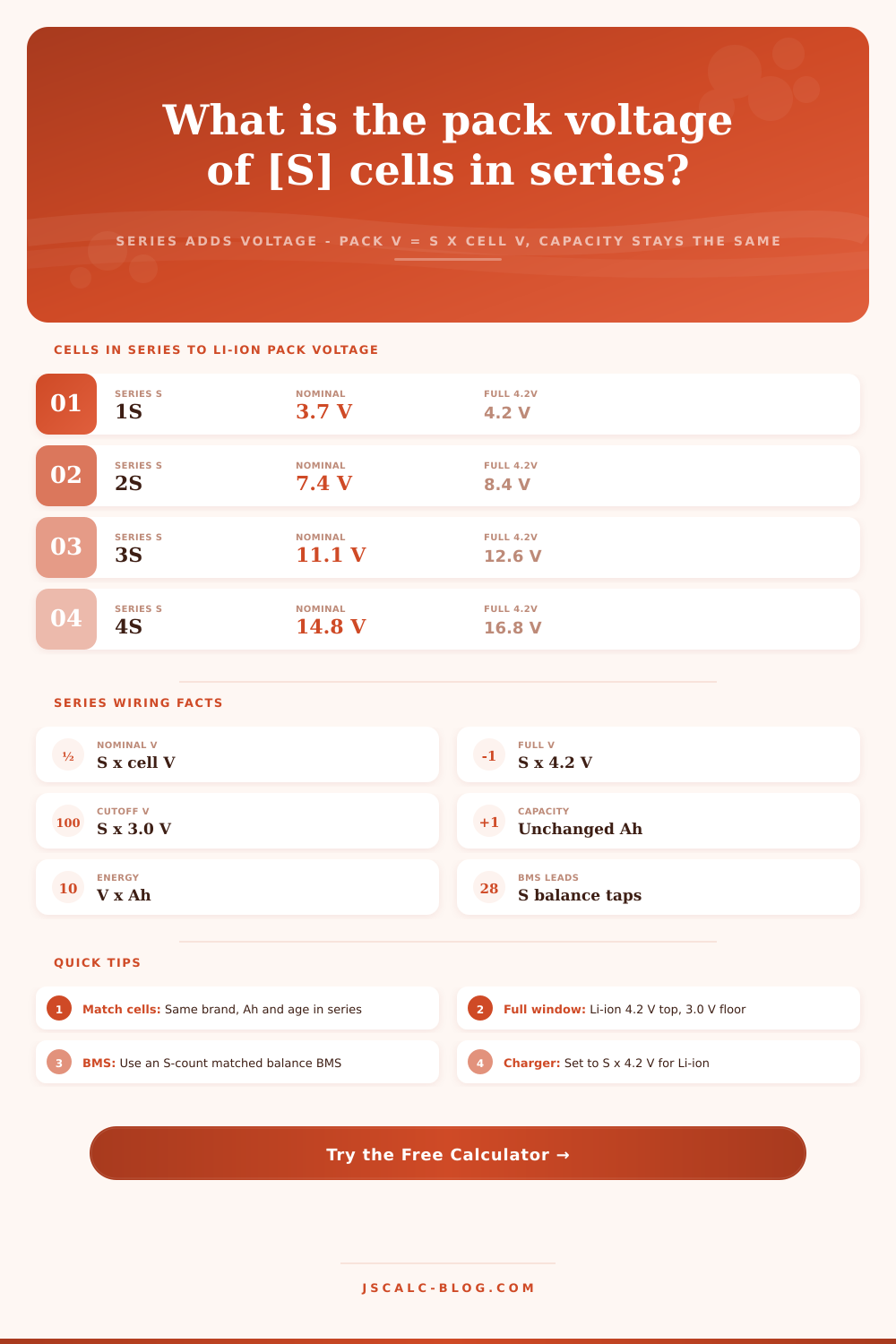
Wiring cells in series stacks their voltages while capacity in amp-hours stays the same. Enter the number of cells S and the cell chemistry to get the nominal pack voltage, the fully-charged and empty cutoff pack voltage window, and the total pack energy in watt-hours, plus the number of BMS balance leads you need.
🎯Real Series Pack Presets
🔌Series Wiring Inputs
How many cells are stacked positive-to-negative in one string.
Picks nominal, full and cutoff cell voltages. Choose Custom to type your own.
Average resting voltage of one cell, used for nominal pack voltage.
Top-of-charge voltage per cell, for example 4.2 V for Li-ion.
Low-voltage cutoff per cell where the BMS should stop discharge.
Amp-hours of a single cell. In series the pack keeps this same Ah.
🔢Series Formula Snapshot
⚡Li-ion Series Voltage Ladder
| Series | Nominal 3.7V | Full 4.2V | Empty 3.0V | Common Name |
|---|---|---|---|---|
| 3S | 11.1 V | 12.6 V | 9.0 V | 3S LiPo pack |
| 4S | 14.8 V | 16.8 V | 12.0 V | 4S RC / power |
| 6S | 22.2 V | 25.2 V | 18.0 V | 6S drone pack |
| 7S | 25.9 V | 29.4 V | 21.0 V | 24V nominal |
| 10S | 37.0 V | 42.0 V | 30.0 V | 36V tool / ebike |
| 13S | 48.1 V | 54.6 V | 39.0 V | 48V ebike |
| 14S | 51.8 V | 58.8 V | 42.0 V | 52V scooter |
| 20S | 74.0 V | 84.0 V | 60.0 V | 72V ebike |
🔋Cell Chemistry Voltage Reference
| Chemistry | Nominal / Cell | Full / Cell | Cutoff / Cell |
|---|---|---|---|
| Li-ion NMC | 3.7 V | 4.2 V | 3.0 V |
| Li-ion (high V) | 3.7 V | 4.35 V | 3.0 V |
| LiFePO4 | 3.2 V | 3.65 V | 2.5 V |
| LTO titanate | 2.4 V | 2.8 V | 1.8 V |
| NiMH | 1.2 V | 1.45 V | 1.0 V |
| NiCd | 1.2 V | 1.45 V | 1.0 V |
| Lead-acid cell | 2.0 V | 2.4 V | 1.75 V |
📋LiFePO4 Series Voltage Ladder
| Series | Nominal 3.2V | Full 3.65V | Empty 2.5V |
|---|---|---|---|
| 4S | 12.8 V | 14.6 V | 10.0 V |
| 8S | 25.6 V | 29.2 V | 20.0 V |
| 12S | 38.4 V | 43.8 V | 30.0 V |
| 15S | 48.0 V | 54.75 V | 37.5 V |
| 16S | 51.2 V | 58.4 V | 40.0 V |
| 24S | 76.8 V | 87.6 V | 60.0 V |
🖥Pack Energy by Series and Capacity
| Series | Nominal V | Cell Ah | Pack Ah | Energy Wh | Balance Leads |
|---|---|---|---|---|---|
| 3S Li-ion | 11.1 V | 2.5 Ah | 2.5 Ah | 27.8 Wh | 3 |
| 4S LiFePO4 | 12.8 V | 100 Ah | 100 Ah | 1280 Wh | 4 |
| 6S Li-ion | 22.2 V | 5.0 Ah | 5.0 Ah | 111 Wh | 6 |
| 10S Li-ion | 37.0 V | 4.0 Ah | 4.0 Ah | 148 Wh | 10 |
| 13S Li-ion | 48.1 V | 14 Ah | 14 Ah | 673 Wh | 13 |
| 14S Li-ion | 51.8 V | 20 Ah | 20 Ah | 1036 Wh | 14 |
| 16S LiFePO4 | 51.2 V | 280 Ah | 280 Ah | 14336 Wh | 16 |
| 96S Li-ion | 355 V | 75 Ah | 75 Ah | 26640 Wh | 96 |
⚙Formula Breakdown
💡Series Wiring Safety Tips
The usual method for constructing a higher-voltage pack with battery cells are to wire them in series. That’s when you connect the positive terminal of one cell to the negative terminal of the next. Each cell adds its voltage; each cell remains just one cell, though so the amp-hour capacity remain unchanged. This calculator inputs the cell chemistry and the number of cells which returns the nominal pack voltage.
It will also compute the total energy in watt-hours, the amount of charge left on the pack before it shuts off (fully-charged) and when it won’t accept more (empty), and how many balance lead you’ll require. It does the math for you so no more trying to remember lots of conversion factors.
How to Connect Battery Cells in Series
That’s the secret: Each cell serves as its own little pump forcing charge around the circuit. Pumps placed one behind the other simply combine there pressures with each additional pump. Therefore, the total voltage equal the total of the individual ones. Because they’re pumping the same amount of charge, the capacity equals the capacity of a single cell. That’s the essence of series wiring. Capacity doesn’t change; voltage does.
If you put three cells into series, you go from a 3.7 volt Li-ion cell to a 11.1 volt pack. Same amp-hours. Understanding that the amp-hour number will not move is the trick. There are three voltages to consider with every series pack. There is more than one.
First there is the nominal or average resting value used in labeling. For example, there is a 48 volt battery. Nominal voltage is the cell count times the cell voltage at rest. Next there is the full-charge voltage; this is the maximum on the voltage scale which is what you need your charger set to. This is Cell Count X 4.2 volts for Li-ion.
Finally, there is the cut-off voltage. This is when your management system need to shut down to prevent damaging the cells. This is generally 3.0 volts/cell for standard lithium. Confusion arises in those starting out in pack building because they mix up these three values. There is a reason it works, but if you don’t understand the difference between full charge and nominal you’ll cook your equipment.
Choosing the correct preset makes a difference because each chemistry has a different nominal voltage. Li-ion NMC is nominally 3.7 volts, whereas LiFePO4 is 3.2 volts. So, the sixteen cell LiFePO4 pack comes out to roughly 51.2 volts and therefore matches nice to the 48-volt system.
If you’re using NiMH cells instead, they’re only 1.2 volts apiece; therefore it takes ten to create a twelve-volt nominal battery pack. In contrast, standard lead-acid batteries uses six 2.0 volt cells stacked in series within the same battery case, resulting in there more familiar rating. When your cells don’t match the usual ones, the calculator will allow you to enter your own precise values from an individual data sheet. All those differences are taken care of as they happen by the calculator above, saving you from having to look up the wrong number yourself.
What about constructing your own forty-eight-volt ebike battery out of three-point-five amp-hour Li-ion cells? You pick thirteen cells wired in series. That’s why they’re called forty-eight-volt packs, even though there nominal voltage is forty-eight point one volts. And that’s exactly what the charger matches, fully charged, the string hits fifty-four point six volts.
When discharged to the floor, the voltage drop to thirty-nine volts as the management system shuts things down. Because the cells are in series, capacity remains constant at three point five amp-hours. This gives you a pack energy of around one hundred and sixty-eight watt-hours which is the limit airlines set for shipping.
It requires a balance connector to the pack that has a separate connection (tap) for each cell. Thirteen cells makes a thirteen-cell balance connector. Parallel does the opposite of series: parallel ties cells side by side so the voltage is that of one cell but the amp-hours adds together. Series stacks cells to raise voltage and leaves capacity alone.
Real packs most often have both, typically written as a string like 13S4P, which means 13 groups (S) in series with 4 cells (P) paralleled in each group. For sizing the voltage of such a pack you only look at the series number. The capacity would be separate and equal to the single-cell amp-hours times the number of cells in parallel.
All the cells carry the same current. A series string is only as strong as the weakest link. In a pack of thirteen cells, for instance, a single weak cell will reach cut-off voltage before the other twelve. The whole pack will shut down even though the remaining cells are not fully depleted. A battery management system is a must, and that means balance leads are non negotiable.
Matched cells make for the longest life; build from the same brand, the same age. Small things matters. Get the full design snapshot by letting the tool start with a preset, adjust the count, then go.
Voltage adds up, but only when you stay within the limits.