Battery Parallel Capacity Calculator
Wire identical cells or packs in parallel to stack capacity and current. Enter the number in parallel and one cell's specs to get total amp-hours, energy in watt-hours, the combined maximum continuous current, and runtime at your load. Nominal voltage stays the same as a single cell because parallel adds capacity, not voltage.
🎯Real Parallel Pack Presets
🔋Parallel Pack Inputs
How many identical units are joined positive-to-positive.
Rated capacity printed on one single cell or pack.
18650 cells are usually mAh; large banks use Ah.
Unchanged in parallel; the pack keeps this voltage.
The safe discharge rating for one cell alone.
Average current the device or inverter draws.
Fraction of capacity you actually use for runtime.
Controls rounding on every result card.
🔢Parallel Formula Snapshot
📊Capacity Stacking 3.4Ah 18650 Cell
| Config | Cells | Total Capacity | Energy at 3.7V |
|---|---|---|---|
| 1P | 1 | 3.4 Ah | 12.6 Wh |
| 2P | 2 | 6.8 Ah | 25.2 Wh |
| 3P | 3 | 10.2 Ah | 37.7 Wh |
| 4P | 4 | 13.6 Ah | 50.3 Wh |
| 6P | 6 | 20.4 Ah | 75.5 Wh |
| 8P | 8 | 27.2 Ah | 100.6 Wh |
| 10P | 10 | 34.0 Ah | 125.8 Wh |
| 12P | 12 | 40.8 Ah | 151.0 Wh |
🔋Combined Max Current by Parallel Count
| Config | Per Cell A | Combined A | Typical Use |
|---|---|---|---|
| 2P | 10 A | 20 A | Power tool pack |
| 3P | 10 A | 30 A | E-scooter |
| 4P | 10 A | 40 A | E-bike pack |
| 6P | 15 A | 90 A | High-drain sled |
| 8P | 15 A | 120 A | Powerwall string |
| 2P | 100 A | 200 A | 12V inverter bank |
| 4P | 100 A | 400 A | Large off-grid |
🔌Common 12V LiFePO4 Bank Builds
| Build | Nominal V | Total Ah | Energy | At 30A Draw |
|---|---|---|---|---|
| 2x 100Ah | 12.8 V | 200 Ah | 2560 Wh | 6.7 h |
| 3x 100Ah | 12.8 V | 300 Ah | 3840 Wh | 10.0 h |
| 4x 100Ah | 12.8 V | 400 Ah | 5120 Wh | 13.3 h |
| 4x 50Ah | 12.8 V | 200 Ah | 2560 Wh | 6.7 h |
| 2x 200Ah | 12.8 V | 400 Ah | 5120 Wh | 13.3 h |
| 6x 100Ah | 12.8 V | 600 Ah | 7680 Wh | 20.0 h |
🗃Parallel Configuration Comparison Grid
| Parallel P | Cell 3.4Ah | Cell 5Ah | Cell 50Ah | Cell 100Ah | Voltage |
|---|---|---|---|---|---|
| 2P | 6.8 Ah | 10 Ah | 100 Ah | 200 Ah | Same |
| 3P | 10.2 Ah | 15 Ah | 150 Ah | 300 Ah | Same |
| 4P | 13.6 Ah | 20 Ah | 200 Ah | 400 Ah | Same |
| 5P | 17.0 Ah | 25 Ah | 250 Ah | 500 Ah | Same |
| 6P | 20.4 Ah | 30 Ah | 300 Ah | 600 Ah | Same |
| 8P | 27.2 Ah | 40 Ah | 400 Ah | 800 Ah | Same |
| 10P | 34.0 Ah | 50 Ah | 500 Ah | 1000 Ah | Same |
⚙Formula Breakdown
💡Safe Paralleling Tips
Running in parallel mean that you can extend your battery life without increasing system voltage. This is simple enough, yet many novices will mistake parallel for a series connection. A series connection add up the total voltage, leaving capacity unchanged. A parallel circuit stacks the capacity, keeping the voltage completely constant.
Once you input your cell specs into the calculator on this page, it do all the math for you; no need to guess at conversions or coefficients.
Understanding Parallel Battery Connections
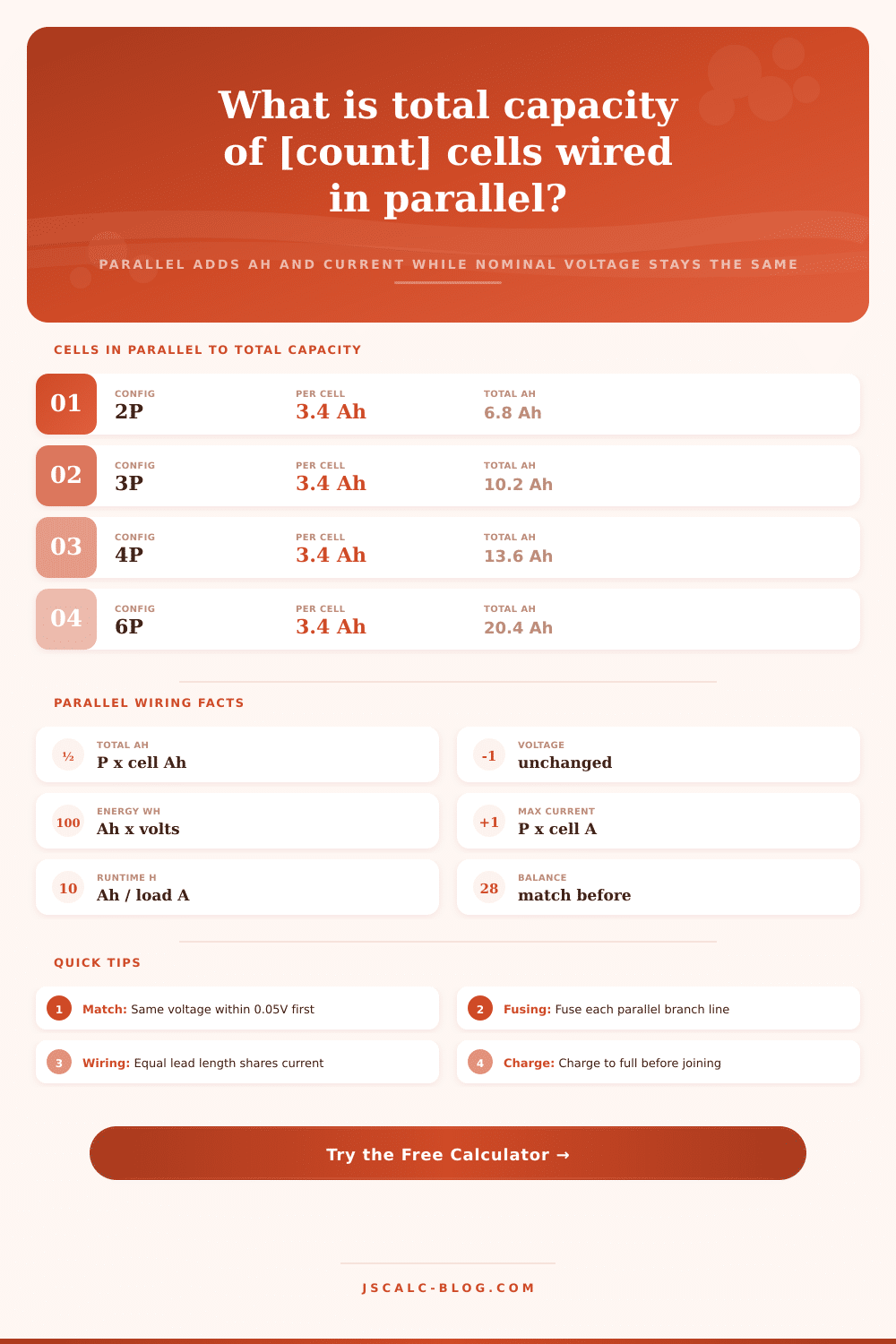
Imagine a pair of identical water tanks sitting next to each other, both plumbed with the same outlet above. Adding the second tank doesn’t increase the voltage (water level). It only increases the overall volume you have available for use (capacity). Same thing happens with batteries. A pair of 3.4-amp-hour cells connected in parallel will remain at their nominal 3.7-volt, but collectively they’ll provide 6.8 amp-hours. Add another pair of those cells in series and you get 13.6 amp-hours, also nominally 3.7 volts. Voltage holds; capacity stacks. That’s the one concept behind everything here.
Total capacity is the number of cells in parallel times per-cell capacity. Nominal volts x total amp-hrs = energy in watt-hours Amp hours are converted to watt-hours by multiplying them by volts. If we do this with our 3.7 volt pack containing 13.6 amp-hours, we get about 50.3 watt-hours of storage (13.6 * 3.7).
Why would we care about watt-hours? Because they enable us to calculate how long a given battery will last different than another (even if the batteries has different voltages), and also match a battery to your device (if your device is rated in watts). For instance, if you’re planning on running a 100 watt load from a bank, a 200 amp-hour bank @ 12.8 volts contains approximately 2,560 watt-hours. This means you could keep a 100 watt load going roughly a full day without eating into your margin with losses.
Beyond the added capacity, parallel wiring increase the maximum current that the pack can safely output. Each branch can carries its portion of the load. For example, if you have a cell rated at 10 amps continuous, four of those cells wired in parallel would be able to output roughly 40 amps total. There’s a table of all the possible combinations and current limits for each on the page.
But parallel wiring only shares current evenly between branches if those branches are electrically equal. Mismatched internal resistance or uneven lead lengths will drive current along path of least resistance, causing one cell to get hotter than another. Many folks do not realize that they’ve gotten it backwards; they think that wiring two batteries parallel automatically loads both equally but physics requires equal paths.
Usable runtime isn’t capacity. Usable amp-hours divided by load current is your runtime in hours. So a 13.6 amp-hour group with a constant 5 amp load is going to last roughly 2.72 hours. You typically don’t pull batteries down to zero. That’s why there’s a depth of discharge selector on the tool. Lithium packs can go to 90 percent, while lead-acid banks are better handled at 50 to 80 percent. This fraction trims usable amp-hours before the runtime math begins. This way it estimates what happens when used like you do versus an ideal situation with a full drain.
To do the wiring in parallel, equalizing all battery State of Charge (SOC) prior to contact is most important. If you bolt a 4.10 volt fully charged cell next to a 3.60 volt depleted cell, the former will dump a huge uncontrolled current onto the latter for initial few seconds while they reach parity. This inrush can cause cells to overheat and stress interconnects. By charging each unit to within about 0.05 volts of other units, you keep this surge nearly zero.
Be careful with protection and wiring because of potential for a large total current. Use equally long leads to all branches so that a 40 amp draw really divides up into four equal parts, not just a few on one side and a bunch on another. Each parallel branch should of be fused slightly above its per-cell rating so that a bad cell doesn’t pull too much current out of its friends. The main bus bars should be sized for the total possible output from the pack.
When wired properly, parallel allows for adding power but at no change in voltage, resulting in consistant runtime.