Battery Pack Configuration Calculator
Design a complete series-parallel (SxP) lithium pack in one place. Enter your series count, parallel count, and single-cell specs to get pack voltage, capacity in Ah, energy in Wh, total cell count, pack weight, and the maximum continuous current and power your build can safely deliver.
🔋Real Pack Build Presets
🔧Pack Build Sheet Inputs
Cells wired in series. Sets total pack voltage.
Cells wired in parallel. Sets capacity and current.
Li-ion is 3.6-3.7 V, LiFePO4 is 3.2 V.
Rated capacity of one cell, in amp-hours.
Mass of a single cell in grams (21700 approx 68 g).
Continuous discharge rating of one cell, in amps.
Extra mass beyond bare cells for total pack weight.
Controls rounding on every result card.
🔢Formula Snapshot
📋Common Cell Types and Nominal Voltage
| Cell Chemistry | Nominal V | Full Charge V | Empty V | Typical Use |
|---|---|---|---|---|
| Li-ion NMC | 3.6 - 3.7 V | 4.2 V | 2.5 V | Ebikes, laptops |
| LiFePO4 (LFP) | 3.2 V | 3.65 V | 2.5 V | Solar, storage |
| LiPo pouch | 3.7 V | 4.2 V | 3.0 V | Drones, RC |
| LTO titanate | 2.4 V | 2.8 V | 1.5 V | Fast charge |
| NiMH | 1.2 V | 1.45 V | 1.0 V | AA packs, tools |
| Lead acid cell | 2.0 V | 2.4 V | 1.75 V | Cars, UPS |
🔋Popular Cylindrical Cell Specs
| Cell Size | Capacity | Weight | Max Cont. A | Example Model |
|---|---|---|---|---|
| 18650 | 3.5 Ah | 48 g | 10 A | Samsung 35E |
| 18650 HD | 2.5 Ah | 45 g | 20 A | Sony VTC5A |
| 21700 | 5.0 Ah | 68 g | 15 A | Samsung 50E |
| 21700 HD | 4.0 Ah | 70 g | 35 A | Molicel P42A |
| 26650 LFP | 3.4 Ah | 90 g | 10 A | A123 26650 |
| 32700 LFP | 6.0 Ah | 145 g | 12 A | EVE 32700 |
🗃SxP Pack Configuration Comparison Grid
| Config | Pack Voltage | Capacity Ah | Energy Wh | Total Cells | Typical Use |
|---|---|---|---|---|---|
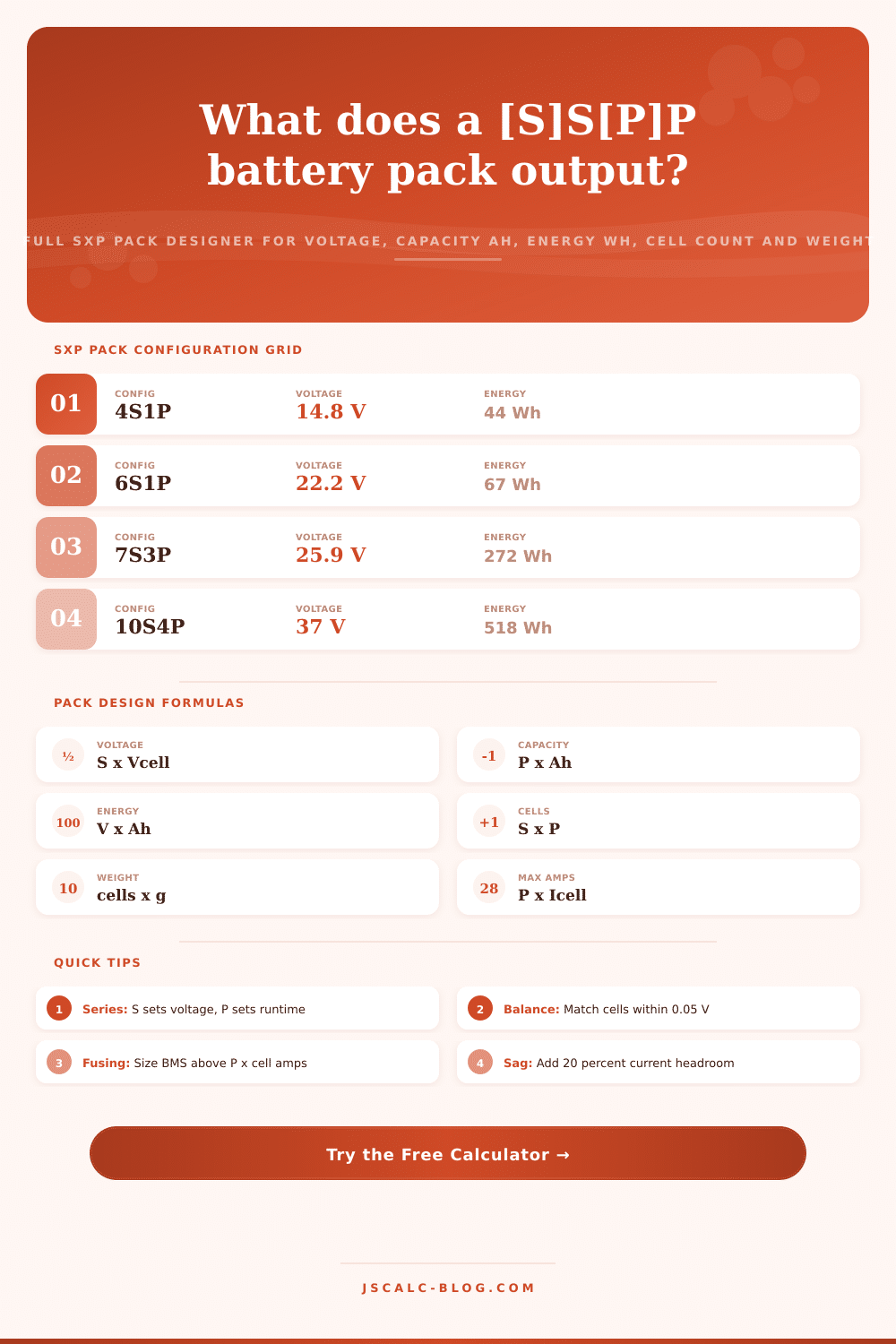
| 4S1P | 14.8 V | 3.5 Ah | 51.8 Wh | 4 | RC car pack |
| 6S1P | 22.2 V | 3.5 Ah | 77.7 Wh | 6 | FPV drone |
| 7S3P | 25.9 V | 10.5 Ah | 272 Wh | 21 | Light ebike |
| 10S4P | 37.0 V | 14.0 Ah | 518 Wh | 40 | 36V ebike |
| 13S4P | 48.1 V | 14.0 Ah | 673 Wh | 52 | 48V ebike |
| 14S5P | 51.8 V | 17.5 Ah | 907 Wh | 70 | 52V EMTB |
| 16S2P | 59.2 V | 7.0 Ah | 414 Wh | 32 | 48V LFP UPS |
| 20S6P | 74.0 V | 21.0 Ah | 1554 Wh | 120 | 72V scooter |
| 24S8P | 88.8 V | 28.0 Ah | 2488 Wh | 192 | Light EV |
⚡Formula Breakdown
💡Pack Design Tips
When most people begin designing their battery pack, they knows what voltage they want, maybe twenty-four volts for a solar shed, or forty-eight volts for an ebike. But do they ever consider where those numbers comes from? Plug your cell specifications into calculator and it will do the math for you. You should of not need to guess at conversion factors and coefficients.
Two number comprise every custom pack: the series count and the parallel count written as SxP. These two numbers defines the whole character of the pack. Read any label, and understanding this split is key.
Understanding Battery Pack Basics
S is for cells wired in series. Series stack the voltage without changing capacity. For example, if you select standard lithium-ion cell with a nominal voltage of 3.7 volts and wire thirteen of them in series, you get about forty-eight volts. Why do you find so many ebike packs listed as being 48V? Because they chose to use thirteen cells in series. If you switch to Lithium Iron Phosphate (LiFePO4) cells with a nominal rating of 3.2 volts, wiring the same number of cell in series will produce a much lower voltage. To reach a similar range, storage applications will uses more cells in series, such as sixteen.
And the S is simply where you select how much voltage the inverter or motor wants to see. In other words, it determines how much potential energy can absorbs to do work.
Cells in Parallel: Cells are wired in parallel in each group. It increase current and capacity without changing the voltage. So, using the same 3.5 Ah cell example, a four-parallel group holds fourteen amp-hours of charge. And that’s true no matter how many series groups you stack them on top off.
Amp hours equal how long a pack will last. Watt hours equals the amount of energy a pack has available to do any given amount of work. That one number give you the combination of both. It is voltage times the capacity. It is one number to let you know whether you have enough juice to run your workshop for the evening, or if you’ll be out of juice before you get home.
Adding parallel cells isn’t just about runtime. Newbies don’t realize that current is also an issue. A cell’s rating is the maximum continuous current it can provide. A pack’s max is number of parallel times that rating. Four cells at ten amps provide a total of forty amps. If you use a controller that needs forty amps but build with two in parallel, each cell must produce twenty amps. That could be above their safe rating and destroy the chemistry. With the current limit shown by calculator you can align your design to the load. This avoids thermal runawayin advance.
Everything else depends on cell selection. Cylindrical format with higher capacity store more energy per unit of weight for a given battery size. But it might not give as much peak current than a higher drain format. A real spec input for your selected cells makes the output build plan credible. That’s preferable to an average based off generic assumptions when you go shopping. The table on the page provide some examples of commonly available chemistries and nominal voltage, along with common formats such as 21700 and 18650. From that background you can determine if you care more about power vs range for your particular use case.
When assembling packs, two simple rules is good for keeping packs healthy.
1) Draw less than ~80% of what you’re paralleling (meaning don’t exceed rated capacity). So you give some room for headroom. Cells run cooler this way. Match cells within about 0.05 volts before connecting them in parallel. Big delta-V causes large balancing currents when connecting that can damage cell or even melt wires. This small detail is critical for safety. Use a set starting config and tune based off your hardware. Then you’ll know exactly where you need to be without second guessing the basics.