AWG Voltage Drop Calculator
Choose a wire gauge from 14 through 4/0, set the current, one-way run, source voltage, copper or aluminum, and phase. Get voltage drop, percent drop, voltage at the load, and the smallest gauge that meets your target percent.
🎯Real Wiring Presets
📝Circuit Inputs
Distance one direction; the tool doubles it for the return wire.
NEC recommends 3% on a branch and 5% total to the load.
🔢Formula Snapshot
📊Gauge Selector: Drop At Your Load
| Gauge | Ω / 1000 ft | Voltage Drop | Percent Drop | Voltage At Load | Verdict |
|---|---|---|---|---|---|
| Enter values above to compare every gauge at your current and run length. | |||||
🗂AWG Resistance & Ampacity Chart
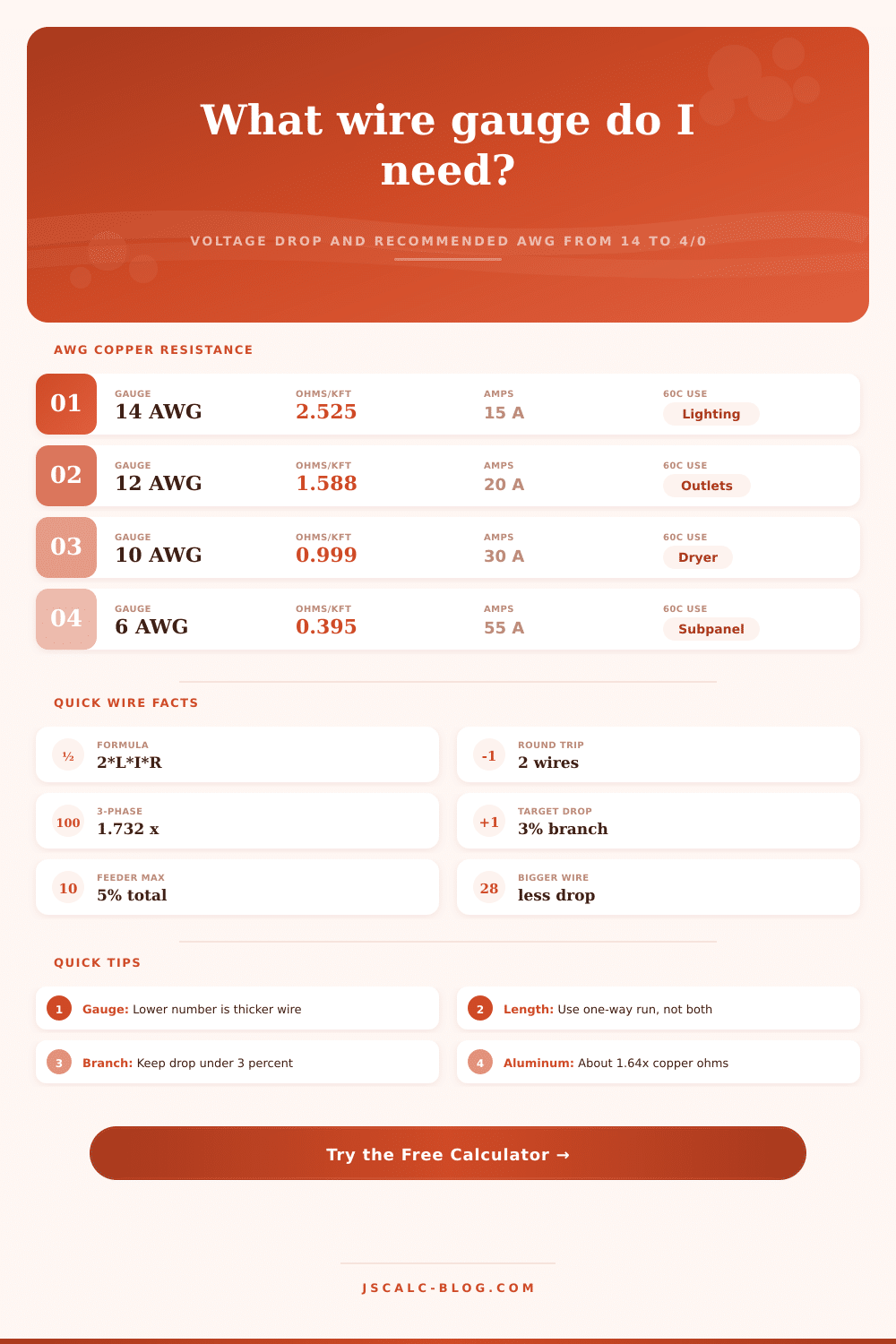
| Gauge | Copper Ω/kft | Aluminum Ω/kft | 60°C Ampacity | 75°C Ampacity | Typical Use |
|---|---|---|---|---|---|
| 14 AWG | 2.525 | 4.141 | 15 A | 20 A | Lighting, small branch |
| 12 AWG | 1.588 | 2.604 | 20 A | 25 A | General outlets |
| 10 AWG | 0.999 | 1.638 | 30 A | 35 A | Dryer, water heater |
| 8 AWG | 0.628 | 1.030 | 40 A | 50 A | Range, EV charger |
| 6 AWG | 0.395 | 0.648 | 55 A | 65 A | Subpanel feeder |
| 4 AWG | 0.249 | 0.408 | 70 A | 85 A | Large feeder, motor |
| 3 AWG | 0.197 | 0.323 | 85 A | 100 A | Feeder |
| 2 AWG | 0.156 | 0.256 | 95 A | 115 A | 100 A subpanel |
| 1 AWG | 0.124 | 0.203 | 110 A | 130 A | Feeder |
| 1/0 AWG | 0.0983 | 0.161 | 125 A | 150 A | Service, large feeder |
| 2/0 AWG | 0.0779 | 0.128 | 145 A | 175 A | Service entrance |
| 3/0 AWG | 0.0618 | 0.101 | 165 A | 200 A | 200 A service |
| 4/0 AWG | 0.0490 | 0.0804 | 195 A | 230 A | Large service entrance |
📏Max One-Way Length For 3% Drop
| Gauge | 120 V @ 15 A | 120 V @ 20 A | 240 V @ 30 A | 240 V @ 50 A |
|---|---|---|---|---|
| 14 AWG | 47 ft | 36 ft | 95 ft | 57 ft |
| 12 AWG | 76 ft | 57 ft | 151 ft | 91 ft |
| 10 AWG | 120 ft | 90 ft | 240 ft | 144 ft |
| 8 AWG | 191 ft | 143 ft | 382 ft | 229 ft |
| 6 AWG | 304 ft | 228 ft | 608 ft | 365 ft |
| 4 AWG | 482 ft | 361 ft | 964 ft | 578 ft |
| 2 AWG | 769 ft | 577 ft | 1538 ft | 923 ft |
| 1/0 AWG | 1221 ft | 915 ft | 2442 ft | 1465 ft |
⚙Full Formula Breakdown
📋NEC Drop Guidelines
| Segment | Recommended Max | Why It Matters | Fix If Over |
|---|---|---|---|
| Branch circuit | 3% drop | Keeps lights and devices at full brightness | Go up one gauge |
| Feeder to subpanel | 3% drop | Leaves headroom for branch drop downstream | Upsize feeder |
| Feeder plus branch | 5% total | NEC informational limit for combined run | Shorten or upsize |
| Motor and sensitive loads | 2% to 3% | Low voltage causes overheating and stalls | Bigger conductor |
| Long low-voltage DC run | 2% or less | Every volt counts at 12 V or 24 V | Much larger wire |
💡Practical Wiring Tips
When you flip the light switch to turn on the garage work lights, they flicker. You’ve got the proper wire gauge for the required amperage and breaker, but there’s something off. Instead of running smoothly, the outlet hum with weak power while your power tools stutter. Welcome to voltage drop in action.
Electricity find resistance and turns perfectly legal wiring into frustrating performance problems. Current moving over distance cost energy that dissapears as heat. To calculate this, simply input your current draw and your distance, and let the calculator do the rest (above). No need to guess about using a stock gauge wire or not.
How to Fix Voltage Drop Problems
Most of us worry only about the ampacity of our wires, meaning how much current we can push through them without them melting. That’s important for safety reasons. But it fail to consider efficiency. Sure, I could push 20 amps through 10 feet of a 12-gauge wire, that would be safe. But pushing 20 amps down that same 12-gauge wire a hundred feet to your shed? Not so much. It just won’t push out all that voltage.
Resistance mount up, stealing off the volts on the way before they even arrive at your appliance. You don’t have to know any formulas; you simply put in the information. One of those pieces of data is the run length. If you’re thinking of using a one-way run, keep in mind that it doesn’t exist. Electricity has to travel back. So if you plug 100 feet into the box, it will double that figure to include the return run. Many amateurs forget about this portion and figure drop based only on half the circuit.
Finally, be sure to note the type of wire, copper versus aluminum. While aluminum is lighter and less expensive, it doesn’t conduct electricity as well as copper. As a result, generally speaking, when changing materials, you’ll have to bump up two sizes to achieve comparable performance. That additional size offsets the increased natural resistance of the material.
Numbers are one thing, but the output is where things get more clear. Anywhere your percent drop exceeds three percent on a branch circuit mean dimmed lights when they’re being used and possibly running hot motors. It’s about finding the sweet spot between performance and cost. For example, you don’t want huge cables for short runs, yet if you push it on long runs, then you invite trouble. You have to be more strict with a subpanel serving an entire house because all those downstream outlet inherit that same voltage loss.
The gauge of the wire isn’t as simple of a chart-following matter; rather, it’s an expectation-setting task. Larger gauges will be heavier, more expensive, and won’t go around corners nearly as easy within tight conduit. Bumping up from ten gauge to eight, for instance, may clear up your drop problem, but you’ll need thicker conduit, bigger boxes, and have a little more patience when installing.
A lot of times, the best thing to do is rethink the layout. Getting a subpanel nearer to the service entrance means shorter overall length, which can then be handled by thinner wires with greater efficiency. Oftentimes, moving the destination is far easier than forcing power down small pipes.
But there is more. There is the real world. Resistance varies based off temperature. A wire isn’t going to work as well if it’s buried in warm dirt or in a hot attic. Standard calculators assume baseline numbers. Experienced electricians incorporate a cushion. One gauge up just in case is not uncommon. They do this not because they think it’s right, but because it’s good practice. And it gives them a little breathing room. It gives them a little peace of mind regarding the loads that may be placed on the system later on, like maybe by the next owner.
This page breaks all of it down nicely with a reference table. It’s laid out well so you can see exactly how dramatic the change becomes in resistance when the gauge numbers decreases. You’ll notice how much the numbers differ and how a small change in diameter affects conductivity. Going from fourteen to twelve gauge reduces resistance greatly and that’s part of the reason code requires heavier wire for regular outlets. It does not need to carry more, but it wants that current to reach the device without being reduced while traveling through skinny copper.
Good wiring, ultimately, dissapears. You don’t see the electrons running from panel to plug when it’s wired correctly, only when it doesn’t arrive forcefully enough. Whether it’s lighting your back yard patio or running a line down to your well pump, testing for voltage drop saves you headaches down the road. It delivers the power you paid for without any waste or worry, ensuring that your investment shines as brightly as you hoped. Motors run cool, lights shine bright and everything hums along quietly in the background.