Antenna Gain Calculator
Find directive gain in dBi from a parabolic dish aperture or from the E-plane and H-plane beamwidths, convert freely between dBi, dBd, and the linear gain factor, and read the effective aperture in square meters. Enter the diameter, frequency, and efficiency and every result card updates with real antenna math.
📡Choose a Mode
🎯Real Antenna Presets
🔢Antenna Inputs
Pick diameter for round dishes, or area for horns and panels.
Reflector diameter; A = pi (D / 2)².
Physical mouth area for non-round apertures.
Operating frequency; wavelength = c / f.
Applies to the frequency value above.
Typical dishes run 55 to 70 percent efficient.
Half-power beamwidth in the elevation plane.
Half-power beamwidth in the azimuth plane.
Enter a known gain, then pick its unit.
The tool converts to the other two units.
Controls rounding on every result card.
📏Formula Snapshot
📡Dish Gain Reference (60% Efficiency)
| Diameter | Frequency | Wavelength | Gain (dBi) | Beam HPBW |
|---|---|---|---|---|
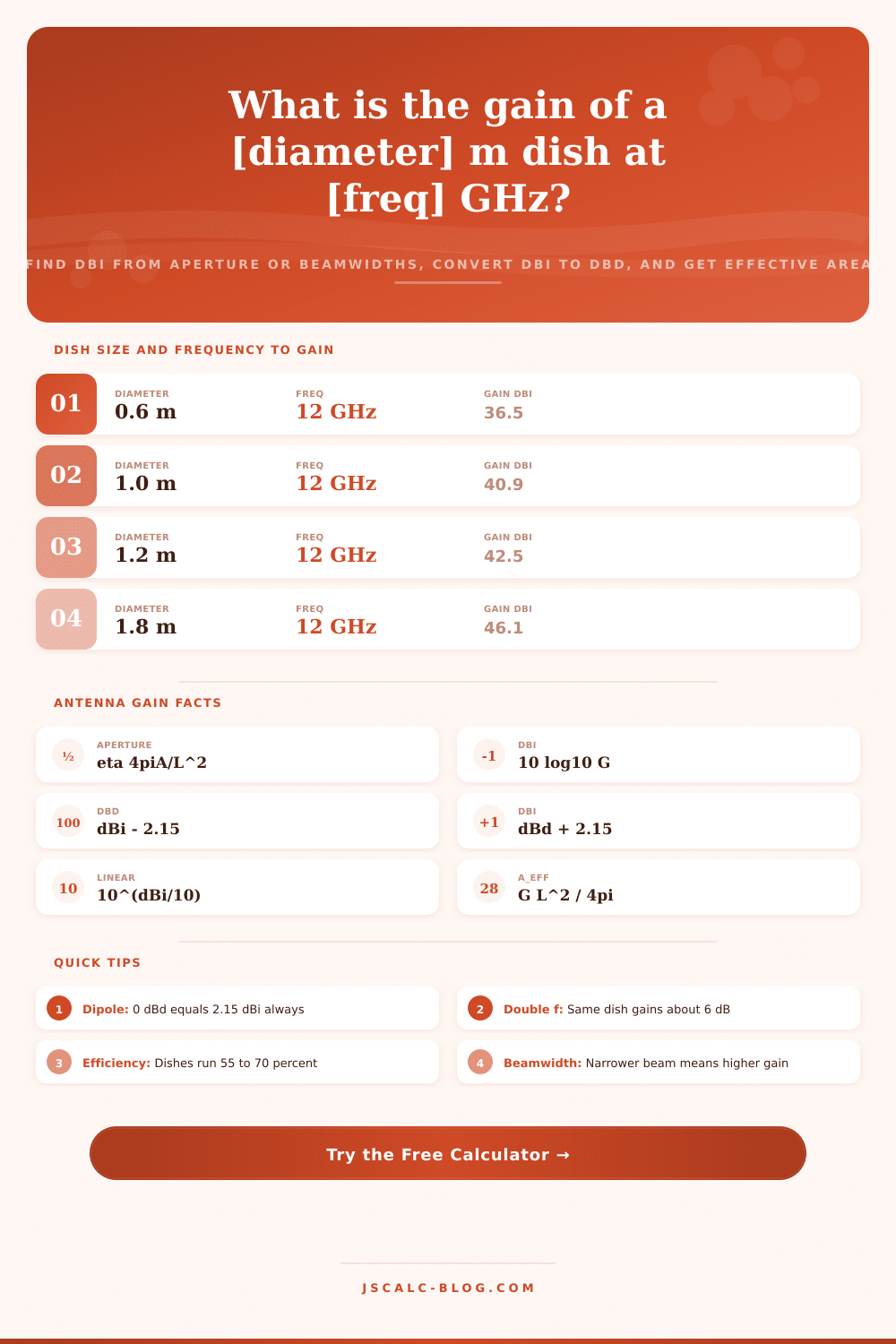
| 0.6 m | 12 GHz | 25.0 mm | 36.5 dBi | 2.9 deg |
| 1.0 m | 12 GHz | 25.0 mm | 40.9 dBi | 1.8 deg |
| 1.2 m | 12 GHz | 25.0 mm | 42.5 dBi | 1.5 deg |
| 1.8 m | 12 GHz | 25.0 mm | 46.1 dBi | 1.0 deg |
| 2.4 m | 6 GHz | 50.0 mm | 41.6 dBi | 1.5 deg |
| 3.0 m | 6 GHz | 50.0 mm | 43.6 dBi | 1.2 deg |
| 0.45 m | 24 GHz | 12.5 mm | 39.1 dBi | 1.9 deg |
| 1.0 m | 2.4 GHz | 125 mm | 26.8 dBi | 8.8 deg |
🔄dBi to dBd and Linear Conversion
| dBi | dBd | Linear Factor | Type of Antenna |
|---|---|---|---|
| 0 dBi | -2.15 dBd | 1.00 x | Isotropic reference |
| 2.15 dBi | 0 dBd | 1.64 x | Half-wave dipole |
| 8.15 dBi | 6.00 dBd | 6.53 x | Small Yagi |
| 14.0 dBi | 11.85 dBd | 25.1 x | Panel or grid |
| 20.0 dBi | 17.85 dBd | 100 x | Small dish |
| 30.0 dBi | 27.85 dBd | 1000 x | Mid dish |
| 40.0 dBi | 37.85 dBd | 10000 x | Large dish |
📧Beamwidth to Gain Estimate
| E-plane | H-plane | Product | Gain at 60% | Application |
|---|---|---|---|---|
| 65 deg | 7 deg | 455 | 17.6 dBi | Cellular sector |
| 30 deg | 30 deg | 900 | 14.6 dBi | Wide panel |
| 10 deg | 10 deg | 100 | 24.1 dBi | Narrow panel |
| 6 deg | 6 deg | 36 | 28.6 dBi | Small dish |
| 3.2 deg | 3.2 deg | 10.24 | 34.1 dBi | 1.2 m dish |
| 2 deg | 2 deg | 4.0 | 38.1 dBi | Large dish |
| 1 deg | 1 deg | 1.0 | 44.1 dBi | Very large dish |
📊Antenna Gain Comparison Grid
| Antenna | Band | Freq | Size | Gain dBi | Gain dBd | HPBW |
|---|---|---|---|---|---|---|
| Rubber duck | UHF | 0.45 GHz | Whip | 2.2 dBi | 0.05 dBd | Omni |
| Half-wave dipole | VHF | 0.15 GHz | 1 m rod | 2.15 dBi | 0 dBd | 78 deg |
| 6-element Yagi | VHF | 0.15 GHz | 2.5 m boom | 10.2 dBi | 8.05 dBd | 50 deg |
| Panel sector | Cellular | 1.8 GHz | 1.3 m panel | 17.6 dBi | 15.45 dBd | 65 x 7 |
| Grid dish | ISM | 2.4 GHz | 1 m grid | 24.0 dBi | 21.85 dBd | 8 deg |
| DBS home dish | Ku | 12 GHz | 0.6 m | 36.5 dBi | 34.35 dBd | 2.9 deg |
| VSAT dish | C | 6 GHz | 2.4 m | 41.6 dBi | 39.45 dBd | 1.5 deg |
| Earth station | Ku | 14 GHz | 4.5 m | 54.5 dBi | 52.35 dBd | 0.3 deg |
| Radio telescope | X | 8.4 GHz | 34 m | 68.2 dBi | 66.05 dBd | 0.06 deg |
| Ka spot beam | Ka | 20 GHz | 0.45 m | 37.6 dBi | 35.45 dBd | 2.3 deg |
⚙Formula Breakdown
💡Practical Gain Tips
The key take-away here: antenna gain isn’t magic. Passive antennas does not magically add any more power to your signal; they can’t make energy from nothing. A passive antenna simply grabs the power you give it and squishes it into a narrower beam (gain). That’s what we mean when we say ‘antenna gain’.
Quantify that squish by using the calculator above. You can calculate gain based off a physical dish dimension or reverse-engineer a data-sheet that only shows beamwidths. The calculator connects radio frequency performance with raw geometry without needing degree in electromagnetics.
What Is Antenna Gain?
This brings us to the central unit: dBi, short for decibels relative to an isotropic radiator. In other words, it’s the radiation from an imaginary perfectly spherical light source that sends equal amounts of light in all direction. Since real-life antennas is directional and focus their energy somewhere, none of them are actualy isotropic.
Another frequently used unit is dBd, or decibels relative to a half-wave dipole. A half-wave dipole has some inherent gain relative to an isotropic radiator, namely 2.15 dBi. That means, if you’re reading a spec sheet and you notice a number listed as 14 dBd, add 2.15 to convert it back to dBi, yielding 16.15 dBi. Mixing up these two units is one of the classic rookie mistakes that will throw off your link budget by several decibels. This tool makes the unit conversion instant, so you don’t need to keep a cheat sheet on your monitor.
The math for dish antennas boils down to electrical size. That is, it’s not just about the apparent physical size of the reflector, it’s about its size relative to wavelength of the signal. At higher frequencies the signals are shorter, so a small dish may out-perform a huge one at lower ones. Aperture mode relies on the standard formula, taking into account both area and efficiency. You enter the area (or diameter), the frequency, and the percent efficiency. Because real dishes has some surface imperfection and blockage by the feed arm, they’re never 100 percent efficient. Set efficiency to roughly 60 percent and you’ll have a good idea what to expect in real life without expecting highest possible number.
Another view of gain comes from beamwidth. You may be able to get a ballpark on gain based upon beamwidth (how narrow is that signal?). The tighter the beam, the greater the gain. That’s what the calculator does. You input either H- or E-plane beamwidth and it calculates gain. That way if you’ve got some numbers in hand but no dimensions, it converts your real-world observation to an RF metric. There is an inverse relationship where a tighter beam mean more gain.
The fourth key output is effective aperture. That’s the effective area of the wavefront captured by the antenna. No antenna is perfect so this will normally be smaller than the physical size of dish. For recieve sensitivity it is the key figure. How much signal power do you need to pull from a weak source? This is critical if you are trying to communicate with deep space or doing an uplink on a satellite.
Intuition tends to break down when it comes to frequency scaling. If you double the frequency, you get four times as much gain from the same physical dish. That’s about a 6 dB increase. This also helps explain why small pieces of millimeter-wave hardware can has such huge amounts of gain. You can see that in the presets of the tool, here are bigger earth station reflectors compared to a typical home satellite dish. They’re all sitting on the same mathematical curve; they’re just at different points on the size-and-frequency axes.
This is how you graduate from a guess-and-check approach to understanding these relationships. You no longer wonder if you should of increase your frequency or buy a larger dish. Instead, you understand the tradeoffs, you can then focus on making the engineering decision that really matters. The tool takes out the algebra for you.