Parity Bit Calculator
Generate the even or odd parity bit for any binary word or ASCII character, build the complete transmitted frame with the parity bit appended, count the ones before and after, and verify a received frame to see whether a single-bit error slipped in.
🎯Common Parity Presets
📝Parity Bit Inputs
Enter raw bits, or a single character to encode.
Only 0 and 1; other characters are ignored.
One character, converted to its numeric code.
7 bits covers codes 0-127; 8 bits pads to a byte.
Sets the rule for the final count of 1-bits.
Where the parity bit is attached in the frame.
Generate builds a frame; Check verifies one.
Full frame as received, including its parity bit.
Toggles the detailed derivation panel.
🔢Parity Rule Snapshot
📋Even and Odd Parity Examples
| Data Bits | Ones Count | Even Parity Bit | Odd Parity Bit |
|---|---|---|---|
| 0000000 | 0 | 0 | 1 |
| 0000001 | 1 | 1 | 0 |
| 0000011 | 2 | 0 | 1 |
| 1010101 | 4 | 0 | 1 |
| 1110000 | 3 | 1 | 0 |
| 1000001 | 2 | 0 | 1 |
| 1111111 | 7 | 1 | 0 |
| 11111111 | 8 | 0 | 1 |
📊ASCII Characters With Parity
| Character | 7-bit Code | Ones | Even Frame (LSB) | Odd Frame (LSB) |
|---|---|---|---|---|
| 'A' | 1000001 | 2 | 10000010 | 10000011 |
| 'B' | 1000010 | 2 | 10000100 | 10000101 |
| 'C' | 1000011 | 3 | 10000111 | 10000110 |
| 'Z' | 1011010 | 4 | 10110100 | 10110101 |
| 'a' | 1100001 | 3 | 11000011 | 11000010 |
| '0' | 0110000 | 2 | 01100000 | 01100001 |
| '9' | 0111001 | 4 | 01110010 | 01110011 |
| space | 0100000 | 1 | 01000001 | 01000000 |
🗃Parity Generation Comparison Grid
| Data Bits | Ones | Even Parity | Odd Parity | Frame (Even, LSB) | Note |
|---|---|---|---|---|---|
| 0000000 | 0 | 0 | 1 | 00000000 | Already even |
| 0000001 | 1 | 1 | 0 | 00000011 | One flips it |
| 1010101 | 4 | 0 | 1 | 10101010 | Even stays 0 |
| 0101010 | 3 | 1 | 0 | 01010101 | Odd needs 1 |
| 1000001 | 2 | 0 | 1 | 10000010 | ASCII 'A' |
| 1111111 | 7 | 1 | 0 | 11111111 | Seven ones |
| 1100000 | 2 | 0 | 1 | 11000000 | Pair of ones |
| 1110000 | 3 | 1 | 0 | 11100001 | Trio of ones |
| 10101010 | 4 | 0 | 1 | 101010100 | Full byte |
| 11111110 | 7 | 1 | 0 | 111111101 | Byte, 7 ones |
🛡What Parity Can and Cannot Catch
| Bit Errors in Frame | Parity Changes? | Detected? | Outcome |
|---|---|---|---|
| 0 (clean) | No | Not needed | Frame accepted |
| 1 error | Yes | Yes | Error flagged |
| 2 errors | No | No | Slips through |
| 3 errors | Yes | Yes | Error flagged |
| 4 errors | No | No | Slips through |
| 5 errors | Yes | Yes | Error flagged |
| Any odd count | Yes | Yes | Detected |
| Any even count | No | No | Undetected |
⚙Formula Breakdown
💡Practical Parity Tips
This page takes an ancient digital trick and makes it visible: a parity bit calculator. A parity bit are an extra bit added to your data to set a rule for how many total bits must be ones. Odd parity or even parity determines whether the count must be odd or even. One little bit allows the recipient to detect if their message was garbled.
Feed in anything from ASCII characters to words written in 1s and 0s and the tool produce the proper parity bit for you. It also strings together complete frame, counts the ones, and then checks incoming frames to identify mistakes. Without requiring any arithmetic by hand, the tool connect the dots based off theory and real numbers.
What Is a Parity Bit?
The idea here is called parity. Parity mean checking if the number of one-bits is even or odd. Do you need to add a bit to force it to match some other thing? Even parity means the transmitter choose the bit to make the overall count of ones even. Odd parity require making the overall count of ones odd. The trick is this doesn’t alter the actual data, easy to understand.
When the receiver sees the bits, they know the scheme. They simply count the ones to see if the rule was broken. If so, the frame was somehow damaged. It is done in microseconds.
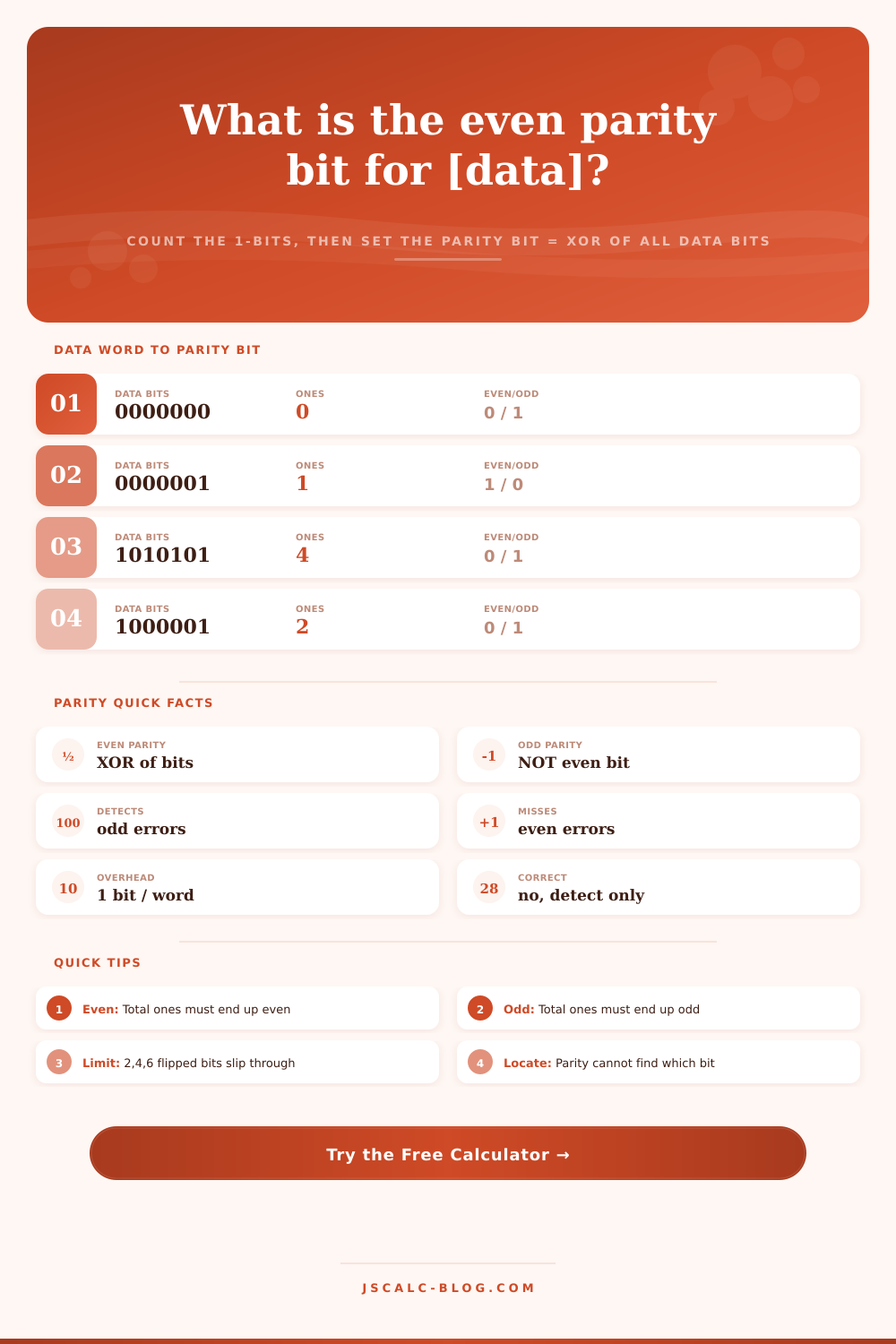
The core logic starts by counting how many bits equal one. For example, what’s the answer for 1010101? Answer: There are four ones in that word. Four is an even number of ones. Thus the even parity bit is zero (because the word meets rules). What about 1110000? That word has three ones. To make a total of four ones, its even parity bit needs to be one.
In math terms, the even parity bit is just the XOR of all the data bits. When there are an odd number of ones, the XOR is one; when there are an even number of ones, the XOR is zero. To see this derivation, consult the calculator, to see how the result comes out.
The opposite of even parity is known as odd parity. Odd parity is just the opposite of even parity. In other words, if even parity requires an even total then odd parity needs to have an odd total. With the 1010101 word above, odd parity gives us a one. This is because five ones is an odd number.
The choice between odd and even is largely conventional but there is a practical difference with odd parity. Because zero is an even number, an all-zero frame can never be valid with odd parity. This means that a dead electric line cannot be mistakenly interpreted as a genuine quiet message. That’s important in noisy industrial conditions.
Once the bit is calculated, it attaches to the data to form the frame that moves down the wire. You can prepend the bit at the beginning of the string or add it on at the end. Math-wise there’s no difference where it sits, only that it needs to stay in the same place so receiving device will know what bit to remove for verification. Sending a 7-bit ASCII character plus adding a parity bit yields an 8-bit byte prepared for transmission.
Enter a genuine letter (A), watch it convert to a packet with framing. This is where the practical application starts, checking a received frame. Paste in your frame you’ve received into the checker mode and then enter in your expected parity scheme. It will recount the ones and tell you if it’s a pass/fail. Did you expect even parity? Count was odd. You have an error.
This is just like what hardware receivers do for you automatically. This is a quick sanity check to avoid manual counting mistakes. Its weakness is that parity will not detect an even number of errors. A single bit error are detected and caught. So is a three-bit error, or a five-bit error. But if there’s a two-bit error (one flipping from zero to one), and one flipping from one to zero… Then overall parity doesn’t change. The frame checks out as good, yet it’s corrupted. It also won’t see four bits all going wrong at once.
All this said, parity persists as a very low-cost method of ensuring data integrity. Adding one bit for each word costs hardly anything, and verifying it only take incrementing over ones (which can be done with a few logic gates in hardware). If you want to go further and actualy repair any errors, not merely detect them, then we leap to Hamming codes which use additional bits to locate where things went wrong.
If your message is long enough to suffer burst error, you can still spread out some form of error correction like a checksum or CRC across several bytes. The idea of parity stays at the heart of how to think about data integrity. Fiddling around with those knobs will help illuminate why robust communication networks don’t just use one cheap hack, but several layered together. It is a little something, but it is enough to support the whole structure of reliabel digital conversation.